A Life oscillator is a nonconstant periodic orbit of the Conway's Game of Life update function . Its period is the least positive integer for which , comparing the entire live-cell set at the same coordinates. A configuration that never changes is instead a fixed point; a Life glider is not a Life oscillator on the infinite board because it returns at displaced coordinates. The Life blinker has period two.[ref]
https://github.com/nathanieljohnston/game-of-life-book/blob/master/oscillators.tex. Johnston and Greene, chapter 3: oscillators and their periods
The Life blinker alternates between horizontal and vertical lines of three live cells. Start with and every other cell dead. The two endpoints each have one live neighbor and die; the center has two and survives. The dead cells and each have three live neighbors and are born. No other dead cell has three. ThereforeThe same neighbor-count argument with horizontal and vertical exchanged gives the second step. Since , the period is exactly two, rather than merely a divisor of two.
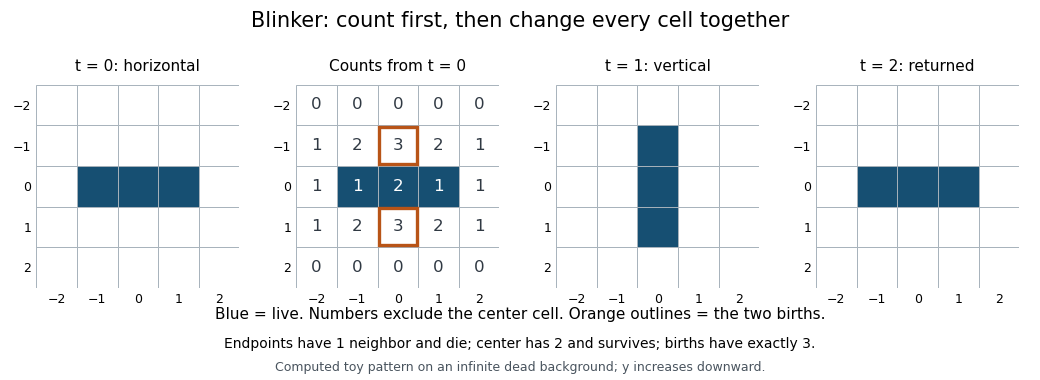

The Life blinker is a minimal hands-on check of synchronous updating. Mark both endpoints for death and both births before changing anything. Removing an endpoint early would make a prospective birth see only two neighbors; adding a birth early would alter other counts. A correct implementation reproduces both sets above exactly, rather than merely keeping the live population equal to three.
Articles by others on the same topic
There are currently no matching articles.