
George C. Rhoderick Created 2026-10-14 Updated 2026-11-05
George C. Rhoderick coauthored research validating microwave spectroscopy for trace-gas analysis. The work tests quantitative response against prepared gas mixtures and calibration standards.
Such comparisons connect a measured spectral amplitude with a chemical amount. Sample delivery and expansion can influence that connection even when line assignment is secure.[ref]
The Validation of Fourier-Transform Microwave Spectroscopy for Trace-Gas Analysis. Printed pages 25–27, quantitative validation
Identity source: www.nist.gov/publications/search_by_author/1148686
Gerald T. Fraser Created 2026-10-14 Updated 2026-11-05
Gerald T. Fraser coauthored validation of Fourier-transform microwave spectroscopy for trace-gas measurements. The instrument combines controlled excitation and molecular expansion with a rotational spectroscopic readout.
Changing carrier conditions can change the sampled populations, so an instrument's sensitivity must be separated from the chemical composition presented to it.[ref]
The Validation of Fourier-Transform Microwave Spectroscopy for Trace-Gas Analysis. Printed pages 25–27, apparatus and nozzle comparisons
Identity source: www.nist.gov/people/gerald-t-fraser
NIST trace-gas FTMW validation experiment 2026-10-14
The NIST validation report used carbonyl sulfide in argon to illustrate the readout. A pulsed nozzle injected a molecular beam along a two-mirror cavity. Approximately excitation prepared quantum coherence; a receiver digitized the decaying electric field, then a Fourier transform produced spectral lines. Counterpropagating cavity waves produced a Doppler shift doublet; its midpoint represents one rest-frame transition.[ref]
The Validation of Fourier-Transform Microwave Spectroscopy for Trace-Gas Analysis. The Validation of Fourier-Transform Microwave Spectroscopy for Trace-Gas Analysis, printed pp. 25–26, Figures 2–3: coaxial apparatus, excitation and OCS readout; PDF pages 31–32
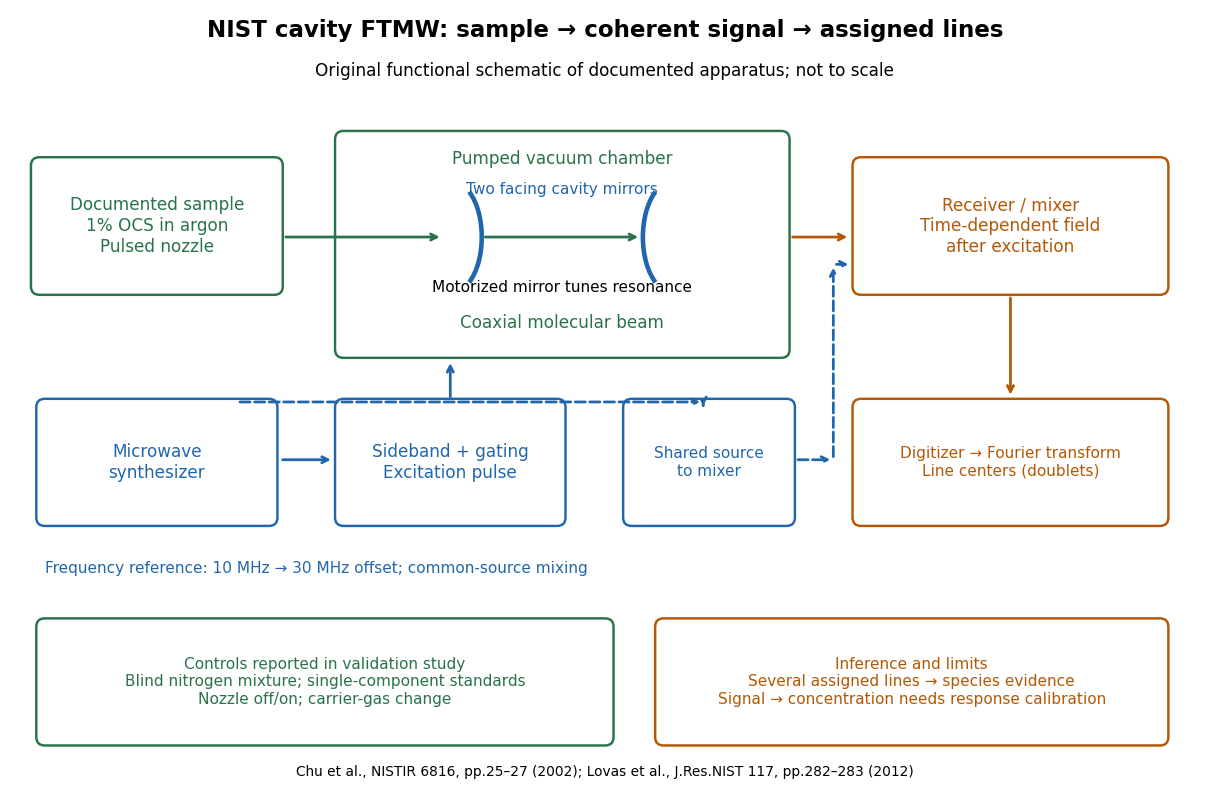
Original functional schematic of the NIST trace-gas FTMW validation experiment
. An original arrangement of the documented sample, cavity, excitation and readout functions; no published figure is copied. The frequency-reference branch summarizes the later portable electronics described in the NIST historical account. The sample fraction is a reported preparation, not a synthetic measured spectrum. Details.
The portable electronics used a common microwave source and a offset derived from a reference. Cavity tuning selects the accessible band; it does not independently calibrate the line's frequency. Absolute accuracy also requires a characterized reference and receiver offset.[ref]
Evolution of Microwave Spectroscopy at the National Bureau of Standards (NBS) and the National Institute of Standards and Technology (NIST) by F. J. Lovas and others. §5, printed pp. 282–283, Figure 20: source splitting, frequency reference, single-sideband modulation, mixer and digitizer
Reported controls included nozzle off/on, carrier-gas changes, and a blind nitrogen mixture. Assigned components were correctly identified. Single-component standards supplied preliminary concentration calibration; one standard per quantified component left response validation incomplete. Condensation and departure from thermal equilibrium in the nozzle were acknowledged limitations.[ref]
The Validation of Fourier-Transform Microwave Spectroscopy for Trace-Gas Analysis. printed pp. 26–27: nozzle/carrier comparison in Figure 6, blind mixture in Table II, one-standard calibration and nozzle-expansion limitations
The lesson is that rotational spectral line assignment and concentration inference answer different questions. Reproducible frequencies support molecular identity; converting signal size into concentration requires calibrated response under the same transfer and excitation conditions. The thermal absorption example above does not model a nozzle's nonequilibrium populations or the cavity's pulsed response.
Pamela M. Chu Created 2026-10-14 Updated 2026-11-05
Pamela M. Chu coauthored validation of Fourier-transform microwave spectroscopy for trace-gas analysis. The study compares an instrument response with known and blind gas mixtures.
A resolved rotational line can identify a molecule, but quantifying its abundance also requires a calibration model. Nozzle expansion and carrier-gas conditions can alter the relation between the prepared mixture and the measured signal.[ref]
The Validation of Fourier-Transform Microwave Spectroscopy for Trace-Gas Analysis. Printed pages 25–27: apparatus, calibration and blind mixture
Identity source: www.nist.gov/people/pamela-m-chu
R. S. DaBell Created 2026-10-14 Updated 2026-11-05
R. S. DaBell coauthored validation of Fourier-transform microwave spectroscopy for trace gases. Comparisons of carrier conditions and a blind mixture test how reliably spectral measurements recover prepared concentrations.
The experiment distinguishes molecular identification from quantitative calibration: detecting a characteristic line does not by itself establish its concentration.[ref]
The Validation of Fourier-Transform Microwave Spectroscopy for Trace-Gas Analysis. Printed pages 25–27, Figures 2–3 and 6, Table II