
Euler circuit criterion Created 2026-09-24 Updated 2026-10-14
Let be a finite undirected multigraph, allowing self-loops and distinct parallel edges, with . Thenwhere is the edge support of a graph, and vertex degrees count each self-loop twice. There is no lower bound of three on the number of vertices. If , the zero-length convention gives an Euler circuit exactly when .[ref]
The two requirements are independent: two separate vertices, each carrying a self-loop, have even vertex degrees but disconnected edge support of a graph, so no Euler circuit can cover both edges.
Necessity follows because a single trail cannot cover edges in different connected components of a graph, while a closed trail pairs all arriving and departing incidences, including those at its starting vertex. For sufficiency, extend a trail using unused edges until no extension is possible. Even vertex degree parity prevents it from stopping anywhere except its starting vertex: a different stopping vertex would have an odd number of used incidences and hence at least one unused incidence. The result is a closed trail.
If unused edges remain, connectivity of the edge support of a graph supplies a vertex on the current closed trail with an unused incident edge. Removing a closed trail leaves even unused vertex degrees, so the same argument constructs another closed trail from that vertex. Splice it into the existing record. The two trails use disjoint edge identities, so the splice repeats no edge. Each splice uses more edges; finiteness ensures termination with an Euler circuit. This is the constructive idea of Hierholzer's algorithm.
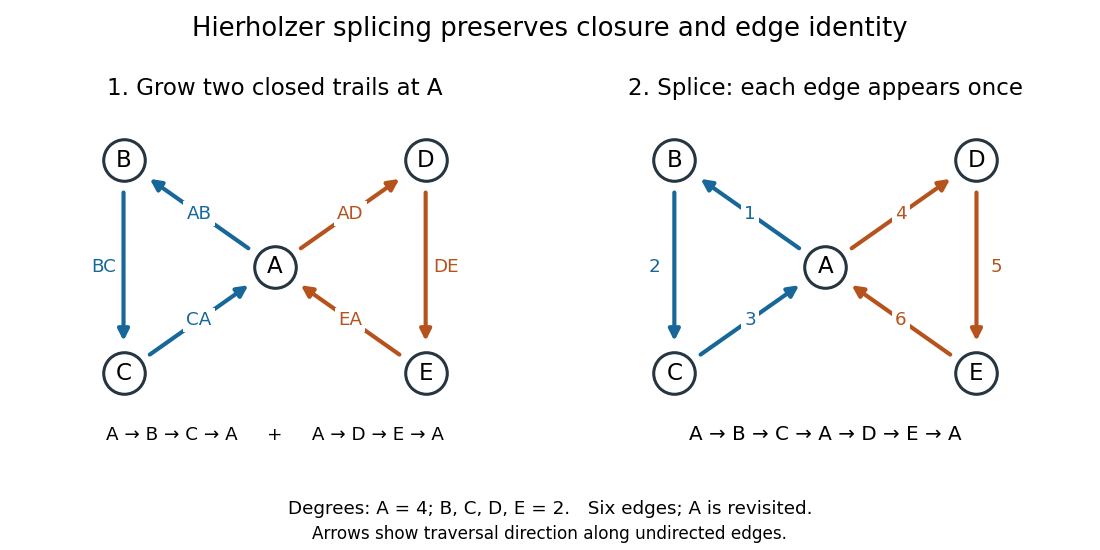
Hierholzer's algorithm inserts one closed trail into another at their shared vertex, using each of six edges exactly once
. Details. 
In the drawing, arrows indicate the chosen traversal direction along undirected edges. The first closed trail uses and the second uses . Insert the second at the final occurrence of in , giving . A reader can check consecutive endpoints, closure, and the six distinct edges directly. With multigraphs, perform the same check on edge identities, since endpoint pairs alone cannot distinguish parallel edges.
Eulerian trail 2026-10-14
An Eulerian trail, also called an Eulerian path, is a trail in a graph traversing every edge exactly once. The name Eulerian path does not require a graph path: vertices may repeat. A Hamiltonian path instead visits every vertex exactly once, and may omit edges. An Eulerian trail may omit isolated vertices, so these are different coverage requirements.
For a finite undirected multigraph with at least one edge, allowing self-loops, an Eulerian trail exists exactly when the edge support of a graph is a connected graph and there are zero or two vertices of odd vertex degree. In the two-odd-vertex case they must be the two distinct endpoints; in the zero-odd-vertex case every Eulerian trail is an Euler circuit. Count a self-loop twice in the vertex degree but once in the trail, and count each parallel edge separately.[ref]
Math 530 Spring 2023, Lecture 6: Multigraphs and digraphs. pp. 1–3, Theorem 1.1.2 and the note about isolated vertices
The parity obstruction is local: each intermediate visit pairs an arriving edge with a departing edge. Only the distinct endpoints can have an unpaired incidence. The handshaking lemma, , also shows that the number of vertices with odd vertex degree is even. Sufficiency in the two-endpoint case reduces to the Euler circuit criterion: add one extra edge between the odd vertices, construct an Euler circuit, rotate its record to start with the extra edge, then delete that edge. The remaining trail has the required endpoints.
For the Seven Bridges of Königsberg multigraph, the vertex degrees at are , so no Eulerian trail exists. Remove the unique edge : the vertex degrees become , and a six-edge Eulerian trail runs from to . Label the parallel edges between and between ; label by and by . A complete record is . It revisits while using every remaining edge once.
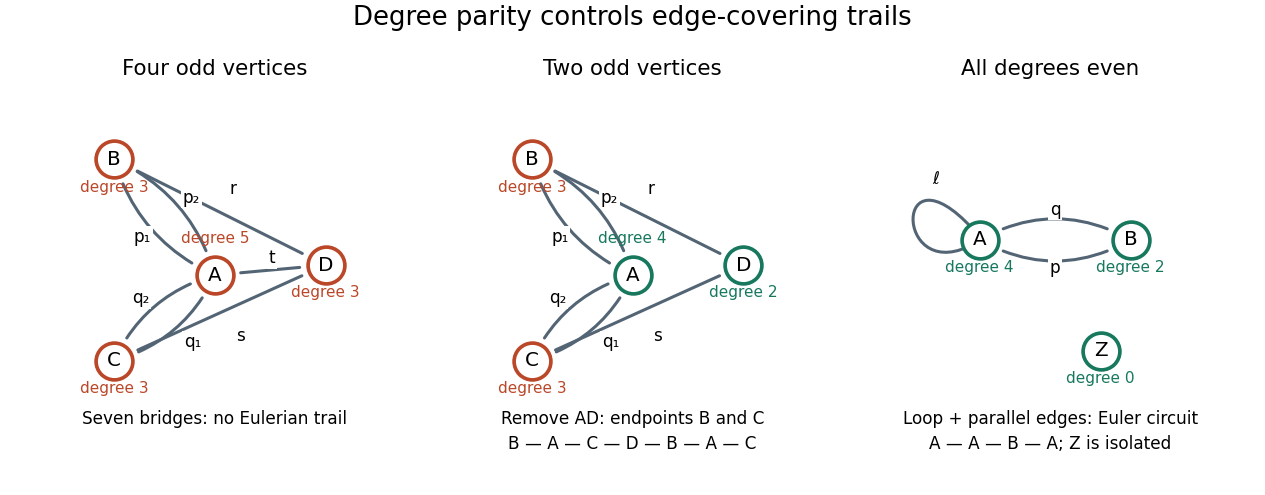
Four odd vertex degrees forbid an Eulerian trail; two allow distinct endpoints; zero allow an Euler circuit
. Details. 