A real number is normal in an integer base when every finite word of digits occurs in its positional notation with the same limiting digit block frequency as every other word of the same length. Write its fractional part as in base , using the expansion that is not eventually all digits when two expansions are possible. For every length and every word , the requirement isOccurrences overlap: the word occurs twice in . There are possible words of length , so is the equal share for each. In a decimal representation, this means frequency for each digit, for each pair, and for each triple, continuing through every finite length. The definition agrees with that used by Copeland and Erdős in their work on explicit normal numbers. [ref]
https://users.renyi.hu/~p_erdos/1946-01.pdf. Arthur H. Copeland and Paul Erdős, Note on Normal Numbers, 1946, opening definition
The appeal is that a precise, deterministic real number can have the same limiting digit block frequencies as repeated draws from a uniform distribution on a finite set, with independence between draws. Champernowne constant is an explicit example. Normality is useful for studying digit distribution, but balanced digits alone establish only a simply normal number, and a finite sample cannot establish any of these infinite limits.
Émile Borel introduced normal numbers and established their prevalence in his 1909 paper applying probability to number theory; the stronger all-base statement is discussed under absolutely normal number. [ref]
https://doi.org/10.1007/BF03019651. Émile Borel, Les probabilités dénombrables et leurs applications arithmétiques, Rendiconti del Circolo Matematico di Palermo 27, 247–271, 1909
For a finite prefix of digits in positional notation, the digit block frequency of a length- word is its number of overlapping occurrences divided by , the number of available starting positions. All such digit block frequencies sum to one. The infinite limit used for a normal number can instead divide counts by : the factor tends to one for fixed .
For the six binary digits , the single-digit counts are three zeros and three ones. Its five adjacent pairs are , givingThis example explains both the overlapping convention and the end correction in a finite sample. The corresponding infinite binary expansion has pair frequencies , rather than the four values required of a normal number in base two.
A real number is simply normal in base if each individual digit in its positional notation has limiting digit block frequency . This is the length-one part of the definition of a normal number. It places no equal-frequency requirement on longer words.
For example, is a simply normal number in base two: each binary digit has frequency . But and never occur, and and each have frequency . Thus is not a normal number in base two. Even a sequence that looks more complicated, such as the deterministic Thue–Morse sequence, must be tested against the actual digit block frequency definition; visual complexity is no substitute for it.
The decimal representation makes the same point in base ten. Every digit has frequency , yet the only adjacent pairs areEach has limiting digit block frequency ; the other ninety pairs have frequency zero. A normal number in base ten requires for every one of the hundred pairs. This rational number is a simply normal number in base ten, but it is not a normal number in that base.
Form Champernowne constant by using concatenation to join the decimal representations of the positive integers after the decimal point. Champernowne proved in 1933 that this particular real number is a normal number in base ten. The construction is striking because its rule is completely explicit, while all finite words have the prescribed limiting digit block frequencies. [ref]
https://doi.org/10.1112/jlms/s1-8.4.254. D. G. Champernowne, The Construction of Decimals Normal in the Scale of Ten, Journal of the London Mathematical Society 8, 254–260, 1933
Copeland and Erdős explicitly recall this result at the start of their own paper. [ref]https://users.renyi.hu/~p_erdos/1946-01.pdf. Copeland and Erdős, Note on Normal Numbers, 1946, first paragraph
The first digits of Champernowne constant have the following exact counts, in digit order :For the adjacent pairs fully inside that prefix, the words occur times respectively. Thus, for example, , which is about , rather than . The prefix ends partway through the decimal representation of ; the many leading ones in earlier positive integers help explain the visible imbalance.
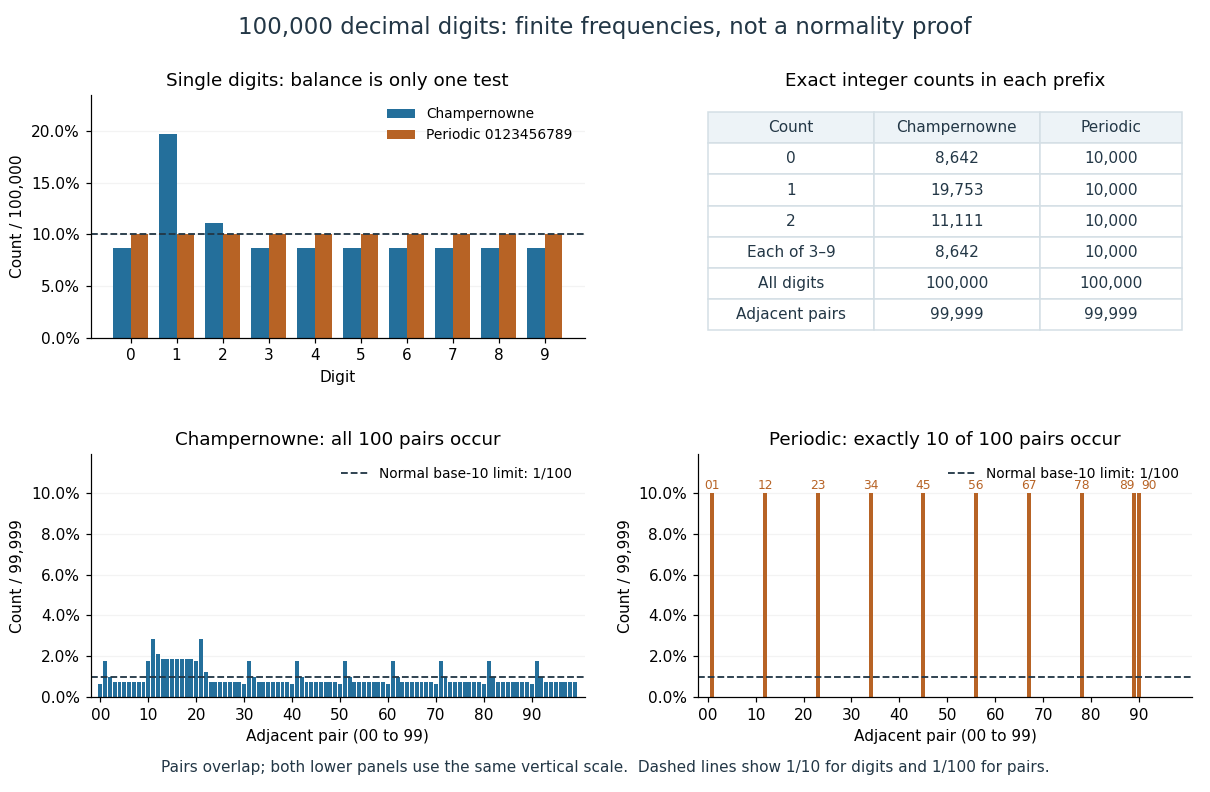
These are finite counts, not a proof of the normal number theorem: a finite prefix can be followed by an all-zero tail. The theorem for Champernowne constant concerns the infinite limit, and establishes base-ten normality, rather than absolute normality. Nor do computations prove normality for familiar constants: the normality of Pi and Euler's number remains unproved, as discussed by Bailey and Borwein. [ref]
https://www.davidhbailey.com/dhbpapers/normal-pseudo.pdf. David H. Bailey and Jonathan M. Borwein, Normal Numbers and Pseudorandom Generators, author manuscript, 2011, introduction
A real number is a normal number in base exactly when its iterates under the integer multiplication map on the circle, , form an equidistributed sequence. Braces denote the fractional part. Multiplication by shifts the positional notation one digit to the left:A length- word with base- integer value specifies the half-open interval , whose length is . Visiting that interval is exactly encountering that word at the next digit position. These digit intervals form arbitrarily fine grids, so their correct limiting visiting frequencies imply equidistribution on every interval. This converts a question about digits into one about a dynamical system. Bailey and Crandall develop this connection using equidistribution of the fractional parts of . [ref]
https://www.davidhbailey.com/dhbpapers/bcnormal.pdf. David H. Bailey and Richard E. Crandall, Random Generators and Normal Numbers, 2003 author manuscript, Section 2
In base ten the word corresponds to . For Champernowne constant, counting the visits for gives precisely the occurrences of in its first digits. For , the base-two integer multiplication map on the circle instead alternates between and ; it never visits , the interval for . This two-point orbit is not an equidistributed sequence.
An absolutely normal number is a normal number in every integer base . This requires every finite word in every such positional notation to have its appropriate limiting digit block frequency. Knowing base-ten normality alone does not establish absolute normality; the base is part of the statement.
Borel's 1909 result says that absolute normality holds almost everywhere for Lebesgue measure: within the exceptions form a Lebesgue null set. In particular, the set of absolutely normal numbers has Lebesgue measure one there. This is a statement about the size of an exceptional set, not a test for a specified constant. [ref]
https://doi.org/10.1007/BF03019651. Émile Borel, Les probabilités dénombrables et leurs applications arithmétiques, 1909
[ref]https://www.davidhbailey.com/dhbpapers/normal-pseudo.pdf. Bailey and Borwein, Normal Numbers and Pseudorandom Generators, 2011, introduction: simultaneous normality in all integer bases
A modern route uses the Birkhoff ergodic theorem and ergodicity of integer multiplication on the circle. For each fixed base and digit interval, the time proportion equals its Lebesgue measure almost everywhere. The bases and finite words form countable sets, so a countable intersection of these measure-one sets still has Lebesgue measure one. For an absolutely normal number, the word therefore has frequency in base two, in base three, and in base ten. The same symbols represent different intervals in different bases.
Articles by others on the same topic


A **normal number** is a real number whose individual digits, and in broader terms, digits of any base, are uniformly distributed. More formally, a number is said to be normal in base \( b \) if, in its expansion in that base, all digits from \( 0 \) to \( b-1 \) appear with equal frequency in the limit as you consider more and more digits.