Treat the quoted solar spectrum as irradiance normal to the beam, approximately constant over the narrow band. The incident band irradiance is and the horizontal value is . The cloud's vertical optical depth is ; including the clear atmosphere gives . The slant optical depth is . Thus the Beer-Lambert law givesThe removed fraction is , almost the full incident horizontal . Beam-normal surface irradiance is twice the horizontal value. These are direct-beam quantities, not the total diffuse-plus-direct surface flux. If the supplied irradiance were already horizontal, the projection factor would instead be omitted.
The Beer-Lambert law solves the source-free attenuation term of the radiative transfer equation. Extinction includes absorption and scattering out of that ray. Missing terms are thermal emission and scattering into the ray from other directions, including repeated scattering and surface reflection.
A cloud can remove nearly all direct sunlight while still supplying substantial diffuse downward radiation. Consequently the total surface solar flux can greatly exceed the direct-beam answer, although reflection sends some energy back to space and absorption can heat matter. At ordinary atmospheric thermal emission is negligible. No unique total flux follows from extinction alone; the single-scattering albedo, angular redistribution and boundary conditions are needed.[ref]
Radiative transfer in the atmosphere by Met Office. Absorption, scattering and thermal-emission processes
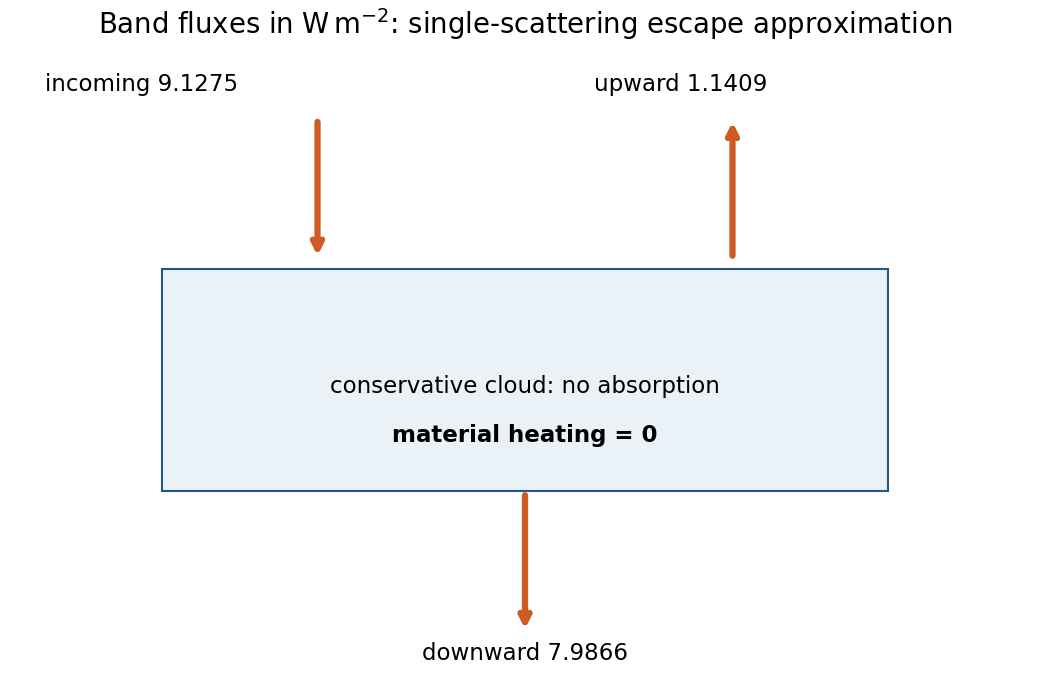
The cloud heating rate in this band is zero: conservative scattering changes photon directions but transfers no net energy to the cloud matter. Let enter its top and . In the stipulated single-scattering escape approximation, the downward and upward outgoing fractions areTheir fluxes are approximately and . With upward-positive net flux, both cloud boundaries have ; henceThe layer heat capacity is . Absorption outside the cloud heats those other layers. Dropping the upward flux would spuriously turn reflection into cloud heating. Neglecting multiple scattering is quantitatively poor at optical depth ten, but conservative multiple scattering still cannot create material heating in this band.

Thick low clouds usually reflect much sunlight and emit infrared at temperatures close to the surface, so their daytime shortwave cooling is strong and their longwave greenhouse contrast relatively small. Cold high clouds can strongly reduce outgoing longwave radiation; thin high clouds reflect less sunlight. Thickness and particle properties matter as well as height.
At night there is no solar term. Warm low-cloud tops commonly cool radiatively, promoting condensation and cloud-driven turbulence that can sustain the layer. A cold, optically thin high cloud can instead absorb more infrared from below than it emits, warming and sublimating and thus shortening its lifetime. A gray-layer diagnostic is absorption minus emission, . This is a tendency, not a universal lifetime ranking: thick cirrus can cool at its top, and ascent, entrainment, humidity and precipitation may dominate.
Articles by others on the same topic
There are currently no matching articles.