Historical Part III Atmospheric Physics papers. Availability of complete worked student solutions has not been established; advertised answer years are skipped when identified. Only solutions are reproduced here, with the original public paper linked from each paper.
Treat the quoted solar spectrum as irradiance normal to the beam, approximately constant over the narrow band. The incident band irradiance is and the horizontal value is . The cloud's vertical optical depth is ; including the clear atmosphere gives . The slant optical depth is . Thus the Beer-Lambert law givesThe removed fraction is , almost the full incident horizontal . Beam-normal surface irradiance is twice the horizontal value. These are direct-beam quantities, not the total diffuse-plus-direct surface flux. If the supplied irradiance were already horizontal, the projection factor would instead be omitted.
The Beer-Lambert law solves the source-free attenuation term of the radiative transfer equation. Extinction includes absorption and scattering out of that ray. Missing terms are thermal emission and scattering into the ray from other directions, including repeated scattering and surface reflection.
A cloud can remove nearly all direct sunlight while still supplying substantial diffuse downward radiation. Consequently the total surface solar flux can greatly exceed the direct-beam answer, although reflection sends some energy back to space and absorption can heat matter. At ordinary atmospheric thermal emission is negligible. No unique total flux follows from extinction alone; the single-scattering albedo, angular redistribution and boundary conditions are needed.[ref]
Radiative transfer in the atmosphere by Met Office. Absorption, scattering and thermal-emission processes
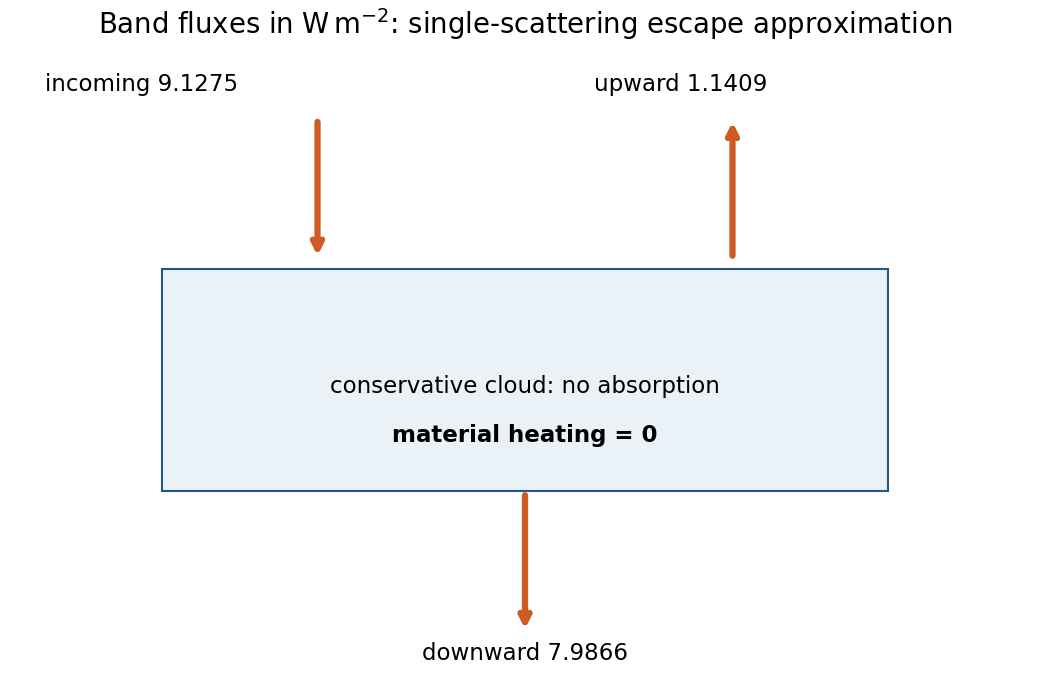
The cloud heating rate in this band is zero: conservative scattering changes photon directions but transfers no net energy to the cloud matter. Let enter its top and . In the stipulated single-scattering escape approximation, the downward and upward outgoing fractions areTheir fluxes are approximately and . With upward-positive net flux, both cloud boundaries have ; henceThe layer heat capacity is . Absorption outside the cloud heats those other layers. Dropping the upward flux would spuriously turn reflection into cloud heating. Neglecting multiple scattering is quantitatively poor at optical depth ten, but conservative multiple scattering still cannot create material heating in this band.
Thick low clouds usually reflect much sunlight and emit infrared at temperatures close to the surface, so their daytime shortwave cooling is strong and their longwave greenhouse contrast relatively small. Cold high clouds can strongly reduce outgoing longwave radiation; thin high clouds reflect less sunlight. Thickness and particle properties matter as well as height.
At night there is no solar term. Warm low-cloud tops commonly cool radiatively, promoting condensation and cloud-driven turbulence that can sustain the layer. A cold, optically thin high cloud can instead absorb more infrared from below than it emits, warming and sublimating and thus shortening its lifetime. A gray-layer diagnostic is absorption minus emission, . This is a tendency, not a universal lifetime ranking: thick cirrus can cool at its top, and ascent, entrainment, humidity and precipitation may dominate.
A convex water surface has higher saturation vapour pressure than a flat one. Equality of chemical potentials with the Laplace pressure gives the Kelvin equationSmall pure droplets therefore need large supersaturation; many subcritical embryos evaporate, making homogeneous droplet formation inefficient under ordinary cloud conditions. Cloud condensation nuclei provide a surface and, when soluble, lower water activity. Köhler theory combines the curvature increase with this solute decrease, giving a critical supersaturation and size for activation.
Warm-rain pathway: condensation first grows activated droplets, but its relative size growth slows. A sufficiently broad size spectrum creates different fall speeds; large drops collect smaller ones by collision-coalescence. Collection efficiency, turbulence, liquid-water supply and residence time control the bottleneck. Rain reaching the ground also requires survival against subcloud evaporation.
Ice pathway: below freezing, saturation vapour pressure over ice is lower than over supercooled liquid. In mixed-phase air, ice can grow by deposition while droplets evaporate: the Wegener-Bergeron-Findeisen process. Ice also collects droplets by riming and combines by aggregation. Adequate ice nuclei, sustained supersaturation and residence time are critical; particles must become heavy enough to fall, with snow sometimes melting to rain. Condensation or deposition alone is not generally sufficient for rapid precipitation.
Droplets remain supercooled because creating an ice embryo costs interfacial free energy: freezing has a nucleation barrier even below the equilibrium melting point. Small droplets also have a low probability of containing an effective ice-nucleating inclusion.
Three heterogeneous routes are immersion freezing around a particle already inside the droplet, contact freezing following a collision with a suitable mineral particle, and deposition nucleation from ice-supersaturated vapour onto a suitable surface. At sufficiently low temperature, homogeneous ice nucleation occurs without a foreign surface. Its onset depends on volume and observation time rather than being a universal exact temperature. No biological ice-nucleating agents are needed for these mechanisms.
Direct effect: nonabsorbing aerosol scatters sunlight, usually increasing reflected shortwave flux over dark surfaces. Absorbing aerosol also heats its atmospheric layer while reducing surface sunlight; the top-of-atmosphere sign depends on its altitude, optical properties and underlying albedo.
Cloud albedo effect: soluble, hygroscopic aerosol readily takes up water and can activate as cloud condensation nuclei. At fixed liquid-water path, more smaller droplets increase optical depth and cloud reflectivity: the Twomey effect. Suppressed collision-coalescence can delay rain and change cloud amount or lifetime, though dynamical adjustments prevent a universal sign.
Semi-direct effect: absorption can alter stability and evaporate clouds, or change entrainment and cloud cover. Insoluble dust may be a poor soluble-droplet nucleus but still scatters/absorbs radiation or nucleates ice; coatings can alter its activation. Solubility, absorptivity and ice-nucleating ability are distinct properties, not mutually equivalent categories.[ref]
The isentropic potential vorticity is Ertel potential vorticity expressed on constant potential temperature surfaces:Here is the vertical curl of horizontal velocity differentiated on an isentropic surface, and is mass per unit area per unit potential-temperature interval. For smooth inviscid adiabatic motion, . Conserved anomalies are advected and deformed, explaining much balanced large-scale weather variability. Diagnosing velocity from PV additionally needs balance, stratification and boundary information. Strong latent/radiative heating, friction and irreversible mixing generate or modify PV, limiting a purely conservative explanation.[ref]
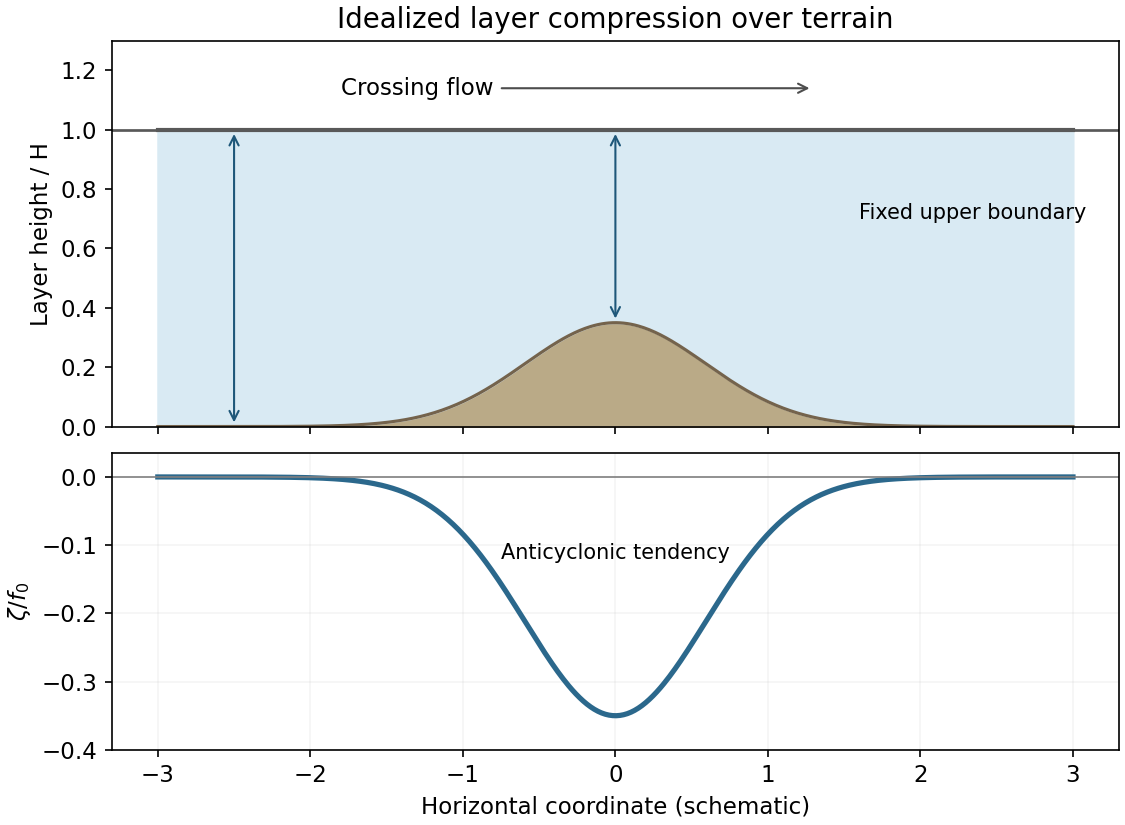
In a simple northern-hemisphere layer with a fixed upper boundary, climbing a mountain compresses the column. Potential vorticity conservation, , then reduces absolute vorticity: at nearly fixed latitude the flow acquires anticyclonic relative vorticity. Descending the lee side stretches the column and restores or increases cyclonic vorticity. For an eastward streamline the idealized turning tendency is clockwise in the compressed region and counterclockwise on re-expansion; the resulting disturbance can launch a stationary downstream Rossby wave pattern.
This column argument is an idealization. Stratified air can move around the barrier, isentropic thickness changes need not equal the mountain height, and wave breaking or friction can change PV. Northern-hemisphere signs reverse if changes sign.
For an approximately conserved isentropic potential vorticity, : increased isentropic layer mass implies more cyclonic vorticity, and decreased layer mass more anticyclonic vorticity at fixed latitude. Equivalently, in the thin-layer analogy, stretching increases and compression decreases absolute vorticity.
The usual summer land-heating picture has a deeper, less stably stratified lower atmosphere and favours a cyclonic thermal low; winter land cooling gives a shallow stable layer and favours an anticyclonic thermal high. These are conditional lower-tropospheric tendencies, not a season-only conservation law. Heating is diabatic and the rougher land surface introduces friction and convergence, so parcel PV need not remain fixed. The sign at every altitude cannot be deduced from “ocean to land” alone without the heating/stability profile and background wind.
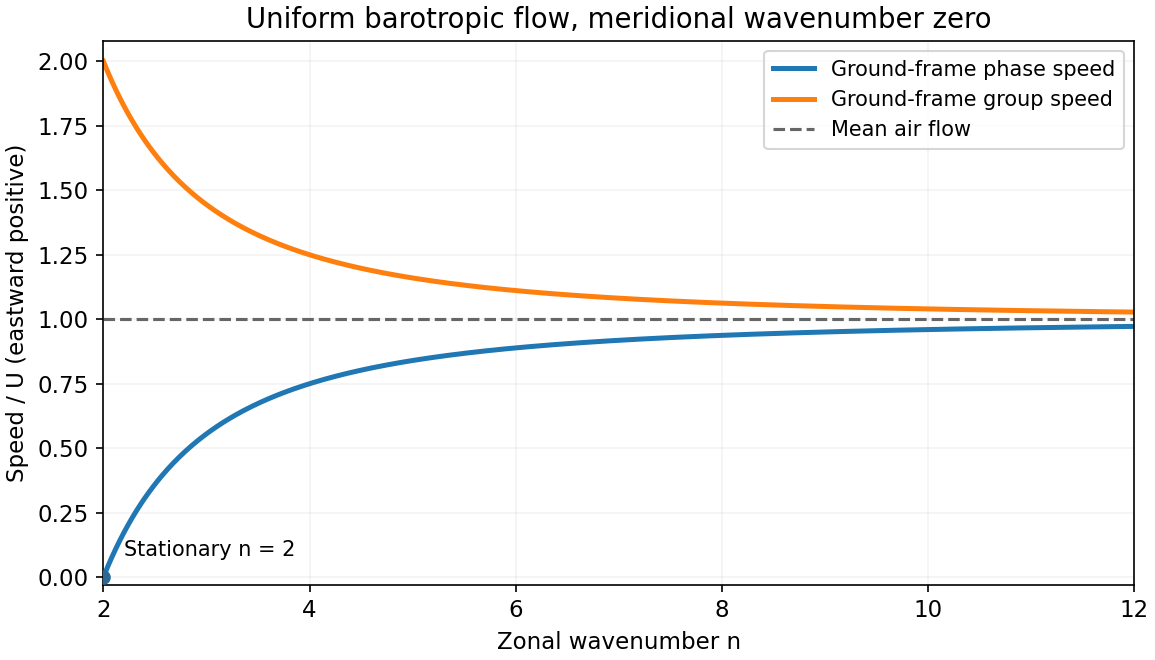
Use a uniform westerly Barotropic Rossby wave model on a local beta plane. Its dispersion is . A zonal wavenumber-two pattern at latitude has , so stationarity requiresFor the zonally varying, meridionally uniform idealization , this is . Meridional structure, deformation radius, mean-flow shear and full spherical geometry change the condition; the latitude and zonal wavenumber alone do not fix a unique observed jet speed.
For a shorter zonal perturbation with the same assumptions,Its phase travels eastward relative to the stationary long wave, but westward relative to the air at speed ; its packet propagates downstream faster than the mean flow in this idealization. For example gives and .
Within the meandering flow, poleward parcel motion lowers relative vorticity and equatorward motion raises it through . Synoptic anomalies can reinforce or oppose the background ridges/troughs according to phase, exchange momentum with it, and transfer energy downstream. Linear superposition alone does not cause mutual growth; stronger interactions require shear, baroclinicity or nonlinear PV advection. No unique amplification rate follows from the supplied information.
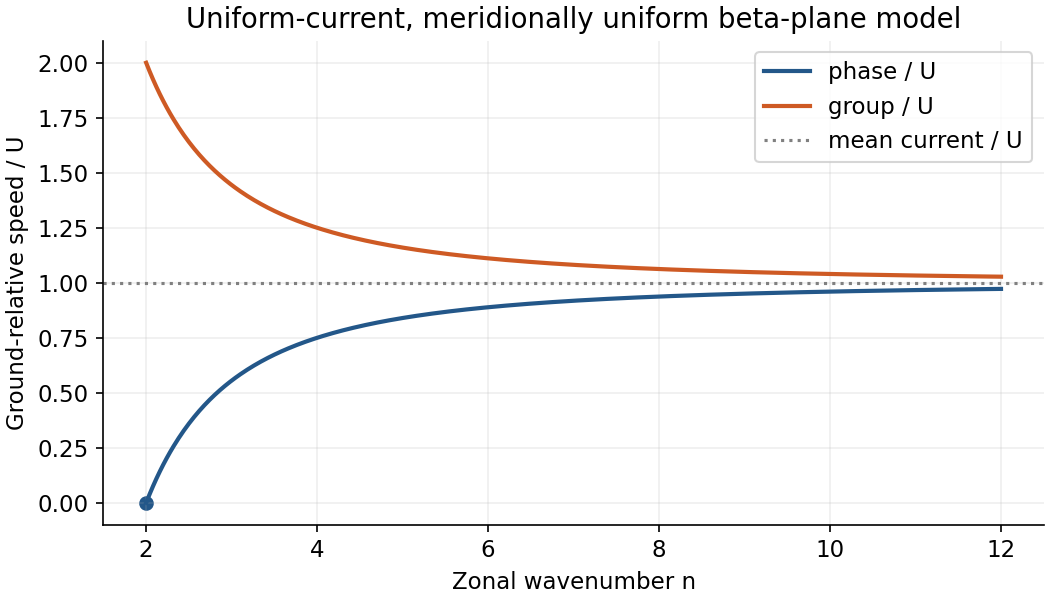
In the stated idealized model shorter Rossby-wave phases move east while packets propagate faster downstream
. Source. Details. In the rotating terrestrial frame, horizontal pressure gradient force and Coriolis force balance in geostrophic balance. Gravity establishes the approximately vertical hydrostatic equilibrium; it is not an additional horizontal force in this balance. With eastward , northward , upward unit vector and Coriolis parameter ,The geostrophic wind runs along atmospheric isobars, with lower pressure on its left in the Northern Hemisphere.
Interpreting the stated south-to-north gradient as , , while . Using the external nominal Earth's rotation rate gives the meridional-pressure-gradient geostrophic windBoth zonal velocities are westward; their signs reverse if the supplied gradient is interpreted as a northward decrease. [ref]
IERS Conventions (2010) by International Earth Rotation and Reference Systems Service. Table1.2, physical PDF p.19: nominal mean angular velocity
The validity criteria for geostrophic balance require horizontal acceleration and friction to be small compared with the balancing forces: Rossby number and slow evolution compared with . The approximation fails near the equator, on sufficiently small or rapidly changing scales, in strongly curved flow needing appreciable centripetal acceleration, and in the frictional surface layer. Neglecting friction near the ground is the stated idealization.
For an illustrative geostrophic wind with linear drag, use acceleration with . The steady horizontal momentum equation givesDrag reduces the wind and hence its Coriolis acceleration; the wind crosses isobars toward lower pressure. Here it points southwest. The pressure-gradient acceleration points south, Coriolis northwest and drag northeast; the three forces sum to zero. The cross-isobar angle satisfies for . A turbulent boundary layer has a vertically varying stress rather than necessarily this constant linear drag.
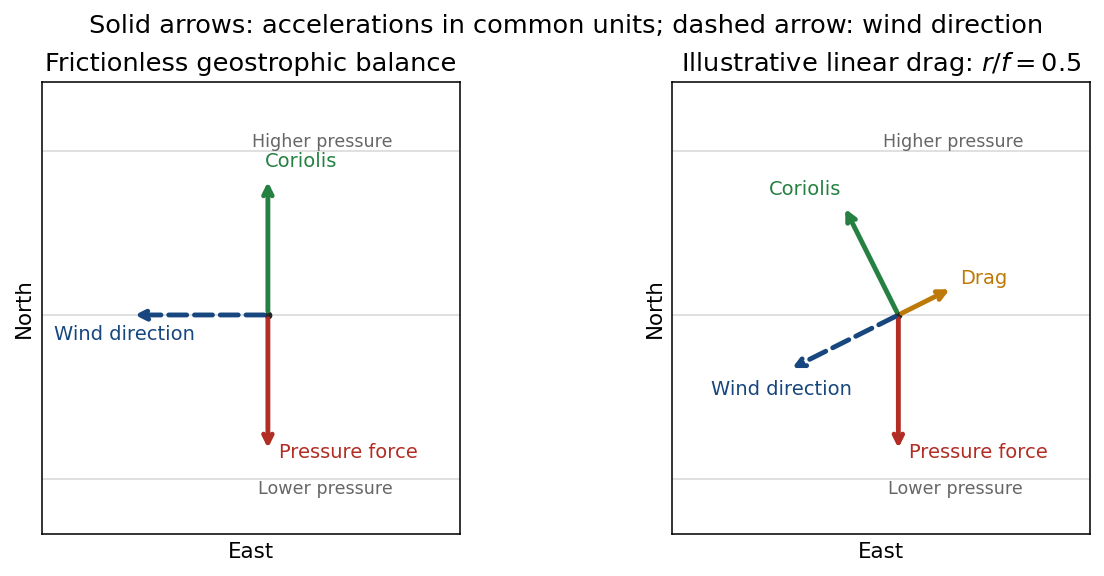
For northward-increasing pressure, frictionless westward flow becomes a slower southwestward flow under illustrative linear drag
. Source. Details. Use spectral radiant exitance per unit wavelength. The Planck law isA hotter blackbody radiates more at every wavelength, its wavelength peak moves to shorter wavelengths according to Wien's displacement law, and its integrated flux rises as by the Stefan–Boltzmann law. The wavelength convention matters: a spectrum plotted per unit frequency has a different peak transformation.
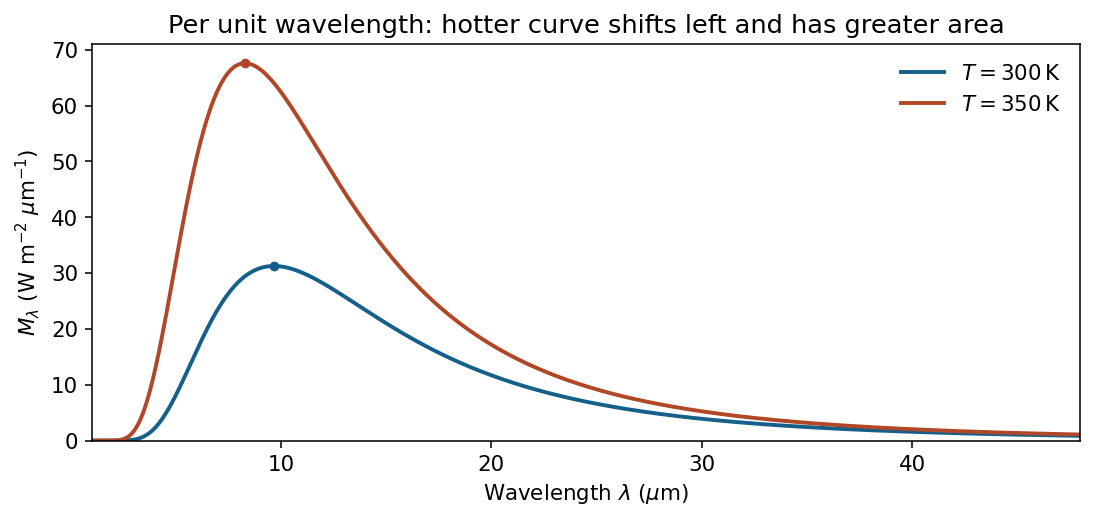
Illustrative wavelength spectra: a hotter blackbody has a larger total flux and a shorter peak wavelength
. Source. Details. For planetary equilibrium temperature, assume an isotropic blackbody star, a circular orbit, negligible internal heating, unit surface thermal emissivity and efficient global heat redistribution so the surface has one temperature. The received stellar irradiance is . A planet of radius intercepts but radiates over , giving the projected-area factor in planetary energy balanceWithout the uniform-temperature assumption, this calculation gives , not a unique arithmetic mean of surface temperature.
With Bond albedo , the absorbed fraction is . Hencea decrease of approximately . This albedo weights incident stellar light and does not imply thermal emissivity .
Define the planetary effective emissivity by outgoing top-of-atmosphere flux . Maintaining the same absorbed stellar power with givesThe greenhouse effect allows thermal radiation to escape from colder layers, so the outgoing flux is less than a black surface at would emit. Downward atmospheric emission contributes to the surface energy balance; this does not violate the top-of-atmosphere energy balance.[ref]
Climate and Earth's Energy Budget by NASA Earth Observatory. Thermal radiation, atmospheric absorption and effective radiating versus surface temperature
A single-layer greenhouse model makes the distinction quantitative. Take a shortwave-transparent, isothermal layer with infrared absorptivity and emissivity , above a surface black in the thermal infrared. Writing , its surface and atmospheric balances areFor , . Radiation escaping to space is , soThus is the planet's effective emissivity; is the layer's infrared emissivity within this particular model. They are not interchangeable. Real atmospheres require wavelength-dependent absorption, a vertical temperature profile and nonradiative heat transport; the measured temperatures alone do not uniquely retrieve an atmospheric optical profile.
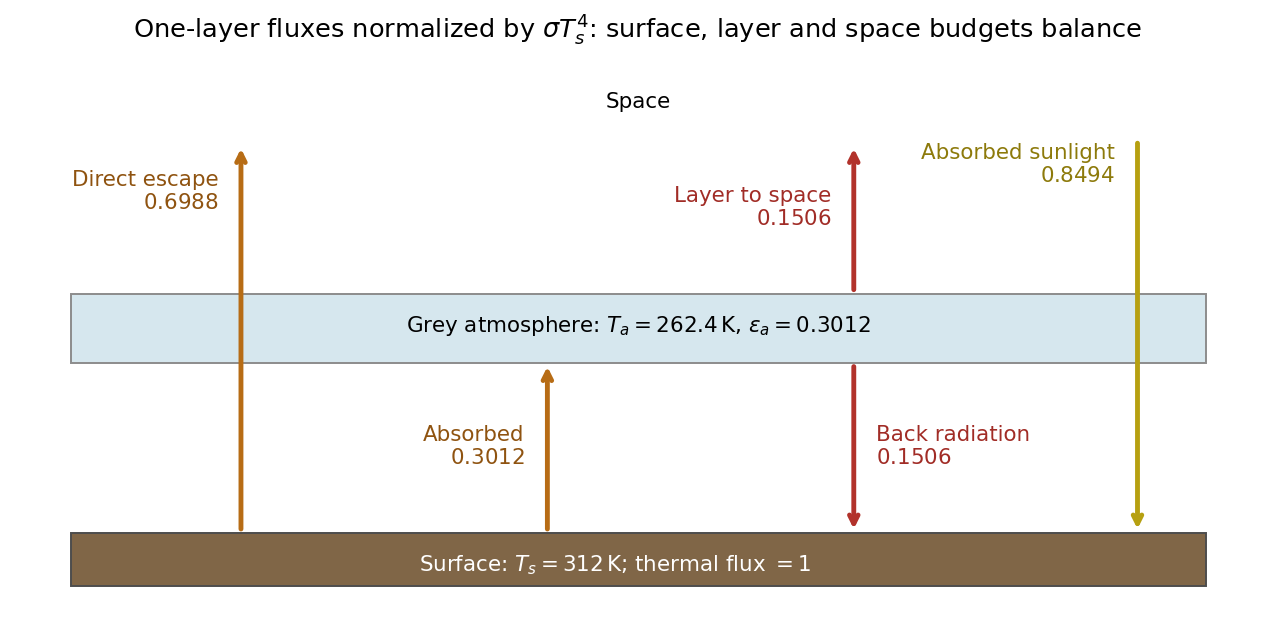
One-layer radiative equilibrium distinguishes planetary effective emissivity from the infrared emissivity of the atmosphere
. Source. Details. A teleconnection is correlated atmospheric variability between separated regions. A principal dynamical pathway is a Rossby-wave teleconnection: a displaced air column conserves potential vorticity, so changing planetary vorticity must be balanced by changing relative vorticity. The background potential-vorticity gradient supplies the restoring mechanism.
In a uniform zonal current on a beta plane, a simple Barotropic Rossby wave hasThe intrinsic phase propagates westward for ; advection can leave a nearly stationary pattern in the terrestrial frame. Energy and information travel with the group velocity, not necessarily with individual crests or the same air parcels. A jet stream can guide wave packets and link distant ridges and troughs.
For example, persistent anomalous tropical heating can excite wave trains that alter remote pressure, temperature and storm tracks. Tropical Pacific ocean-temperature anomalies can modify that heating, yielding reproducible extratropical patterns. Their phase and strength depend on the background winds, potential-vorticity gradients, damping, season and eddy feedbacks. A correlation pattern is not by itself proof of a unique causal pathway, and not every teleconnection is a single stationary linear wave.[ref]
Teleconnections and stationary Rossby waves by Isaac Held. 9March2015: rotating-sphere response to localized equatorial heating and extratropical ENSO patterns
A foehn wind is relatively warm, dry downslope air on a mountain's lee side. In the classical condensation pathway, ascending windward air expands and cools at the dry adiabatic lapse rate until the lifting condensation level. Condensation then releases latent heat, reducing the cooling rate to the moist adiabatic lapse rate. Atmospheric precipitation removes condensate, and the descending parcel warms by compression at approximately the dry rate. Its relative humidity falls.
For equal starting and finishing heights, complete condensate removal and a constant moist lapse rate above condensation height , the precipitation-driven foehn warming isHere is the parcel's maximum height and . The warming is adiabatic compression during descent, not heating by friction. Without condensation or a difference in source air, a reversible dry parcel returning to its original height would regain its original temperature.
Precipitation is not essential to every foehn event. Isentropic foehn drawdown can bring air of higher potential temperature from aloft down the lee slope; turbulent mixing and extra solar heating beneath clear skies can also contribute. The sketch shows the classical rainout pathway rather than asserting a unique mechanism.[ref]
Foehn effect by Met Office. How does the foehn effect work? Condensation/rainout, drawdown, mixing and radiative warming
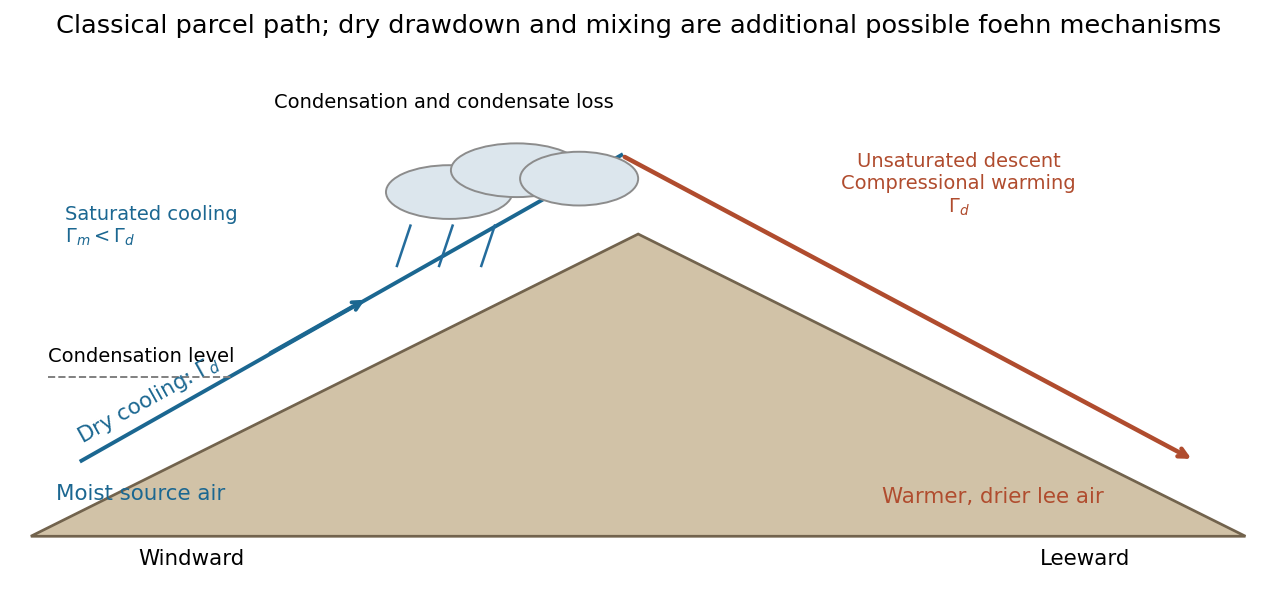
Classical foehn pathway: moist ascent and condensate loss followed by dry compressional warming on the lee side
. Source. Details. For dry atmospheric Ertel potential vorticity, use absolute vorticity and potential temperature :The conservation statement is Ertel's theorem for smooth, inviscid, adiabatic flow with conservative body forces and a thermodynamic equation of state . Stretching of cancels deformation of in their material derivative; the remaining baroclinic triple product vanishes because lies in the span of . The atmospheric form includes ; the commonly used Boussinesq approximation version has a different normalization.
In a predominantly vertical stratification, . Thus rotation and stratification jointly label air masses. Material conservation explains how parcels deform and stretch while preserving a useful scalar, supports Rossby waves, and helps diagnose sharp fronts, jets and stratospheric intrusions.
Under an appropriate balance model, potential-vorticity inversion recovers associated wind and temperature fields from a PV distribution together with stratification and boundary data. PV alone does not specify every component of an arbitrary atmospheric flow. Potential-vorticity generation by heating and friction limits conservative parcel reasoning near strong heating, surface stress or mixing.[ref]
Fundamentals of Atmosphere-Ocean Dynamics by Michael Edgeworth McIntyre. PartII§12, equationII.17, physical PDF pp.150–152: dry atmospheric PV and qualified invertibility
A blackbody absorbs all incident radiation and, in thermal equilibrium, emits the Planck law spectrum with integrated flux . Earth reflects some incoming sunlight, while its surface and atmosphere absorb and emit selectively with wavelength. With solar irradiance and Bond albedo A, the equilibrium planetary effective radiating temperature isReflection lowers this temperature relative to the zero-albedo value. The greenhouse effect makes the surface warmer than the effective emitting temperature: in a simple diagnostic , . This effective emissivity summarizes atmospheric transfer, not a universal material constant. At fixed absorbed sunlight, greenhouse warming does not require a different equilibrium outgoing flux. [ref]
Climate and Earth's Energy Budget by NASA Earth Observatory. Absorbed/reflected sunlight and effective radiating versus surface temperature
The stated is positive net energy uptake, not necessarily the imposed radiative forcing itself. A linear climate forcing-response energy balance isHere F is the perturbing forcing, is the net stabilizing radiative response and C is an effective areal heat capacity. The residual heats the Earth system, mainly through ocean heat uptake, with additional storage and melting. Finite heat capacity and ocean exchange delay equilibration. The imbalance alone determines neither F, the warming rate without C, nor the eventual equilibrium warming . Feedbacks change the response coefficient. The given number is treated as the examination's premise, not a present-day observational estimate. [ref]
The Earth's Energy Budget, Climate Feedbacks, and Climate Sensitivity by Piers Forster and others. §7.4.1 andBox7.1, forcing–response budget; sign convention here uses positive damping lambda
The entropy form of dry potential temperature follows from its parcel definition. The potential temperature is the temperature a parcel would reach if brought reversibly and adiabatically to a reference pressure . For dry air of fixed composition, treated as an ideal gas with constant specific heat capacity,Per unit mass, the first law of thermodynamics, together with for specific volume, gives . The reversible form of the Second law of thermodynamics then givesHence dry reversible adiabatic motion has . Pressure changes cause expansion cooling or compression warming, while the pressure factor in theta compensates exactly. Adiabaticity alone is insufficient if irreversible mixing or viscous dissipation produces entropy. Condensation or freezing supplies latent heating, so ordinary dry potential temperature need not be conserved in a moist adiabatically moving parcel.
The radiative-convective structure of the terrestrial atmosphere reflects several processes. In the troposphere, absorbed sunlight heats the surface, which transfers energy upward by sensible heat and evaporation. Convection and large-scale ascent cool air by expansion; condensation releases latent heat and reduces the cooling rate of saturated ascent. Radiative cooling of the atmosphere balances part of this upward transport. The dry adiabatic lapse rate is ; moist convection generally gives a smaller lapse rate. The observed mean profile is a radiative–convective balance, not one universal dry adiabat.
In the stratosphere, ultraviolet absorption by ozone heats the layer and produces the mean temperature inversion, suppressing deep convection. Higher in the mesosphere, weaker ozone heating and radiative cooling allow temperature to decrease again. In the thermosphere, absorption of energetic solar radiation by the tenuous gas raises its kinetic temperature. Its low density means that a high kinetic temperature does not imply a large heat content.
Tropopause and other transition heights vary with latitude and season. Near-surface inversions and clouds further modify local profiles. [ref]
Layers of the Atmosphere by National Oceanic and Atmospheric Administration. Jetstream, troposphere through thermosphere and their heating mechanisms
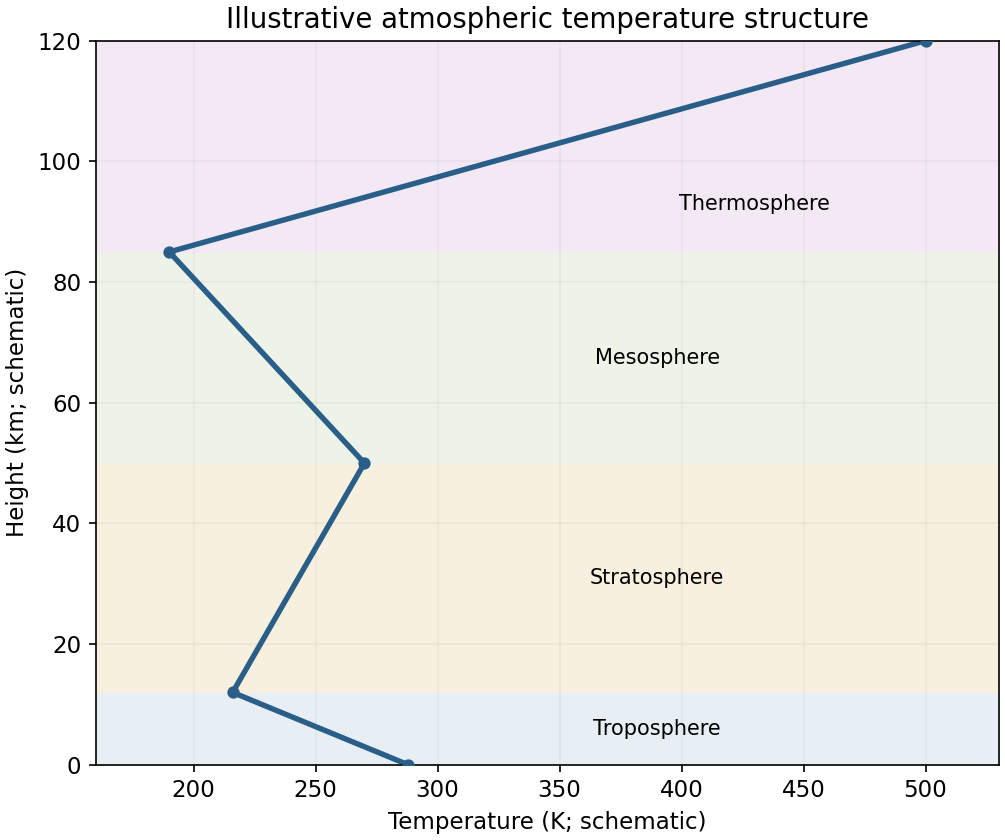
Atmospheric temperature profile
. Source. Details. Clouds reflect shortwave sunlight, usually cooling the planet, and absorb and emit thermal infrared radiation, usually warming the surface relative to clear sky. Their net effect depends on altitude, temperature, optical depth, phase and the underlying surface: thick low clouds often have strong shortwave cooling, while cold high clouds can have a comparatively strong longwave warming effect. Surface and top-of-atmosphere budgets must be distinguished; absorbing radiation within a cloud can heat the atmospheric layer while shading the ground.
Condensation and freezing release latent heat; evaporation and melting absorb it. These processes change buoyancy, stability and convective transport. Entrainment of dry air can evaporate droplets and cool the cloud edge, while precipitation removes condensate and water.
Microphysics controls the radiative properties. For liquid droplets with a fixed liquid-water path W, the cloud optical depth at fixed liquid-water path is approximatelyThus more numerous smaller droplets at fixed W give a brighter, optically thicker cloud: the Twomey effect. Ice habit, phase and particle-size distribution also alter scattering, absorption and precipitation. Cloud-water and lifetime adjustments need not preserve W, so a microphysical perturbation has no universal net radiative sign. [ref]
A convex liquid surface has additional surface free energy. The resulting Kelvin equation for a pure spherical water droplet isHere gamma is surface tension and is molar mass. Smaller droplets therefore need a higher environmental vapour pressure to avoid evaporating; forming pure-water embryos by homogeneous condensation has a large nucleation barrier.
An atmospheric droplet normally forms on a cloud condensation nucleus. Dissolved salt reduces water activity and hence equilibrium vapour pressure, opposing the curvature effect. Köhler theory combines them:Using the radius form, with radius and diameter conventions in Köhler activation kept distinct, the Köhler activation radius is , with . Supersaturation above this maximum activates a wet aerosol into a growing cloud droplet. Solubility, particle size and wettability determine the threshold; not every particle activates. Cooling by ascent commonly supplies the necessary modest supersaturation. [ref]
A single parameter representation of hygroscopic growth and cloud condensation nucleus activity by M. D. Petters and S. M. Kreidenweis. 2007, curvature/solute competition and critical activation; radius convention explicitly used here
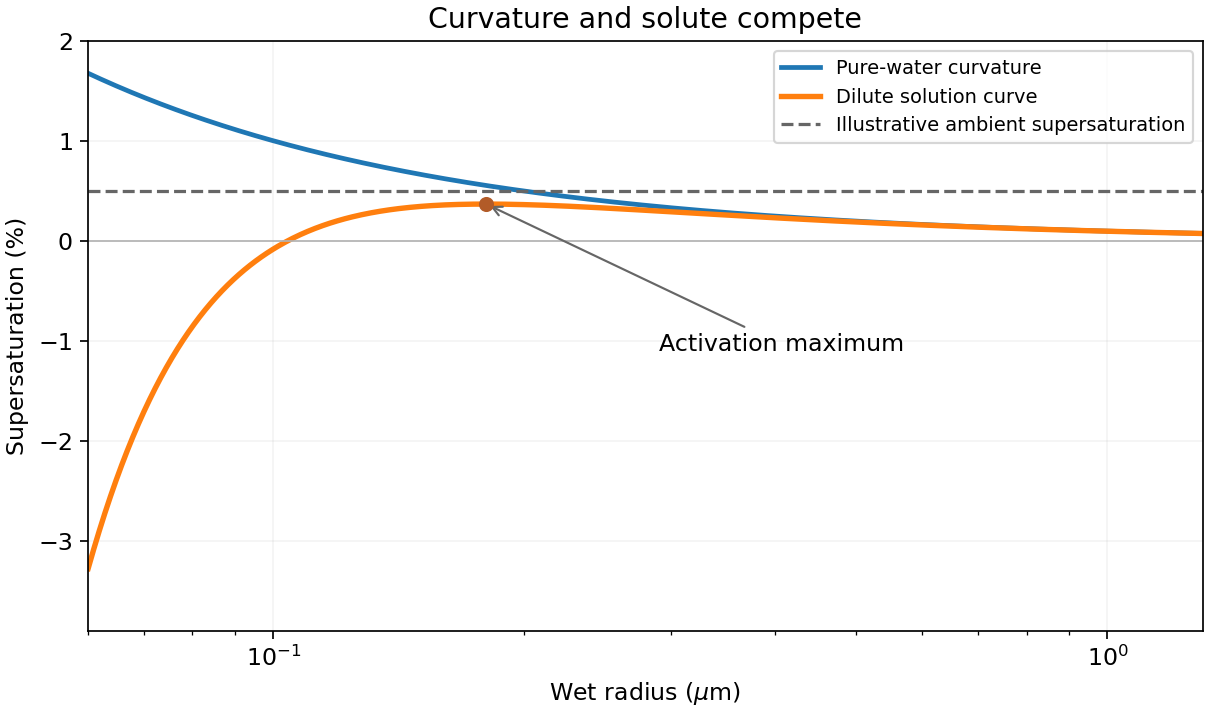
Köhler activation
. Source. Details. Warm-rain growth: condensation first creates cloud droplets, but its approximate growth narrows relative size differences and becomes inefficient at making large raindrops quickly. A broadened size spectrum lets larger, faster-falling drops collect smaller ones by collision-coalescence. The cloud-droplet collision kernel combines collection efficiency and differential settling. Turbulence, sufficient cloud depth and liquid-water content determine whether collector drops grow rapidly enough. Collisions must actually lead to merging rather than bypass, bounce or breakup.
Ice-phase growth: in a mixed-phase cloud, equilibrium vapour pressure over ice is lower than over supercooled liquid. Ice can grow by deposition while droplets evaporate: the Wegener-Bergeron-Findeisen process. Ice particles then grow further by riming of supercooled droplets and by ice-crystal aggregation. They may fall as snow or melt into rain. Deposition, riming and aggregation are distinct processes; depositing vapour alone need not complete precipitation growth.
Precipitation efficiency depends on the supply of suitable collector drops or ice, residence time, updraft speed, supersaturation and collection/sticking efficiencies. Competition among too many small particles can inhibit growth, and evaporation or sublimation below the cloud can prevent condensate from reaching the surface. Both pathways require growth and fall-out to compete successfully with these losses. [ref]
International Cloud Atlas by World Meteorological Organization. Glossary: accretion, aggregation, coalescence; snow as single or aggregated ice crystals
A droplet can remain liquid below its equilibrium melting temperature through supercooling: a microscopic ice embryo must first pay an interfacial free-energy cost. The nucleation barrier can therefore delay freezing even when bulk ice is thermodynamically favoured. Solutes, available surfaces, temperature, droplet volume and exposure time affect the probability; zero degrees Celsius is not an automatic freezing threshold for every atmospheric droplet.
At least four physical routes are relevant:
- Homogeneous ice nucleation: an ice embryo forms within deeply supercooled liquid without a foreign surface.
- Immersion freezing: a suitable particle already inside a liquid droplet catalyses an ice embryo.
- Contact freezing: a suitable particle contacting the droplet surface triggers heterogeneous freezing.
- Deposition nucleation: ice appears from vapour on a suitable solid surface under ice-supersaturated conditions; pore condensation or a thin liquid film can participate, so the observed mode need not imply a single direct molecular pathway.
Mineral particles provide nonbiological examples of heterogeneous nuclei. A particle's presence alone does not guarantee activity at a given temperature. The cloud ice nucleation versus ice growth distinction matters: the processes listed concern the formation of new ice; subsequent depositional growth, riming and aggregation are separate from initiating that first crystal.
There are several distinct radiative pathways:
- Direct scattering: predominantly nonabsorbing particles, such as many sulfate or sea-salt aerosols, redirect sunlight and commonly increase reflected shortwave radiation over a dark surface. Hygroscopic growth increases their wet size and can increase scattering.
- Direct absorption: absorbing particles, such as soot or some mineral dust, heat the layer containing them while reducing sunlight at the surface. The top-of-atmosphere sign depends on particle optics, altitude, clouds and surface albedo; atmospheric heating is not the same as surface warming.
- Cloud activation: a soluble, hygroscopic particle can act as a cloud condensation nucleus. At fixed liquid-water path, more activated droplets lower the effective radius and increase cloud albedo through the Twomey effect. Precipitation and water-content adjustments can modify that response. Insoluble particles may still activate when sufficiently wettable or coated, and some serve as ice nuclei, changing cloud phase.
- Cloud adjustment to aerosol heating: absorbing particles alter temperature, relative humidity and stability. This semi-direct aerosol effect can evaporate cloud or, in other configurations, help sustain it; its sign is not universal.
Solubility and optical absorption are independent properties: insoluble does not mean absorbing, and soluble does not mean nonabsorbing. Coarse particles can also affect terrestrial infrared radiation, while dark-particle deposition on snow can lower surface albedo. These effects should not be folded into a single universal aerosol cooling rule. [ref]
For a hydrostatic, stably stratified atmosphere, define isentropic mass density and relative vertical vorticity evaluated on an isentrope, . Then isentropic potential vorticity isIt is the hydrostatic isentropic form of dry Ertel potential vorticity, . For inviscid, adiabatic motion with fixed composition and conservative body forces, , so parcels carry their PV along isentropes. Stable stratification makes the coordinate transformation well defined.
Heating and friction spoil simple material conservation. More explicitly, with and nonconservative force per mass ,Thus the distribution is especially useful away from strongly diabatic clouds and frictional boundary layers. Explaining a velocity field by potential-vorticity inversion additionally requires an appropriate balanced-flow approximation and boundary information; a PV value alone does not specify the entire flow. [ref]
Fundamentals of Atmosphere-Ocean Dynamics by Michael Edgeworth McIntyre. PartII§12, Ertel conservation, isentropic form and qualified invertibility
In an idealized crossing flow, take a layer between a mountain and an approximately fixed upper boundary. If its upstream depth is H and the terrain height is , climbing reduces its depth to . Conservation of shallow-water potential vorticity givesAt nearly fixed northern latitude, with negligible upstream relative vorticity, : compression produces an anticyclonic tendency. For an eastward flow this corresponds to a rightward/equatorward turning tendency. On the descending side, re-expansion restores cyclonic vorticity relative to that compressed state. Meridional displacement also changes f and participates in the balance.
The corresponding mountain-crossing isentropic PV balance uses rather than geometric depth: reduced isentropic mass thickness requires reduced absolute vorticity, and increased thickness the reverse. The geometric cartoon assumes an upper boundary that does not simply rise with the terrain. A real mountain can displace isentropes, block low-level flow or generate a downstream Rossby-wave pattern; friction and latent heating can change PV. Thus the local compression sign is a model tendency, not a universal map of every orographic circulation.
In the usual lower-tropospheric seasonal land-heating vorticity tendency, summer land is warmer than the adjacent ocean: the heated layer deepens, favouring stretching and a cyclonic thermal-low tendency in the Northern Hemisphere. In winter, colder land favours a shallow stable layer and an anticyclonic thermal-high tendency. In a column model conserving at fixed f,so deepening and shallowing give the stated signs.
This is a conditional layer picture, not an assertion that heating conserves dry isentropic PV. In the isentropic expression, replace h by ; an isolated temperature contrast does not specify that mass thickness. Diabatic heating, changes in stratification and increased surface drag over land alter the PV budget. The coastal vorticity tendency from variable surface drag illustrates another complication: the curl of a horizontal drag is , whose coastal contribution depends on wind and coastline orientation. Vorticity can also differ with height. Without those profiles one cannot assign a universal sign to the full circulation solely from the season; the summer-low/winter-high tendency is the standard idealization.
Use a locally uniform eastward barotropic current on a beta plane. For horizontal wavevector , the Barotropic Rossby wave dispersion relation isThe stationary zonal-wavenumber-two Rossby-wave condition is therefore . For the usual assumption ,Here is supplied; is an explicitly identified external nominal rotation constant, not an invented historical handbook value. [ref]
IERS Conventions (2010) by International Earth Rotation and Reference Systems Service. Table1.2,printedp18/physicalPDFp19, nominal angular velocity
The number assumes no meridional structure; a nonzero l or finite deformation radius changes the required speed. Zonal wavenumber alone does not fix those additional parameters.For a shorter zonal disturbance with integer and , the shorter Rossby-wave propagation inside a stationary long wave hasIts intrinsic phase motion is westward relative to the air, but both the weather pattern and its packet move eastward relative to the ground. Packet energy propagates downstream faster than the phase, giving Rossby-wave downstream development: downstream systems can amplify as upstream systems decay. Disturbances also superpose and interfere. In the strictly linear uniform-flow model they do not directly scatter from one another; finite-amplitude eddies can exchange momentum and heat and modify the background. Their detailed nonlinear interaction requires amplitudes and geometry, not just a wavenumber. [ref]
Fundamentals of Atmosphere-Ocean Dynamics by Michael Edgeworth McIntyre. Rossby-wave phase/group propagation and wave–mean-flow interaction


Articles by others on the same topic
There are currently no matching articles.