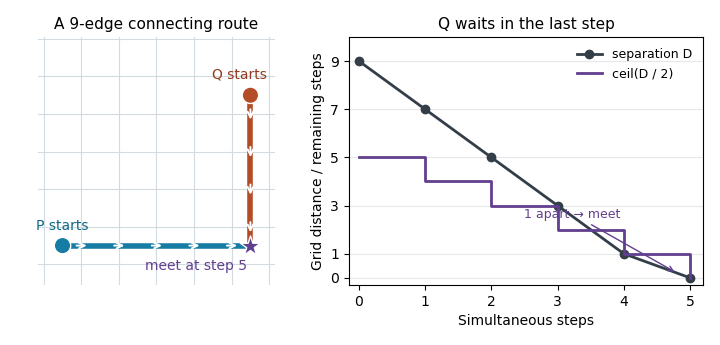
Let be their Manhattan distance. Each joint action can reduce by at most two, so use the simultaneous rendezvous distanceThis heuristic function is nonzero whenever the robots are apart. For a transition , the triangle inequality givesApplying the ceiling function yields , and . Thus is a consistent heuristic, hence an admissible heuristic.
In the unobstructed grid this estimate is exact. Along a shortest route of length , both robots approach a middle room, taking at most steps each; when is an odd integer, the robot with the shorter route waits once. That final wait prevents a crossing from being mistaken for a meeting. With obstacles the same formula remains a relaxation heuristic, though it need not be exact.

Articles by others on the same topic
There are currently no matching articles.