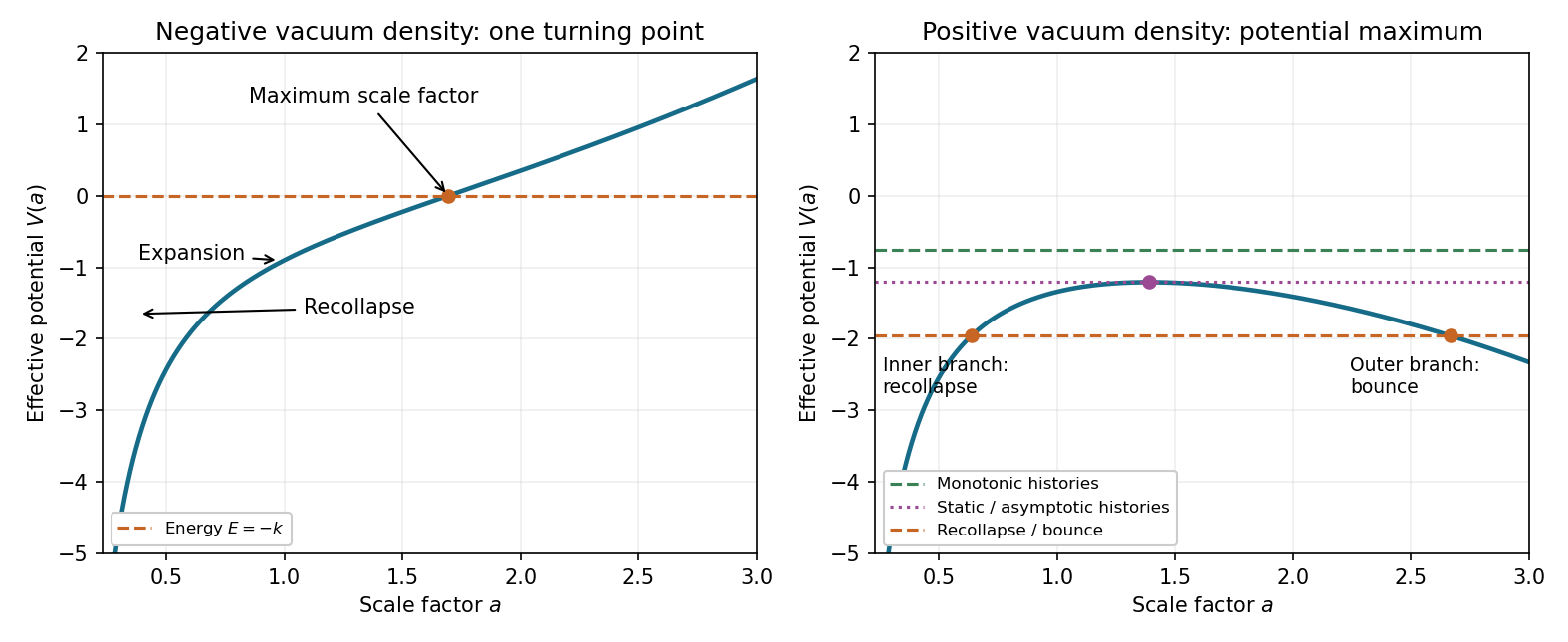
Use cosmic time here; derivatives with respect to conformal time will be used from Question 2 onward. Conservation of pressureless matter and radiation in cosmology makes and constant. DefineThe Friedmann equation is a mechanical energy equation,For nonnegative dust and radiation, at least one nonzero, tends to as and to as , whileThus every energy line meets the potential once. An expanding solution reaches this turning point and then contracts: . The Friedmann effective potential for matter, radiation and vacuum is sketched below, alongside the positive-vacuum case.

To bound the full cosmic time from the initial zero of to its final zero, use the Friedmann acceleration equation:Put maximum expansion at , with and . The forced-oscillator identity isUntil the first zero and for , the kernel is nonnegative and the bracket is nonpositive. Hence , so contraction cannot remain at positive beyond . Applying the same argument backward from maximum expansion bounds the expanding half. Therefore the negative-vacuum Friedmann lifetime bound isAt either endpoint, nonzero dust or radiation has divergent density. If both are absent, the same estimate instead bounds the open Anti-de Sitter spacetime coordinate patch; its coordinate zeros are not a finite lifetime of the maximally extended vacuum spacetime.
Set . The Friedmann effective potential for matter, radiation and vacuum now readsWith nonzero nonnegative dust or radiation, tends to at both ends. Its stationary point satisfiesEquivalently when ; the right-hand side decreases strictly, so there is exactly one stationary point. It is a maximum becauseThe energy line in the preceding sketch therefore gives five broad types of history:
- Monotonic expansion. For , the universe expands from to arbitrarily large .
- Monotonic contraction. Reversing cosmic time gives the corresponding contracting history.
- Recollapse. For , the inner allowed interval ends at : the universe expands from zero to and contracts back to zero.
- Bounce. The outer allowed interval starts at . A universe contracting from large reaches and re-expands. Here , so at the turning point.
- Static equilibrium. For , and give the Einstein static universe.
At the critical energy there are also marginal branches within the monotonic classes: expansion from zero can approach asymptotically, or expansion can start asymptotically at and proceed to infinity; contraction gives their reversals. They must not be mistaken for reaching the static solution in finite time. Indeed near the maximum,so diverges logarithmically. The static equilibrium is unstable. Since , the recollapsing, bouncing and static cases require positive spatial curvature .
For an Einstein static universe, both and vanish. The Friedmann acceleration equation givesand therefore impliesThe Friedmann equation additionally fixes the spatial curvature:Thus the acceleration balance is necessary but must be accompanied by the static energy constraint.
Without radiation, the Friedmann acceleration equation changes sign when . The cosmological redshift satisfies , and conservation of pressureless matter gives . HenceThe expanding spatially flat model is decelerating above this redshift and accelerating below it. Positive is required for such a transition; a negative value gives no accelerated expanding epoch. If the displayed redshift is negative, the transition lies in our future.
Articles by others on the same topic
There are currently no matching articles.