Let the rapidly varying phase be , so and . The dispersion law is the Hamilton-Jacobi equation . Differentiating it and following a path with group velocity gives the ray tracing equationsThe final relation is obtained by the chain rule along that path; its two spatial terms cancel.
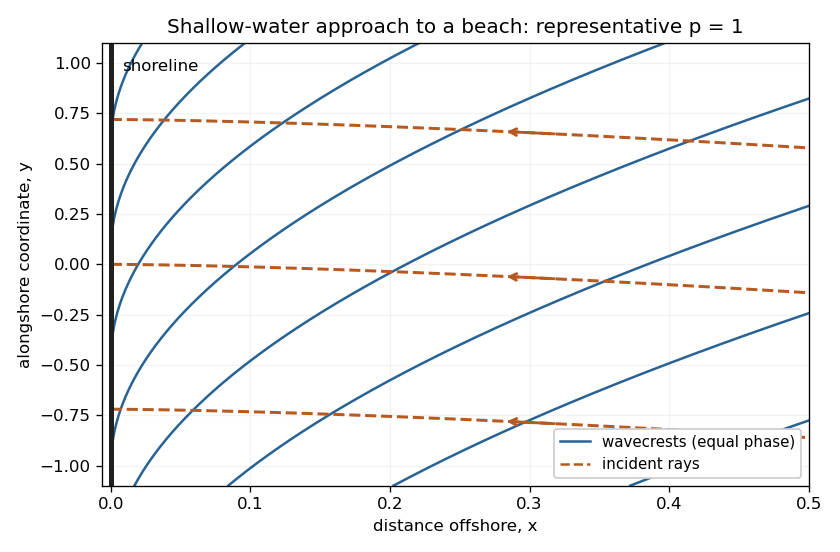
The medium is stationary and independent of , so and are conserved. For deep water far from shore, . Choose the incident branch with and ; choosing the opposite alongshore direction changes its sign. Since the dispersion relation depends on direction only through , the group-velocity component ratio is . Hence the required implicit ray equation isNear shore, and . Thus , whose integral givesThe rays approach the shoreline normally. A crest is a level set of . Its slope is , so crests become parallel to the shoreline. Their separation in the shore-normal direction is and decreases to zero. These are formal ray asymptotics; for , the slow-variation assumption eventually fails arbitrarily close to the shoreline. The sketch shows a representative shallow-water case ; it illustrates these limiting directions rather than assuming that value in the derivation.

Articles by others on the same topic
There are currently no matching articles.