Let be the coordinate basis of the defining representation of . Write for . The six form a basis of the symmetric power , with weight . A basis for the tensor product of Lie algebra representations consists of all 36 ordered tensorsThe order of the two factors matters; there is no quotient identifying their interchange.
Each weight of a representation has the form , where the nonnegative integers satisfy . Its weight multiplicity is the number of ways to split this triple into two nonnegative triples, each summing to two. The possible patterns, including every permutation, areFor example, splits as , the reverse split, or , giving multiplicity three. For , the four splits pair with and with , each in both orders. The multiplicities sum to , verifying the dimension.
The following weight diagram uses Dynkin labels ; the circle numbers give multiplicities and orange points mark the Closed dominant Weyl chamber.
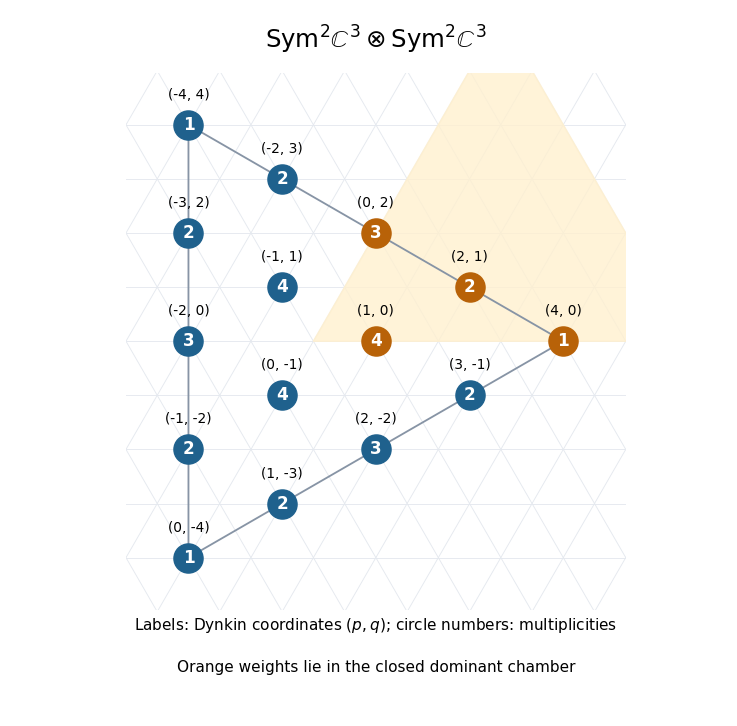

Take the simple roots and . A weight represented by is in the Closed dominant Weyl chamber exactly when . Among nonnegative triples of total four, the possibilities are . Using , their explicit weight space bases areEach listed tensor has the required summed weight, and the monomial basis from part (i) shows linear independence and exhausts all possible tensors of that weight. Thus these are all the requested bases.
Use the positive simple-root raising operators and . On the weight space of , the first maps both and to , while the second annihilates both. Consequentlyis a nonzero highest-weight vector; the remaining positive-root operator also annihilates it. Its Dynkin labels are , and the generated submodule is the irreducible highest-weight representation with that highest weight.
Put and , acting on both tensor factors. Direct calculation givesDefine the linearly independent tensorsThey both have weight , andTherefore . To prove that they exhaust this weight space, its weight differs from the highest weight by . The Poincaré-Birkhoff-Witt theorem expresses all descendants at that difference using and : the third possible operator is their difference. Hence the space has dimension at most two, and the two independent vectors already found give
Articles by others on the same topic
There are currently no matching articles.