The initial table of content was limited to the first level because it is larger than 1000 articles. There are 2117 articles in total. Expand a branch to load its children.
Use complex inner products linear in the first argument throughout. The spectral theorem for compact self-adjoint operators states that, for a compact operator on a Hilbert space, its nonzero spectral values are real eigenvalues, each of finite multiplicity, with no possible accumulation point except zero. Moreover,where are the mutually orthogonal eigenspace projections. The operator series converges in operator norm when the nonzero eigenvalues are listed in decreasing absolute value. The sum is at most countable, even if the kernel is nonseparable. Zero need not be an eigenvalue.
First prove that a nonzero compact self-adjoint operator has an eigenvalue of magnitude its norm, without assuming a spectral decomposition. Put and choose unit vectors with . Since , expansion givesCompactness of supplies a subsequence for which converges; the displayed estimate then forces itself to converge to a unit vector satisfying . The vectors and are eigenvectors for and , respectively, whenever nonzero, and they cannot both vanish. This proves the claim.
Self-adjointness gives reality of every eigenvalue and orthogonality of eigenspaces for distinct eigenvalues. An eigenspace for cannot contain an infinite orthonormal sequence: its images under would have pairwise distance , contradicting compactness. The same argument proves that there are only finitely many mutually orthogonal eigenvectors with eigenvalues of magnitude at least any given . Hence all nonzero eigenspaces together have a countable orthonormal basis, and their eigenvalues tend to zero if there are infinitely many.
Let be the orthogonal complement of the closed span of all these eigenspaces. It is invariant under . If were nonzero, the norm-attaining eigenvalue argument applied to that compact self-adjoint restriction would produce another nonzero eigenvector, a contradiction. Thus , and the converse inclusion follows from orthogonality. This establishes the asserted decomposition. On its orthogonal summands the tail of the operator series has norm equal to the supremum of the omitted eigenvalue magnitudes, proving norm convergence.
Finally, a nonzero complex number not among these eigenvalues has positive distance from their set and from zero. Inverting separately on the eigenspaces and kernel therefore gives a bounded inverse. This proves that no other nonzero spectral values occur and completes the theorem.
For a finite-rank operator , define and its trace norm bywhere are its nonzero singular values, counted with multiplicity. The finite-rank spectral theorem gives orthonormal systems with , where .
For every bounded operator ,Choose the contraction taking to and vanishing on their orthogonal complement. It attains equality, soThis formula proves the triangle inequality and absolute homogeneity. Also , so vanishing of the trace norm forces . Thus it is a norm on the vector space of finite-rank operators.
The map , where , is a bounded linear map into the dual of this normed space. Its norm is at most . Rank-one tests give the reverse inequality: and , so taking unit vectors gives .
Conversely, let be a bounded linear functional for the trace norm. The sesquilinear form satisfiesThe Riesz representation theorem gives a unique bounded operator with , and . Since every finite-rank operator is a finite sum of rank-one operators, linearity implies for every . HenceThe same identification extends to the completion, the trace-class operators. This is trace-class duality; completeness of the original finite-rank space is not required to identify its bounded dual.
For an orthonormal basis , define the Hilbert-Schmidt norm by . For a possibly uncountable basis, the nonnegative sum means the supremum over finite subsets. Parseval's identity gives, for any other orthonormal basis ,Changing the domain basis in the last expression proves basis independence. Polarization gives a basis-independent inner productwith the same first-argument linear convention. The sums converge by the Cauchy-Schwarz inequality. The operator-norm bound follows by applying Cauchy-Schwarz to the coordinates of a unit vector.
To prove completeness, let be Cauchy in this norm. The operator-norm bound gives a bounded-operator limit . For a finite subset of the basis,For large , the right side is uniformly small by the Cauchy property. Taking the supremum over shows is Hilbert-Schmidt and ; it also shows is Hilbert-Schmidt. Thus the Hilbert-Schmidt operators form a Hilbert space. Finite-rank operators are dense there: keeping finitely many basis columns makes the sum of omitted squared column norms tend to zero. The operator-norm bound then shows that every Hilbert-Schmidt operator is compact.
Now let be a strongly continuous unitary representation of the compact metric group , as is standard for a representation of a topological group. Fix and average the positive rank-one operator :The integrand is continuous in the Hilbert-Schmidt norm, so this Bochner integral exists in the complete space just proved. Normalized Haar measure and invariance show that is positive, compact and commutes with every . Moreover,the integrand is positive near the identity and every nonempty open set has positive Haar measure. Thus . A nonzero eigenspace is finite-dimensional and invariant under , by (a). Within it choose a nonzero invariant subspace of smallest dimension; it is irreducible. Its orthogonal complement is invariant because the representation is unitary, so the finite-dimensional space splits into irreducibles.
Take a maximal orthogonal family of such finite-dimensional irreducible invariant subspaces. If their closed span had a nonzero orthogonal complement, the same averaging argument on that complement would produce another member, contradicting maximality. ThereforeThis compact averaging of a rank-one operator argument does not require itself to be separable. Strong continuity is the topological representation hypothesis used in the averaging step.
A Hadamard space is a complete CAT(0) space. A useful equivalent definition, which makes the remaining assertions consequences rather than assumptions, is a complete metric space in which every pair has a midpoint , with , satisfyingThis is the nonpositive-curvature midpoint inequality. Euclidean Hilbert spaces satisfy it with equality in the parallelogram formula. The comparison argument in (c) shows that this definition gives the usual CAT(0) triangle condition.
Write . If is any other metric midpoint, apply the inequality from (a) to the chosen midpoint with . The right side is , so . Every pair has a unique midpoint.
Choose successive midpoints to define on all dyadic parameters. Consecutive points at level have distance . The triangle inequality gives for dyadic . Conversely,which gives the reverse bound. Thus equality holds. Completeness extends this map uniquely and continuously to , retaining . It is a constant-speed geodesic.
Every other geodesic has the same midpoint, and then the same successive midpoints, so agrees on all dyadic parameters. Continuity gives agreement everywhere. Hence
First extend the midpoint inequality along any constant-speed geodesic from to . If , the function is midpoint-convex by (a). Iteration proves its convexity bound for dyadic , and continuity then gives the Hadamard squared-distance inequalityApply this first to with , and then to with :Simplification givesIn a Euclidean comparison triangle, the cosine rule gives the scalar product of the two vectors from the common vertex as . The squared distance between their multiples and is exactly the right side displayed above. Taking nonnegative square roots proves the required triangle comparison, including degenerate Euclidean triangles.
Let lie in the closed ball of center and radius . On their unique geodesic, the Hadamard squared-distance inequality givesThus every point of that geodesic lies in the ball. By uniqueness there are no other geodesics to consider, so every closed ball is geodesically convex.
The Stone theorem for the circle group says that a strongly continuous unitary representation of has an orthogonal decompositionEquivalently, strongly, with mutually orthogonal projections summing strongly to the identity. Define these projections using normalized Haar measure:Haar invariance gives . Changing to in the adjoint integral proves . Applying the defining integral to gives by orthogonality of the characters . Thus are orthogonal projections, and their ranges are exactly the indicated character subspaces.
It remains to prove completeness of these subspaces. The Fejér kernel has the finite expansionIt is nonnegative, has normalized integral one, and its integral outside any fixed neighborhood of the identity tends to zero, since the denominator in the usual geometric-sum formula is bounded away from zero there. Strong continuity therefore givessplit the integral into that neighborhood, where is small, and its complement, where it is bounded by . The integral on the left is . Hence the closed span of all is . Orthogonality then gives the unweighted strong sum and the stated representation formula.
Conversely, any orthogonal decomposition indexed by the integers gives this representation; continuity follows first on finite sums and then on all vectors by the uniform unitary norm bound. With its generator isThis diagonal operator is self-adjoint and . Thus the circle theorem is the integer-spectrum version of the one-parameter theorem.
The Stone theorem for one-parameter unitary groups states that every strongly continuous unitary representation of is uniquely for a possibly unbounded self-adjoint operator . Its domain isConversely every self-adjoint gives such a group by the Borel functional calculus for a normal operator.
Prove the forward direction by putting , initially defined as the norm derivative at zero. Its domain is dense: for , the vector has derivative . Smooth approximate identities make . The group law gives and on that domain. Differentiation of preserved inner products shows that is skew-symmetric, so is symmetric.
The derivative operator is closed. Indeed, if and , integrate the orbit derivative to obtainTaking limits gives the same identity with ; dividing by at zero proves and .
Now define bounded Laplace integralsShifting the integration variable in and taking the derivative at zero shows that andHence and are both surjective. Since , this means and are surjective.
Here is why these range conditions establish self-adjointness rather than just symmetry. If , solve . Then . Thus , and symmetry gives equality with .
The permitted functional calculus now gives . It is unitary, strongly continuous by dominated convergence against spectral measures, and differentiable with derivative on . Differentiate for ; the two derivative terms cancel because both groups preserve the domain and commute with their generator. Its value is consequently the constant . Density of the domain implies on all of .
For completeness, the converse and the exact domain follow from the same calculus. If , dominated convergence applied to gives the derivative . If that norm derivative exists, Fatou's lemma applied to its squared norm gives , so . The derivative characterization also proves uniqueness. Thus
For a discrete group, one standard definition of amenability is the fixed-point property: every continuous affine action on a nonempty compact convex set in a locally convex space has a fixed point. The equivalent state formulation, which may be stated without proof here, is that there is a left-invariant invariant mean on . Equivalently, every unital left-translation-invariant star-subalgebra of admits a left-invariant state, with continuity for the supremum norm; one may equally pass to its norm closure. A state means a positive linear functional of norm one with value one on the constant function one. Restriction proves the subalgebra formulation from the full-algebra version, and taking the full algebra proves the converse. Such a mean is finitely additive on indicator functions, not necessarily countably additive.
Write on and on bounded functions. We prove equivalence of this mean condition, the Reiter condition, and existence of a Følner sequence.
Assume first that an invariant mean exists. Fix a finite set . In the real Banach space with sum norm, consider the convex setIf zero were outside its norm closure, the Hahn-Banach separation theorem would give bounded real functions and such thatfor every such . Testing point masses at showsApplying the positive invariant mean makes the left side zero and the right side at least , a contradiction. Therefore zero is in the closure: for any a finitely supported probability measure makes the sum of the translation defects over less than . Enumerate the countable group, take the first elements for and , and obtain a sequence satisfying the Reiter condition. This proves (1) implies (2).
Next assume (2). An probability measure can be approximated in norm by finitely supported probability measures, by restricting to a large finite set and renormalizing. Replacing by changes each defect by at most . Thus simultaneous small defects for finitely many translations can be achieved with finite support.
For such , set . The elementary identity for givesIf the sum of defects over is less than , some with must satisfy ; otherwise integration would contradict that strict inequality. Applying this layer-cake extraction of Følner sets to successive finite sets of translations gives nonempty finite with each relative boundary tending to zero. Hence (2) implies (3).
Conversely, normalized counting measures satisfyso (3) implies (2). Finally, from (2) define states . The dual unit ball of is weak-star compact by the Banach-Alaoglu theorem; take a convergent subnet, since this compactness need not be metrizable. Its limit is positive with , andThus is invariant, proving (2) implies (1). Together these implications establish all three equivalences. Countability is used to obtain sequences from finite tests; it is not a justification for replacing the compactness subnet by a subsequence.
Assume the invariant set is nonempty, as required for any fixed-point assertion. For , put and . Boundedness makes these finite. The parallelogram identity gives, for ,The midpoint lies in , so a minimizing sequence satisfiesSince is closed in a Hilbert space, the sequence converges to . The function is 1-Lipschitz, hence . The same midpoint inequality proves uniqueness of this minimizing center.
An affine isometry from the group maps onto itself, since its inverse also preserves . Therefore it preserves and sends its unique minimizer to another minimizer. Uniqueness givesThis proof applies to a closed bounded convex subset, the substantive meaning of the printed “convex subspace”; if it is literally a bounded vector subspace, it is just the zero subspace.
The topology needed here is the weak-star topology , meaning pointwise convergence on . With the literal weak topology , the claimed compactness is false. For example, is separable and . Its unit vectors have no weak cluster point: every coordinate functional forces a cluster point to have all coordinates zero, while the bounded functional has value one throughout. Thus the dual unit ball is not weakly compact. We prove the intended weak-star assertion in full.
Choose a countable dense set in the unit ball of . On defineEach term is at most , so the series converges. The triangle inequality is immediate, and forces equality on the dense set and hence on all of . It is therefore a metric. Convergence in this metric is equivalent to convergence on every : one direction follows from any individual term, and the other by bounding the series tail uniformly. Because , approximation of any unit vector by then gives convergence on all of . The same finite-tail and approximation argument for neighborhoods proves equality with the weak-star topology, not just agreement of its convergent sequences.
Given a sequence in this ball, diagonal selection gives a subsequence converging at every , since each coordinate lies in a compact disk. Uniform norm bounds then make it pointwise Cauchy at every . Define as the limit. Linearity passes to the limit, and , so . The subsequence converges to it in the metric. Thus this metric space is sequentially compact, hence compact, proving
Use the same intended weak-star topology as in (b), and assume . The induced operator is , so ; it is weak-star continuous because evaluation after applying is still evaluation at a vector of .
Choose and form the averagesInvariance and convexity put every in . Weak-star closedness and (b) make compact, so some subsequence converges to . Telescoping givesbecause both orbit points lie in the dual unit ball. Weak-star continuity now gives . Hence This is the weak-star fixed point theorem for an adjoint operator; it does not require to be a contraction on the entire dual space.
If “weakly closed” is interpreted literally as closed for , the result can fail. Take , let be the left shift and the right shift on . The setis a nonempty weakly closed convex subset of the unit ball: its defining coordinate inequalities and sum equality are weakly closed. It is invariant under the right shift. But a fixed vector of that shift has first coordinate zero and then every coordinate zero, so none belongs to . This supplies a counterexample to the literal topology and explains why the weak-star qualification is essential.
Put . For a unitary operator, , soThis follows from the general identity . The averaging operators have and equal the identity on . On a vector , telescoping givesThe uniform norm bound extends this convergence to the closure of the range. Thus tends to identity on and to zero on its orthogonal complement. Consequentlywhich is exactly convergence in the strong operator topology. This proves the Von Neumann mean ergodic theorem in the requested unitary case.
For a unital star-subalgebra , the Von Neumann double commutant theorem statesHere is the commutant of an operator algebra, consisting of operators commuting with every element of . The double commutant is closed in either topology: multiplication by a fixed bounded operator is continuous in both. Therefore both closures of lie in .
For the converse, let and choose finitely many vectors . In putIt is invariant under the diagonal action of and its adjoints, so its orthogonal projection commutes with that diagonal action. Consequently each matrix entry belongs to . The diagonal operator with entry therefore commutes with . Since , the tuple belongs to , and hence so does . By the definition of , one element approximates this entire tuple arbitrarily closely. This is exactly approximation in every strong-operator neighborhood of . It proves and thus both asserted equalities. In particular, is a Von Neumann algebra.
The Kaplansky density theorem strengthens the result by preserving norm bounds:It also holds for the self-adjoint and positive unit balls; the full ball can in fact be approximated in the strong-star topology, meaning strong convergence of both operators and adjoints. We prove the bound rather than merely scaling the unbounded approximants furnished by the double commutant theorem.
First put , a unital C-star algebra. Its self-adjoint part is weak-operator dense in : symmetrize any weak approximating net. For a convex subset, strong and weak operator closures agree. To see this explicitly, separation from a strong closure supplies a continuous real functional on finitely many image vectors, hence one of the form , which is also weak-operator continuous. The Hahn-Banach separation theorem would then separate the point from the weak closure as well. Thus every self-adjoint is a strong limit of self-adjoint , initially without a common norm bound.
The needed functional-calculus continuity follows directly from resolvents. The resolvent identity givesThe first factor has norm at most one, so the right side tends strongly to zero. The same holds at . Both resolvent nets are uniformly bounded, so their products converge strongly. Their scalar functions generate a self-adjoint algebra separating points of and vanishing at infinity. The Stone-Weierstrass theorem, applied to the one-point compactification, makes this algebra uniformly dense in . Uniform approximation and the functional-calculus norm bound therefore showThis proves strong continuity of functional calculus through resolvents without an unjustified uniform bound on the original .
If and , choose a real compactly supported continuous equal to the identity on and bounded in absolute value by one. Then are self-adjoint contractions and converge strongly to . For a positive contraction , choose instead equal to the identity on ; this gives positive contractions. These prove the two restricted versions for .
For an arbitrary contraction , apply the self-adjoint result in the matrix algebra toThe strong closure of is , since finitely many entries may be approximated simultaneously. The upper-right entries of the approximating self-adjoint contraction matrices belong to , satisfy , and converge strongly to . The lower-left entries are and converge strongly to . This proves the full strong-star assertion for .
Finally transfer the bounds from to the possibly nonclosed algebra . A contraction has an approximant with , so is an -contraction within of . Self-adjoint approximants are obtained by symmetrizing first. For a positive contraction, approximate by and use the positive contraction , which tends in norm to as . Combining these norm approximations with each finite-vector strong approximation proves all versions for . The reverse inclusions follow because the relevant norm bounds and the inequalities defining a positive operator are preserved by strong limits.
Interpret the involution as the adjoint for the Hilbert-space structure on . The hypotheses make a cyclic vector for an operator algebra for both and . They also make it a separating vector for each: if , then vanishes on , and similarly for . Thus the Tomita operatoris well defined, antilinear, invertible and satisfies . Define the modular operator and modular conjugation byWe calculate them explicitly to prove the commutant assertion.
The finite-dimensional structure of a unital star-algebra gives an orthogonal decompositionThis is the usual matrix-block structure: minimal central projections separate the simple summands, and each simple matrix algebra acts as its defining representation with a multiplicity space. Identify each vector block with an -by- matrix with its Hilbert-Schmidt inner product. The two algebras act by left and right multiplication. If has rank , the left orbit has dimension and the right orbit dimension . Cyclicity on both sides therefore forces . Every is square and invertible.
Right multiplication by a suitable unitary is a unitary change of this identification commuting with the left algebra. The polar decomposition of each therefore lets us assume . In one such block, for an arbitrary matrix , the Tomita operator isIts polar factors areIndeed, is an antiunitary involution and . The fact that is a positive operator is transparent in a basis diagonalizing : it multiplies the matrix unit by the positive ratio . These are therefore the unique polar factors of .
Finally, if denotes left multiplication,As ranges over the full matrix block, these are exactly its right multiplications. Applying this on every block and transporting back by the unitary identifications provesThis also establishes the required modular definitions intrinsically, independent of the chosen matrix coordinates.
Write , the group von Neumann algebra, and define right translations by . Left and right translations commute, so every commutes with every . A Von Neumann factor means that the center of is exactly .
Suppose every nonidentity conjugacy class is infinite and is central. Put . Since commutes with both regular actions and ,The action on a basis vector is , so the coefficients of are constant on conjugacy classes. A nonzero constant on an infinite class would have infinite squared sum. Thus all coefficients away from the identity vanish and .
Commutation with the right action now gives for every , because those vectors form the right orbit of . Hence and is a factor. This argument also shows that is separating for .
Conversely, if a nonidentity class is finite, thencommutes with every , since conjugation permutes . Therefore . It is not scalar: is nonzero and orthogonal to . Consequently is not a factor. We have provedThe condition is vacuous for the trivial group, whose algebra is indeed a factor.
The dense commutant orbit makes separating for , so is well defined on the dense subspace . Put . The assumed identity says that this positive vector functional is a tracial positive functional. HenceIt extends to an antiunitary involution on , with . This is the modular conjugation, and the modular operator in this tracial case is .
On the dense subspace ,Thus it acts by right multiplication and commutes with all left multiplications; . We prove the reverse inclusion rather than assuming the general Tomita commutation theorem.
Let , , and . The setis weakly compact and convex. Indeed, trace-class duality and the Banach-Alaoglu theorem make the bounded-operator ball compact in a topology stronger than the weak operator topology. The algebra is weak-operator closed, and is weakly continuous, so its image is weakly compact.
For use the polar decomposition of a bounded operator , . Both and belong to : continuous functional calculus gives , and tends strongly to . The polar decomposition is proved independently in Question 8. Since commutes with ,The trace identity givesTherefore . Meanwhilewith the supremum attained by . For the upper bound, traciality gives ; evaluating this on bounds its absolute value by .
These support inequalities imply . Otherwise the Hahn-Banach separation theorem would separate from this closed convex set by a real inner-product functional. Since is dense, its separating vector could be approximated by some , preserving strict separation, contrary to the displayed inequality. Thus for an of norm at most .
The bounded operator commutes with and sends to . It agrees with on the cyclic vector and therefore on all of , hence on . This proves , and so
For the regular representation, take . It is cyclic for the left action and for the commuting right action. On finite sums of left translations, its vector functional is the identity coefficient, so . This extends to the whole group von Neumann algebra by the bounded strong-star approximations of Question 6, taking limits of the vector functional and products. The conjugation is explicitlyConsequentlyThus the commutant in (b) is exactly the Von Neumann algebra of right regular translations, with the inverse in fixing the representation convention.
A bounded self-adjoint operator is a positive operator when for every . Equivalently its quadratic form is nonnegative. We construct its positive square root of an operator directly and prove uniqueness.
If its positive square root is zero. Otherwise set , , and . Then and is positive. It is also a contraction. Indeed, the Cauchy-Schwarz inequality for the positive form gives , and henceThe scalar binomial series has the formThe last equality follows by taking in the nonnegative series. Thereforeconverges in operator norm. Every is a positive contraction: its even powers are squares, its odd powers have form , and their norms are at most one. Each partial sum for is consequently positive, since it is at least . The limit is positive. Multiplying the absolutely convergent series and using the scalar coefficient identity gives . This construction also shows that is a norm limit of polynomials in and thus commutes with every operator commuting with .
Now suppose is another positive square root. It commutes with , hence with . ThusThe difference vanishes on the range of and on its closure. It also vanishes on its kernel: if , the fact that and are positive operators gives , and the Cauchy-Schwarz inequality for their positive forms implies . Since is self-adjoint, the orthogonal sum of its kernel and closed range is all of . Therefore , proving
The polar decomposition of a bounded operator states that every bounded is uniquelywhere is a partial isometry with initial space and final space . Its initial and final orthogonal projections are and .
Existence of was proved in (a). For every ,Thus the map is well defined and isometric on . It extends uniquely to an isometry between its closed range and . Extend it by zero on to obtain . The equation and the projection assertions follow immediately. Any other normalized partial isometry with the same product must agree on the dense range of and vanish on its orthogonal complement, giving uniqueness. The kernel normalization is essential; without it an action on the kernel could be added.
A useful consequence for a Von Neumann algebra is that the polar factors of also belong to . The polynomial construction in (a) puts in the norm-closed algebra . For , the inverse of belongs to by a convergent Neumann series, andThese operators are contractions, since . On vectors the difference from has norm at most , and on the kernel it is zero. Density and the uniform bound prove the strong limit. Strong closedness of then gives . This justifies the use of algebra-valued polar factors in Question 7(c).
A closed subspace invariant under a star-algebra is reducing, since it is invariant under every adjoint as well. Thus the orthogonal projections onto commute with . Consider the bounded intertwinerIts kernel is , so its initial polar space isIts closed range isFor the inclusion from left to right, lies in and is orthogonal to . Conversely, approximate any in the displayed by and apply . The images converge to and equal , proving the reverse inclusion after closure. The overline on the sum is present in the original PDF and is essential for potentially nonclosed sums.
Take the polar decomposition between these Hilbert spaces. Because intertwines the two actions of , its adjoint does also, so commutes with the action on . Its positive square root therefore commutes as well. The identity shows on its dense initial range that intertwines, and continuity extends this to . It is an isometry onto . ConsequentlyThe unitary here is a unitary between the indicated Hilbert space modules, not an assertion that the unclosed algebraic sum is a Hilbert space.
One implication is immediate: a unitary module equivalence makes each space an isometric copy of the entire other space, which is closed and invariant. For the converse, choose isometric intertwiners and supplied by the two embeddings. Their ranges are closed reducing subspaces. We construct the unitary, proving the Schröder-Bernstein theorem for Hilbert space modules in this setting.
Put , an isometric intertwiner of into itself, and let . The spaces , , are mutually orthogonal. For , applying the isometry relation reduces their inner product to one between and , which is zero. Henceis a closed reducing submodule of , and . Its orthogonal complement lies in , because it is orthogonal to . Combining these decompositions givesApply the inverse isometry on to obtainThe operatoris therefore an isometry onto : it is isometric on each orthogonal summand and their images are the two orthogonal summands just exhibited. Both pieces intertwine the action of , as do the projections onto and , so is a unitary module equivalence. This proves the reverse implication with no finiteness assumption on either module.
The identified involution is . It is central: it commutes with because it is a power of , and with because it is a power of . We use the normal form theorem for an amalgamated free product: the two factors embed, an alternating product of elements outside the amalgamated subgroup is nonidentity, and fixed coset representatives give a unique reduced expression. Here choose representatives in the first cyclic group and in the second.
An effective expression from the normal form theorem for an amalgamated free product iswhere each is a nonidentity representative and successive representatives come from different factors. Reduce powers by and , using these identities for negative integers too. Move the central factors left and reduce their total exponent modulo two. Whenever adjacent representatives come from one factor, multiply them, split off their contribution, and delete a resulting identity. Each such combination reduces the number of representatives, so the procedure terminates. By the normal form theorem for an amalgamated free product, the input is trivial exactly when . In particular because each factor embeds. This gives the soluble word problem in finite cyclic amalgams algorithm without merely asserting that a normal form exists.
In the specified quotient, the extra relator makes commute. Put . Its abelian group presentation givesConversely , satisfy every quotient relator in , and send to . Thus the quotient is exactly , rather than just a cyclic group of order dividing twenty. If are the exponent sums of in the input, its quotient word problem is
Use . The two defining relators say that commutes with , hence is central. The given group commutator identities giveConsequently a word collection in a two-step nilpotent group algorithm maintains an integer triple , initially . Reading , with , changes it to ; reading changes it to . Each step uses the displayed multiplication rule and reads one letter, so it terminates and produces the requested expression.
By the stipulated uniqueness, the word is trivial exactly when , which solves its word problem for a group. Moreover the commutator subgroup is : the quotient by is abelian, and itself is a commutator. It is central, so the nilpotency class is at most two. Uniqueness also implies , since and are distinct triples. Hence the exact nilpotency class is .
The primitive recursive functions are the smallest collection containing zero functions, successor , and coordinate projections, and closed under composition and primitive recursion. The recursion scheme forms from already constructed functions byConstants follow by composing successor with zero. Define addition, multiplication and exponentiation successively byAt each stage the initial and step functions are compositions of primitive recursive functions already available. Induction on gives , , and , with the recursive convention . Composition with the second projection now gives
A recursive function is a total computable function: an algorithm halts on every input and returns the specified value. Equivalently it is an everywhere-defined member of the partial recursive functions, obtained from the initial zero, successor and projection functions by composition, primitive recursion and unbounded minimization. In minimization , the sequential search must find a zero after all earlier tests have been defined; otherwise the result is undefined. The Church–Turing thesis allows the algorithmic formulation here.
A recursively enumerable set is the domain of a partial computable function. Thus an algorithm halts and accepts exactly on members of , and may run forever on nonmembers. Equivalently an algorithm lists exactly its elements, allowing repetition and allowing an empty output for the empty set. To pass from a listing to a membership semidecision, wait for the input to appear. To pass back, use dovetailing on all inputs and list each whose recognizing computation halts. This differs from a recursive set, whose zero-one characteristic function is total recursive and decides both membership and nonmembership.
The halting problem asks whether program halts on input , given effective codes for both. Suppose a total decision algorithm returned one exactly when that computation halts. Construct a program which, on input , computes and then loops forever if the answer is one, but halts if it is zero. Let be the code of . If , the specification of makes it diverge, while if the same specification makes it halt. Both alternatives contradict correctness. Therefore the halting problem is . This is a diagonal argument, not merely the observation that individual simulations can run forever.
Let . Simulating the specified program semidecides membership, or dovetailing all simulations enumerates , so is a recursively enumerable set. The same diagonal program rules out a total decision algorithm for . Thus . Encoding a pair also gives an enumerable nonrecursive set of all halting program-input pairs.
Suppose has a finite group presentation. Work in the free product and putThe freely generate a subgroup of . Indeed, in a reduced word in these conjugates, combine adjacent powers with the same index. Expanding the remaining word leaves nonzero powers of separated by nonzero powers of , so the normal form theorem for a free product makes it nonidentity. This proves the free conjugate bases in a rank-two free group fact we need.
The group homomorphism killing sends to , including . These are a free conjugate basis by the same argument with interchanged. A nonempty reduced word in the therefore has nontrivial image and cannot be trivial in . Thus extends to an isomorphism between the two rank- free groups embedded in .
Adjoin one stable letter implementing this isomorphism:We assume Britton's lemma, including its assertion that the base embeds in this HNN extension, and the factor-embedding assertion of the normal form theorem for a free product. Hence . The presentation is finite, and its relations express every generator in :Eliminating by Tietze transformations therefore gives a two-generator finite presentation with . This explicitly constructs the two-generator HNN embedding; it does not rely on an arbitrary two-generator embedding preserving finite presentability.
The Messuage lemma for groups is the following effective collapse-versus-embedding statement: from a finite group presentation for and a word , one can algorithmically write a finite presentation such that in makes trivial, whereas makes the specified copy of embed in . It can also be arranged that the image of normally generates . We use this lemma as an assumed construction, as requested; the construction of its presentation does not require deciding which case applies.
Let be a finitely presented group with insoluble word problem for a group, whose existence is allowed. Set , with of infinite order. It is finitely presented, and the normal form theorem for a free product embeds both and the infinite cyclic factor. Thus an input word from is trivial in exactly when it is trivial in , while is certainly infinite.
Apply the Messuage lemma for groups to this . If in , the constructed group is trivial and hence finite. If , it contains and is infinite. ConsequentlyA hypothetical algorithm deciding infinitude from arbitrary finite group presentations would therefore decide every input word in , a contradiction. There is no such algorithm. The infinite cyclic free factor ensures the reduction does not need an additional assumption about the size of .
The Higman embedding theorem says that a finitely generated group embeds in a finitely presented group if and only if it has a recursive presentation of a group, that is, a presentation on finitely many generators with a recursively enumerable set of relators. We use its embedding direction as an assumed theorem. The reverse direction follows by expressing subgroup generators as words in the larger group and enumerating finite products of conjugates of its relators and their inverses; comparison after free reduction enumerates all null words in the subgroup. This is the enumerable identities of finitely generated subgroups argument. The theorem does not assume that the recursively presented group's word problem for a group is decidable.
Take a recursively enumerable set that is not recursive, for example the diagonal halting set from Question 2 shifted by one. To obtain a finitely generated group with recursive presentation but undecidable word problem for a group, first define the countable Right-angled Artin groupTranslation of the indices gives an automorphism . The semidirect product with its infinite cyclic shift is generated by and has presentationTo verify this presentation, the semidirect product satisfies its relators, while the reverse map sends to ; all translated commutation relations follow by conjugation. These maps are inverse on their generators. Thus embeds in .
For , the word is trivial. For , map to the free generators of and every other to one. Every defining commutator of maps to one, since the only possible relation involving both surviving generators would have separation , which is absent. The resulting group homomorphism sends to the nontrivial reduced word . HenceThis proves the shift-invariant graph groups encode arbitrary sets construction rather than supposing that a missing relator automatically means a nontrivial word. A word algorithm for would decide , so none exists. Since is enumerable, the displayed two-generator presentation is a recursive presentation of a group. By the Higman embedding theorem, embeds in a finitely presented group . A word algorithm for , composed with substitution of the two fixed generator-image words, would solve the word problem for . Therefore .
Write and let be the quotient group homomorphism. The subgroup in the question is exactly the fiber product of groupsEvery specified generator belongs to the right-hand side, so one inclusion is immediate. For the reverse inclusion, diagonal generator pairs produce for every . Alsoso their products and inverses produce for every . If , then and , proving equality.
In particular . Constructing the input pair is effective, so a solution of the membership problem for a subgroup would solve the insoluble word problem for a group in . The subgroup membership problem is therefore undecidable. This is the Mihailova subgroup construction; its finite generating set follows from the finiteness of .
The algebraic characterization is the Boone-Higman theorem:Here need not be finitely generated or finitely presented. We prove the equivalence using the Higman embedding theorem, Britton's lemma and the normal form theorem for a free product. The original characterization is Theorem I of An algebraic characterization of groups with soluble word problem.
First suppose the embeddings exist. Choose a word in representing some fixed , and fixed words in representing the finite generators of . Given a word in those generators, one search enumerates proofs that in the finite group presentation of . A second search enumerates all finite products of conjugates in of , and all proofs that any such product equals . All these searches are effective: a proof of equality is a finite product of conjugates of defining relators, checked in the free group, and dovetailing handles the countably many candidates.
If , simplicity gives , so is such a finite product with conjugators in , which are also elements of . The second search eventually succeeds. If , every such product is trivial, so it cannot equal , but the first search succeeds. Running the two searches in parallel thus decides the word problem for a group in . This is semidecision of nonidentity in simple subgroups; no enumeration of or word algorithm for is required. The choice of the fixed word for is an existence choice of a finite string, not an algorithm for discovering from an arbitrary presentation.
Conversely suppose the word problem for a group in is soluble. We construct a recursive simple envelope by cyclic HNN extensions, keeping all effectiveness requirements explicit. Start with , where has infinite order. Reduced free product words give a word algorithm for and an algorithm testing membership in and recovering its exponent. The original null words of are decidable and therefore enumerable, so has a recursive presentation of a group.
Inductively assume has an effectively enumerable generating set, a recursive presentation, a word algorithm, and an algorithm for membership and exponent in . Form . For each nonidentity word in , introduce distinct stable letters , and introduce another letter , with relationsLet be this multiple HNN extension of . A computable enumeration of all words of , filtered by its word algorithm, indexes the nonidentity used here. Repeated representatives of the same element cause no difficulty: their stable letters are simply distinct.
Every associated subgroup in these relations is infinite cyclic. For , the words and are cyclically reduced free product words with respectively two and four syllables; their nonzero th powers have lengths and . Therefore the reduced syllable length of an input bounds the finitely many possible exponents needed to decide membership in each subgroup and find the exponent. Membership in is immediate, and membership in is inherited from . This proves effective cyclic membership in a free product, including the crucial point that the order of is never needed.
By Britton's lemma, embeds in . To solve its word problem, repeatedly find a pinch in an HNN extension using these membership algorithms, transport the known exponent across its defining isomorphism, and remove two stable letters. With no pinch left, a word retaining stable letters is nontrivial and not in the base; otherwise the base word algorithm applies. The same reduction decides whether an input lies in : if stable letters remain it does not, and if none remain use the base cyclic-membership algorithm. This verifies the inductive effectiveness claims rather than asserting that HNN extensions automatically preserve decidable word problem. Only the finitely many stable letters in the input need inspection.
The union is nontrivial, since retains infinite order under every embedding, and has an effective countable recursive presentation: enumerate each stage's relators and dovetail the enumerations. We now prove simplicity. Let contain , and take a stage with . The commutator belongs to , so its displayed conjugation forces . Conversely, in the quotient by the normal closure of , the relation for forces ; then the relation for forces every nonidentity to be one. Thus the normal closure of contains each . All newly adjoined stable letters belong to a later , so this normal closure is all of . Hence , proving that is a simple group containing .
Finally apply the explicit two-generator HNN embedding from Question 3 to an effective countable list of generators of . Its same free-conjugate-basis argument works for every finite word, and its relations are recursively enumerable, so it embeds in a two-generated recursively presented group . The Higman embedding theorem embeds in a finitely presented group . Composing the inclusions gives , completing the proof of both directions.
A subgroup is a benign subgroup when there are an embedding of into a finitely presented group and a finitely generated subgroup with . Finite generation is required of , not of itself. We use Britton's lemma, the normal form theorem for an amalgamated free product, and, for the final quotient assertion, the Higman embedding theorem.
Choose witnesses and for . The amalgamated free product embeds both witnesses and their common copy of . It is finitely presented: take their two finite presentations and add the finitely many equalities identifying the images of a finite generating set of . These equalities identify all elements of , so they present precisely the amalgam. The original intersections and are preserved by the embeddings.
Now form the finitely presented groupOnly finitely many commutation relators, one for each of the chosen subgroup generators, are needed. The subgroup is exactly the multiple HNN extension of centralizing and . To prove this claim, take a word in reduced for those associated subgroups. It remains reduced in : a -pinch with a coefficient in occurs precisely when that coefficient lies in , and an -pinch precisely when it lies in . Britton's lemma therefore prevents any extra relation, and it also embeds .
Write . The subgroup is finitely generated. If , Britton reduction must first pinch , requiring ; its value is then . The remaining can represent a base element only if , and then its value is again . Conversely every commutes with both letters. Henceso the intersection is benign.
For the join, put and , again finitely generated. The subgroup generated by in isIndeed, expanding conjugate-copy syllables as or shows that the only possible Britton reductions are exactly the identifications in the indicated amalgamations; a reduced amalgam word therefore has no additional way to become trivial.
We use this elementary consequence of amalgam normal forms: if , then inside the subgroup is and intersects exactly in . A reduced expression with a syllable cannot lie in , because multiplying it by an inverse base element still leaves a reduced nontrivial amalgam word. Apply this first to with , obtaining and . Since , apply it again in to obtain .
Each element of lies in , and each element of lies in , since the corresponding stable letter centralizes it. Thus , and . Intersecting the previous identities with givesThis proves the intersection and join of benign subgroups construction with actual finitely generated witnesses inside .
Finally let be benign, witnessed by in a finitely presented group . Choose finite generators for and express both and a finite generating set for as words in . Enumerate every word on , every word on those generators of , and every finite proof in the presentation of that their substituted words are equal. Dovetail these searches and list when such a proof is found. Exactly the words representing elements of are listed: membership has a finite expression in the generators of , and every valid equality has a finite relator proof. Since is normal, these are exactly the null words of .
Use this enumerable list as relators on the finite alphabet . Its normal closure is precisely the kernel of , so it is a recursive presentation of a group for . The Higman embedding theorem now yieldsThis is normal benign subgroup quotient embedding; no word algorithm for or membership algorithm for was assumed.
Take a basis of the defining representation of the sl2 Lie algebra, with , , , , and . A monomial basis of the symmetric power isFor the exterior power , put for . These ten elements form a basis, and their weights of a representation add:Thus the complete weight-space decomposition, with explicit bases, isThe weight diagram therefore has multiplicities at weights , respectively.
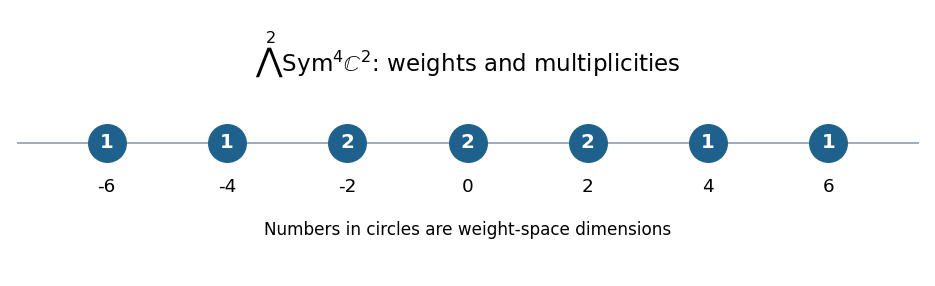
Weights and multiplicities of the exterior square of Sym4 C2
. Details. The induced raising operator and lowering operator act bySince and has weight , it generates the seven-dimensional irreducible sl2 Lie algebra module . By complete reducibility of semisimple Lie algebra representations, subtracting its weights , each of multiplicity one, from the weight diagram leaves weights once each. HenceThese are the only two irreducible isomorphism types occurring as submodules.
For the three-dimensional summand, calculate and . Thereforeis a nonzero highest-weight vector of weight . The classification of finite-dimensional sl2 representations shows that the submodule it generates is the irreducible module , of dimension three.
Apply the lowering operator to the highest-weight vector from part (ii). Since and , we obtainThis is nonzero because are distinct elements of the exterior power basis. Both have weight zero. As a consistency check, the raising operator sends this vector to , as required by the sl2 highest-weight lowering formula.
Let be the coordinate basis of the defining representation of . Write for . The six form a basis of the symmetric power , with weight . A basis for the tensor product of Lie algebra representations consists of all 36 ordered tensorsThe order of the two factors matters; there is no quotient identifying their interchange.
Each weight of a representation has the form , where the nonnegative integers satisfy . Its weight multiplicity is the number of ways to split this triple into two nonnegative triples, each summing to two. The possible patterns, including every permutation, areFor example, splits as , the reverse split, or , giving multiplicity three. For , the four splits pair with and with , each in both orders. The multiplicities sum to , verifying the dimension.
The following weight diagram uses Dynkin labels ; the circle numbers give multiplicities and orange points mark the Closed dominant Weyl chamber.
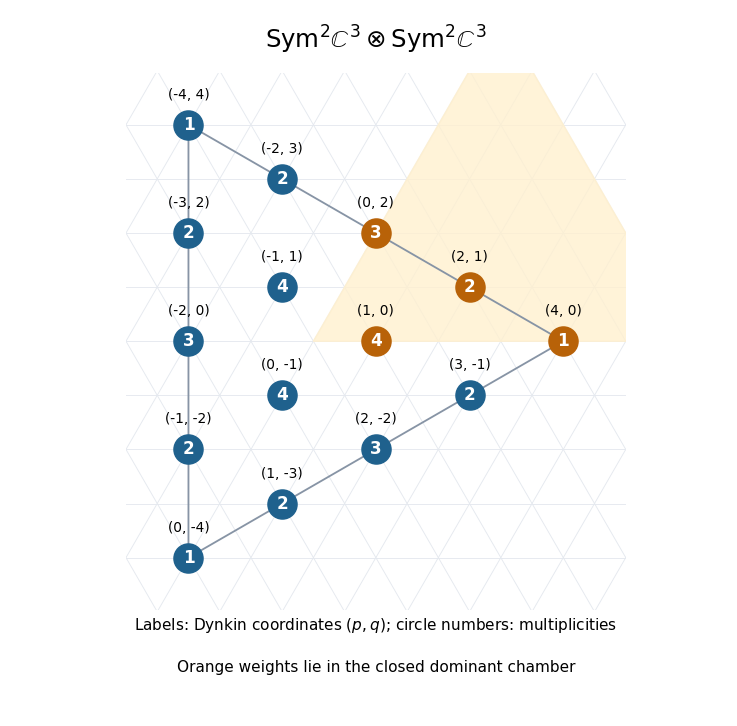


Take the simple roots and . A weight represented by is in the Closed dominant Weyl chamber exactly when . Among nonnegative triples of total four, the possibilities are . Using , their explicit weight space bases areEach listed tensor has the required summed weight, and the monomial basis from part (i) shows linear independence and exhausts all possible tensors of that weight. Thus these are all the requested bases.
Use the positive simple-root raising operators and . On the weight space of , the first maps both and to , while the second annihilates both. Consequentlyis a nonzero highest-weight vector; the remaining positive-root operator also annihilates it. Its Dynkin labels are , and the generated submodule is the irreducible highest-weight representation with that highest weight.
Put and , acting on both tensor factors. Direct calculation givesDefine the linearly independent tensorsThey both have weight , andTherefore . To prove that they exhaust this weight space, its weight differs from the highest weight by . The Poincaré-Birkhoff-Witt theorem expresses all descendants at that difference using and : the third possible operator is their difference. Hence the space has dimension at most two, and the two independent vectors already found give
In the finite-dimensional setting, let denote the irreducible highest-weight representation of highest weight , where are nonnegative integers. Thus are its Dynkin labels. The target has labels . Write the highest-weight difference in simple roots asThe dominant weight multiplicity formula for sl3 gives zero unless are nonnegative integers, and otherwise givesFor completeness, this multiplicity is an actual count. In the sl3 interlacing character formula, use top row and bottom entry ; the target diagonal exponents are . The middle row obeys andEach allowable integral gives one Gelfand–Tsetlin basis vector. Subtracting the lower bound from the upper bound gives the minimum of , which reduces to . This proves the displayed multiplicity formula in the case at hand.
Since both summands have a nonzero weight space and their dimensions at sum to three, their multiplicities must be one and two. For multiplicity one, the minimum is zero. The cases and give and ; the remaining cases or give and . Hence the full family isFor multiplicity two, the minimum is one. The cases and give and ; the remaining cases or give and . ThusThe minimum conditions exhaust all cases and each listed module has the stated multiplicity. All candidate unordered pairs are . There are infinitely many at this stage; the question imposes no upper bound on their highest weights.
Let , whose Dynkin labels are . Since is the sum of the two simple roots, its boundary distances in the dominant weight multiplicity formula for sl3 are . ConsequentlyFor a module in , this multiplicity is one in the two families having or , and two for and . For a module in , it is two in the families having or , and three for and . In each case, increasing by one increases the minimum only if neither nor already limits it.
Articles were limited to the first 100 out of 2117 total.
Articles by others on the same topic
There are currently no matching articles.