De Moivre's theorem states that for integer . For , write its polar form as , where . If and , equality of moduli gives and equality of arguments gives . Thus the distinct roots of a complex number areChanging the chosen argument of only permutes these roots. For the only root is zero. Taking and gives the cube rootsCubing any of them returns ; geometrically they are equally spaced on the circle of radius two.
Put . Squaring the two nonnegative moduli and expanding gives . Completing the square yieldsThus the locus is an Apollonius circle with center and radius . No extraneous points were introduced by squaring, because both original sides are nonnegative. Its intersections with the imaginary axis are and , useful landmarks for the sketch. It surrounds zero but does not pass through zero:
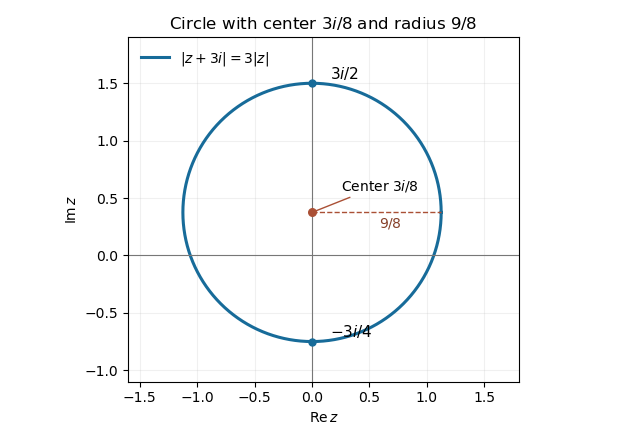
Apollonius circle centered at three eighths i with radius nine eighths and imaginary-axis intercepts minus three quarters i and three halves i
. Articles by others on the same topic
There are currently no matching articles.