Let . Uninfected births and density limitation give , while horizontal transmission transfers individuals to the infected class at rate . Infected births are infected by vertical transmission, and their net demographic growth is . ConsequentlyThese give the stated equations. Adding them gives , displaying the additional mortality due to disease.
At the disease-free equilibrium point , the linearization of a dynamical system of the infected equation is . Thus exponential invasion occurs exactly when . At equality there is no positive linear growth rate; the nonlinear boundary dynamics described below do not give sustained invasion.
Assume first and . The nonnegative equilibrium points areand, when both coordinates are nonnegative,The Jacobian matrix at has eigenvalues , so cannot attract an initially positive uninfected population. At the eigenvalues are . At , for , they are and . At an interior , the equilibrium equations reduce the Jacobian matrix toThus the coexistence equilibrium is asymptotically stable precisely when .
For positive initial populations these local results identify the global outcome. The relation bounds all trajectories. With the Dulac function , the divergence of the rescaled vector field is , excluding interior periodic orbits. Boundary saddles cannot attract an interior trajectory except at the merging thresholds. The resulting long-term outcomes areAt , merges into ; at , it merges into . The merged equilibria still attract interior trajectories, but convergence along the zero-eigenvalue direction is algebraic. For example at , put , . The local centre manifold has , and . At the other threshold, using , , gives and .
The invariant axes also matter: leads to whenever ; leads to for and to extinction for . At , coincides with . If , disease declines for and any initially positive tends to . If also , every point is an equilibrium and the initial population proportions are preserved.
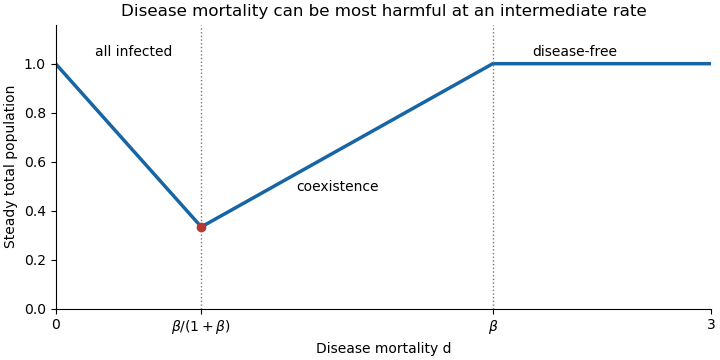
For and positive initial populations, summing the coordinates of the attracting equilibrium point gives the steady total populationIts minimum is at . Small mortality leaves a fully infected population with only modest demographic loss. Raising mortality first reduces that population; after the threshold it suppresses infection sufficiently for the uninfected population to recover. Beyond the invasion threshold the disease cannot persist.
Articles by others on the same topic
There are currently no matching articles.