A reduced positive definite binary quadratic form satisfies , with when or . These inequalities select representatives under proper equivalence of binary quadratic forms; the changes of variables have integer entries and determinant .
For the first binary quadratic form, put , . For the second, put , . Both changes preserve coprime integers, and giveProper representation means using . For , gives a value greater than , while forces . For , the smallest values are and . For , again gives only primitively; gives , and gives at least . Thus the three smallest properly represented values areFor example the original variables can be chosen as for , and for .
Every positive definite binary quadratic form can be reduced: integer shears first make , and interchanging the variables when decreases the positive leading coefficient, so this procedure terminates. To enumerate the reduced forms of discriminant minus forty-four, reduction gives , hence . Checking with the reduced inequalities gives exactlyThe second represents only even integers. The last two have the same represented values, by . The first and third are the reduced versions of and . Therefore every represented odd integer occurs in at least one of , whether or not its original representation was primitive.
Let be the closure of the polynomials in for the uniform norm. It is a closed algebra, since products of uniformly convergent sequences converge uniformly on the compact set .
Choose a point with . The uniformly convergent geometric seriesshows that this reciprocal belongs to . Join to by a continuous path in . Its image is compact and disjoint from , so their distance is positive. Partition the path into finitely many steps shorter than .
Suppose and , with on the path. Thenconverges uniformly on , since . Every partial sum belongs to , by its algebra property, and so does the limit. Working backwards along the partition transfers the pole from to . Thus : a polynomial exists withThis pole-moving polynomial approximation is the elementary mechanism behind the polynomial Runge theorem.
Order the prescribed lengths as . Construct a prefix code on the binary tree. At depth , previously assigned codewords exclude of the vertices. The Kraft inequality impliesso an available vertex can be assigned to the next symbol. None of the assigned words is a prefix of another. Reading each word up to the next assigned vertex gives unique decoding, so this constructs the required uniquely decodable code.
For completeness the same length inequality is necessary even for a uniquely decodable code which is not a prefix code. Write and . For successive symbols, distinct symbol strings have distinct concatenated codewords. At total length there are at most such strings. ThereforeTaking th roots and letting gives . This is the McMillan inequality.
Set . The relative entropy inequality givesHere Shannon entropy uses base , with . The relative entropy is nonnegative, with equality precisely when the two probability distributions coincide; this follows from . Consequently equality holds exactly whenIn particular all alphabet symbols must have positive probability for equality with finite prescribed lengths.
The command fits the simple linear regressionusing ordinary least squares. The fitted conditional mean is a straight line in time. The regression residuals are mainly positive at the beginning and end and negative in the middle, so the mean function needs curvature.
A direct improvement is polynomial regression of degree two:The nested-model F-test tests against a nonzero quadratic coefficient. If measurements were used, its statistic isA small reported -value supports the quadratic term. The new regression residuals should then be checked for remaining systematic structure, changing variance and temporal dependence, because the F-test assumes independent errors of common variance. Radioactive decay also motivates an exponential mean, but the displayed curvature already justifies this simple nested comparison.
fit2 <- lm(Counts ~ Time + I(Time^2), data = geiger)
anova(fit1, fit2)There are seeds and their germinating proportion is , giving the survival-augmented Ricker map with zero survival. A positive equilibrium point satisfies , soIt exists when and is strictly linearly stable when . Thus the usual strict linear-stability interval is .
With winter survival, surviving adults and new plants add:Writing , the linearization of a dynamical system has multiplier . Hence the strict linear-stability interval becomesIts lower endpoint is less than . Its upper endpoint exceeds : for , is decreasing in and equals at .
The nonlinear stability at the Ricker flip threshold needs a separate check. The upper endpoints have multiplier , so the strict linear test alone does not decide stability there. They are in fact locally asymptotically stable, with algebraic rather than geometric convergence. To see this, put at . The local map isand its second iterate is . The cubic coefficient in parentheses is positive for every . Thus, if “stable” includes nonlinear endpoint stability, the upper inequalities can be replaced by ; the lower endpoints have no positive equilibrium.
Use equal small excisions on the two sides of each real pole. The Cauchy principal value isFor , close the complex contour in the upper half-plane and indent above , leaving the poles outside the contour. The residue theorem and the vanishing of the large semicircle integral give the principal-value integral as times the sum of the two real-pole residues. Each clockwise indentation contributes times its residue. Sincethe sum is . Taking the real part yields the answerThe decay on the large arc follows directly from and the quadratic denominator.
The Hamiltonian is . On a regular family of closed phase-space trajectories, action-angle variables are canonical coordinates in which is periodic modulo and . Hamilton's equations then give and .
The action variable isThe orientation is that of the motion, so the integral is the positive enclosed phase-space area divided by .
A constant-energy phase-space trajectory of the harmonic oscillator is the ellipseIts area is . Thus the action and slow energy change areThe action variable is an adiabatic invariant when , with staying positive. Averaging over many short oscillations therefore keeps approximately fixed; an increase in frequency increases the energy in the same proportion.
The Flatness problem is the extreme closeness to spatial flatness required in the early universe if ordinary decelerating expansion is to produce the observed near-flat universe. From the Friedmann equation, with and curvature constant ,During decelerating expansion grows. The Friedmann acceleration equation gives . Thus makes an expanding universe accelerate, increases and suppresses : this is the inflationary solution of the flatness problem.
The slow-roll approximation neglects compared with and compared with . For the positive-field branch, taking ,Integrating the field equation and gives the slow-roll solutionThe potential slow-roll parameters are . They cease to be small when is of order in these units; the customary endpoint is . Equating the approximate kinetic and potential energies instead gives , another order-one indicator, not a precise endpoint of an approximation that is already failing.
For a simple continued fraction, defineMultiplying the matrices givesTheir determinants also give . If the infinite tail is , the same formula impliesThe denominators of these continued fraction convergents tend to infinity, since . Hence they converge to .
The square-root algorithm for the periodic continued fraction of a quadratic irrational, using , and , givesThe first four continued fraction convergents are . Direct substitution gives positive solutions to the requested Pell-type equations:
Work in the complete Banach space with the uniform norm. Each is closed. Indeed if uniformly and witnesses membership in , pass to a subsequence with . For each , uniform convergence and continuity giveThus witnesses membership for .
Each has empty interior. Approximate an arbitrary uniformly by a piecewise-linear function on a uniform mesh, and let bound the absolute slopes of . On a sufficiently fine uniform refinement of mesh , add a triangular oscillation of fixed small amplitude , alternating between and at successive vertices. The resulting function is still as close to as desired, and every segment has absolute slope at least . For any , choose the farther endpoint of a segment containing . Its distance is between and , sowhen is small. Therefore .
By the Baire category theorem, the complement of is dense and nonempty. If the local limsup in the question were finite at some , its nearby differences would satisfy a finite bound. The remaining differences, with , are bounded by . Combining the bounds would put in some , a contradiction. Hence the required limsup is infinite at every point, including one-sided approaches at the endpoints.
True. Apply the preceding Baire category theorem argument simultaneously to , . The union of all the corresponding is still a countable union of closed sets with empty interior, so its complement is nonempty. For any , choose with . For ,The right-hand limsup is infinite at every , proving the assertion for every positive exponent.
Let . Uninfected births and density limitation give , while horizontal transmission transfers individuals to the infected class at rate . Infected births are infected by vertical transmission, and their net demographic growth is . ConsequentlyThese give the stated equations. Adding them gives , displaying the additional mortality due to disease.
At the disease-free equilibrium point , the linearization of a dynamical system of the infected equation is . Thus exponential invasion occurs exactly when . At equality there is no positive linear growth rate; the nonlinear boundary dynamics described below do not give sustained invasion.
Assume first and . The nonnegative equilibrium points areand, when both coordinates are nonnegative,The Jacobian matrix at has eigenvalues , so cannot attract an initially positive uninfected population. At the eigenvalues are . At , for , they are and . At an interior , the equilibrium equations reduce the Jacobian matrix toThus the coexistence equilibrium is asymptotically stable precisely when .
For positive initial populations these local results identify the global outcome. The relation bounds all trajectories. With the Dulac function , the divergence of the rescaled vector field is , excluding interior periodic orbits. Boundary saddles cannot attract an interior trajectory except at the merging thresholds. The resulting long-term outcomes areAt , merges into ; at , it merges into . The merged equilibria still attract interior trajectories, but convergence along the zero-eigenvalue direction is algebraic. For example at , put , . The local centre manifold has , and . At the other threshold, using , , gives and .
The invariant axes also matter: leads to whenever ; leads to for and to extinction for . At , coincides with . If , disease declines for and any initially positive tends to . If also , every point is an equilibrium and the initial population proportions are preserved.
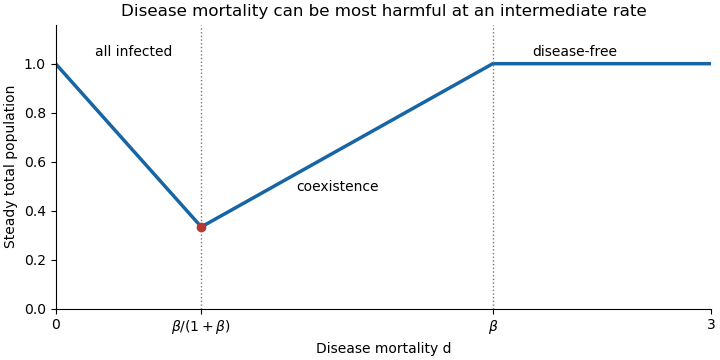
For and positive initial populations, summing the coordinates of the attracting equilibrium point gives the steady total populationIts minimum is at . Small mortality leaves a fully infected population with only modest demographic loss. Raising mortality first reduces that population; after the threshold it suppresses infection sufficiently for the uninfected population to recover. Beyond the invasion threshold the disease cannot persist.
The terms in the Boltzmann equation respectively describe dilution by expansion, pair annihilation, and pair production from the thermal bath. The annihilation rate per volume is ; is the corresponding production rate. Antiparticles satisfy the same equation with replaced by . Subtracting givesInitial particle-antiparticle symmetry therefore persists. Detailed balance in the thermal bath gives , soDuring radiation domination, with fixed effective relativistic degrees of freedom, and . Thus and the dilution terms cancel in :After cosmological particle freeze-out, neglect . For constant the exact reduced solution isFor the post-freeze-out relic abundance, the familiar answer additionally neglects compared with . It is an approximation, not an exact consequence of the post-freeze-out equation without initial data. A smaller annihilation cross-section means smaller , earlier decoupling and less depletion, so weakly interacting particles normally have a larger relic abundance.
Zorn lemma states that a nonempty partially ordered set in which every chain in a partial order has an upper bound has a maximal element. Here is a proof from the axiom of choice and Hartogs theorem.
Suppose there is no maximal element. Every chain has a strict upper bound: choose an upper bound and then an element strictly greater than . The family of sets of strict upper bounds is a set of nonempty subsets of the underlying set . The axiom of choice is used here to choose, simultaneously for every chain , one strict upper bound .
By Hartogs theorem there is an ordinal admitting no injection into . Transfinite recursion defines for byAt each stage the previous elements form a chain, and is strictly above every one of them. Hence is an injection , a contradiction. Therefore a maximal element exists.
Replace the strict partial order by its reflexive closure . Partially order all partial orders on extending by inclusion. A chain has an upper bound given by its union: transitivity and antisymmetry each concern finitely many pairs, which all lie in one member of the chain. By Zorn lemma there is a maximal extension .
If are incomparable under , defineThis adds . It is transitive: composing an old pair with a new one stays in the added set; composing two new pairs would require , which is impossible. It is antisymmetric: an added pair and a reverse old pair would again imply , and two reverse added pairs would do the same. Thus is a larger partial order, contradicting maximality. Therefore is total, and removing its diagonal gives a total order extending the original strict order.
A well-founded relation has a minimal element in every nonempty subset; with the axiom of choice this is equivalent to having no infinite strictly descending sequence. If an extension is a well-order, its least element in any nonempty subset is minimal for the original relation, so the original order must be well-founded.
However not every total extension need be a well-order. Take the empty strict order on , which is well-founded. Its extension defined by if in the usual order is total and has no least element.
A Hamilton cycle is a cycle graph which visits every vertex of a finite graph exactly once, apart from returning to its starting vertex. A graph is Hamiltonian when it contains such a cycle.
Let be a longest path. Every neighbour of either endpoint lies on it. Among the indices , mark those with an edge and those with an edge. Their total number isso some index has both marks. The edges at that index close the path into the cycle graphThe minimum-degree hypothesis also forces the graph to be a connected graph: each component would otherwise have at least vertices. If , an edge from this cycle to an outside vertex would give a longer path by opening the cycle at its incident vertex. Hence , proving the Dirac theorem and Hamiltonicity.
The bound is sharp. For , take two disjoint copies of , with minimum degree . For , take two copies of sharing exactly one vertex. The minimum degree is , but the shared vertex is a cut vertex, which no Hamiltonian graph can have. Both constructions have
Add missing cross-edges to a hypothetical non-Hamiltonian balanced bipartite graph until it is maximal with that property. The complete bipartite graph is Hamiltonian for , so a missing cross-edge remains. Adding it creates a Hamilton cycle, and removing it gives a Hamilton pathFor each , consider the conditions and . Since , they hold together for some . Following the path from to , crossing to , following the remaining path backwards to , and crossing back to gives a Hamilton cycle already in the original maximal graph. This contradiction proves the stated Hamiltonicity criterion.
For , two disjoint copies of have vertices in each class and minimum degree . For , the disjoint union has vertices in each class and minimum degree . Both are disconnected and hence non-Hamiltonian. Thus the sharp counterexamples have for every .
For a finite group , subgroups , and a complex group representation of , the Mackey restriction formula isChoose one representative of each double coset . The conjugate subgroup representation is a representation of on the same vector space, with . Restriction of a representation keeps the vector space and restricts the acting subgroup. induced representation is , and analogously for each subgroup of . The displayed isomorphism is an isomorphism of -representations. These definitions specify every summand and its subgroup.
If is -transitive, it is transitive by extending one-element tuples to -tuples. Apply -transitivity to tuples beginning with to see that the stabilizer subgroup is -transitive on the remaining elements.
Conversely, given two ordered -tuples of distinct elements, transitivity first supplies carrying their first entries to each other. Conjugating the given stabilizer hypothesis shows that the stabilizer of the target first entry is -transitive. An element of that stabilizer then maps the remaining entries of the image tuple to their targets. Composing the two elements proves -transitivity. For , the condition on zero-tuples is vacuous.
For finite nonempty , let be the basis vectors of the permutation representation. PutThe line is fixed by , and is the augmentation subrepresentation of a permutation representation. Since in , they have zero intersection and their dimensions add to . Hence .
The printed formulation does not explicitly require to be finite. For an infinite nonempty -set, interpret as finite-support vectors. Choose one finite orbit (all orbits are finite because is finite), replace by , and use the same augmentation kernel. This again splits off a trivial summand. The nonempty-set assumption is needed; the empty permutation module contains no trivial summand.
As printed, the equivalence needs a transitivity hypothesis. A group acting trivially on two points has , so is one-dimensional and irreducible, although the action is not even transitive.
Here is the intended result for a transitive action. The set is then finite, and, for a point stabilizer , its permutation character is . Frobenius reciprocity givesThe last equality follows because an -fixed vector has constant coefficients on each orbit. There is exactly one trivial constituent, since the action is transitive. Therefore, writing for the character of ,By character orthogonality, is irreducible exactly when this equals . One stabilizer orbit is , so this happens exactly when is transitive on , equivalently when is two-transitive. Moreover is not trivial, since a transitive action has only one independent fixed vector in the whole permutation module.
The complete correction without assuming transitivity is also precise: is irreducible exactly for a two-transitive action or the exceptional action on two fixed points. Indeed for a finite set with orbits, the fixed subspace of has dimension . If and is irreducible, must itself be a one-dimensional trivial module, forcing and . If is infinite, is infinite-dimensional and cannot be irreducible: any nonzero vector generates a submodule of dimension at most .
If is an irreducible polynomial, any two roots have the same minimal polynomial. Thus the map carrying to is a field embedding. The extension theorem for field embeddings extends it to an embedding of the splitting field into an algebraic closure. Since is normal, its image is , so it is an element of the Galois group.
Conversely, factor into irreducible factors over . An automorphism preserves the vanishing of each factor, so it cannot send a root of one factor to a root of another. Since there are no repeated roots, different factors have disjoint root sets. Transitivity on all roots therefore forces a single irreducible factor. This proves the equivalence.
Label the distinct roots . Define by . Composition respects this rule, so it is a group homomorphism. If its image permutation is the identity, fixes all the roots; they generate , so is the identity. Thus is injective.
For , label the roots . The splitting field is and its nontrivial automorphism swaps precisely roots . Hence .
For , Eisenstein criterion gives irreducibility. The real root generates a degree-three real field. Adjoining a primitive cube root of unity gives a further extension of degree two, since it is nonreal and satisfies . Thus its splitting field has degree . In characteristic zero this is a Galois extension, so its Galois group has order . The injection into is therefore an isomorphism.
Let and let be a primitive fifth root of unity. Then . The field degrees and both divide , while adjoining the two generators gives . Consequently .
The cyclotomic field is Galois with cyclic group of order . The Fundamental theorem of Galois theory gives a normal subgroupThus and the chain has abelian successive quotients, proving that is a solvable group. One may refine it by inserting the inverse image of the order-two subgroup of , giving cyclic factors .
A simplicial approximation to is a simplicial map satisfying the open-star conditionfor every vertex . Equivalently, whenever lies in the interior of a simplex of , lies in that simplex. In particular and are joined by the simplexwise straight-line homotopy.
The Simplicial approximation theorem says that, for finite , every continuous has such an approximation after sufficiently many barycentric subdivisions of . For general complexes one uses a subdivision adapted to the open-star cover; a single uniform number of barycentric subdivisions is the compact-domain version.
Given triangulations , , choose a simplicial approximation on a suitable subdivision . Its chain map sends an oriented simplex to , with repeated-vertex simplices sent to zero. It commutes with the boundary operator and induces . Compose this with the subdivision isomorphism and the triangulation identifications to define .
For , a positively oriented fundamental loop winds times around the target circle. With integer coefficients,All higher homology groups vanish. The result can also be read from a subdivision into copies of a target fundamental cycle.
The Baire category theorem in the needed version states that a nonempty complete metric space cannot be a countable union of closed sets with empty interior. To prove it, suppose are such sets and start with a nonempty open set . Inductively choose closed balls of positive radius at most , with and . This is possible because each complement is open and dense. The centres form a Cauchy sequence; completeness supplies a limit in every closed ball. It lies in and outside every , proving the theorem.
Here the sequence spaces are over the real scalars, as required by the Euclidean-plane assertion. Suppose an isometry existed. On the compact complete space , the setsare closed. They cover that space: for a nonzero sequence in , the supremum norm is attained at a coordinate; for every coordinate works. By the Baire category theorem, one contains a product of open arcs. Shrink the arcs to be disjoint. The real coordinate difference is then continuous and nonzero, so its sign is constant on the product. Thus the chord distance has the separated formIn particular its alternating sum on every four-point rectangle is zero. Parametrize the arcs by angles with . Their chord distance is , whose mixed derivative isThe zero rectangle identity would force this mixed derivative to vanish, a contradiction. Therefore no such isometry exists.
For a real vector , list its signed sums over all choices , followed by infinitely many zero coordinates:This is linear, has finite support and lies in . Choosing the signs of the components gives . Thus , the required linear isometry.
On the complex torus , the Weierstrass elliptic function is a degree-two map to the Riemann sphere, and its fibres are the pairs , with coalescence at the four branch points. An even elliptic function is constant on every fibre, so away from those branch points it descends to a meromorphic function of .
The descent also holds at a branch point. At a half-period , evenness and periodicity give , so its local Laurent series uses only even powers of . Also is a local coordinate proportional to . At , use instead. Thus extends meromorphically across every branch point and infinity. Every meromorphic function on the Riemann sphere is a rational function, proving .
For a nonconstant rational function in coprime form, : a generic equation has that many roots on the sphere. Degrees of holomorphic maps multiply under composition. Hence the degree isConstant functions have degree zero. Degree two therefore occurs exactly when is a Möbius transformation:Conversely every such function is even, elliptic and of degree two.
For with vanishing ideal , the Zariski tangent space at isIt is the kernel of the Jacobian matrix of generators for the ideal, or intrinsically the dual of . A point is a singular point of an algebraic variety when this tangent dimension exceeds the local dimension of the variety; otherwise it is nonsingular. For an irreducible affine variety the local dimension at a closed point equals its dimension.
Write . A projective hypersurface singularity must have and all four first partial derivatives zero. If all coordinates were nonzero, writeOn , differentiation gives , a contradiction. Thus some coordinate is zero; by symmetry take . The surface equation gives , so a second coordinate is zero, say . Then , so a third coordinate is zero. The remaining four projective possibilities indeed have every first derivative zero. Therefore all singular points areOver the usual characteristic-zero ground field, each is an ordinary double point: near , the affine equation has nondegenerate quadratic part , and symmetry treats the others.
Use the two charts of the blowup of the affine plane at the origin. In the chart , the total transform isso the proper transform has equation . It misses the exceptional divisor and is smooth, since its derivative with respect to is there.
In the chart , the total transform is , so the proper transform isIts equation has partial derivative with respect to , so it is smooth even at its unique intersection with the exceptional divisor. The two chart descriptions agree on their overlap. Thus one blowup makes the cusp nonsingular, although it is tangent to the exceptional divisor there.
A parametrization is . It gives a homeomorphism , with inverse obtained from the height and angular position. Its first fundamental form isFor a surface of revolution with radius , the Gaussian curvature is . Thus . The waist is a closed geodesic: vanishes there, and can be parametrized at constant speed.
For the uniqueness of a closed geodesic on a negatively curved cylinder, use Gauss-Bonnet theorem with piecewise geodesic boundary:A geodesic disk with smooth boundary would require curvature integral . A disk bounded by a geodesic monogon would require , and a geodesic bigon would require . All are impossible when .
Here is the topological reduction needed to apply this observation without assuming simplicity. Lift a closed geodesic to the universal covering plane of the cylinder. A self-intersection of its lift supplies an innermost monogon by the Jordan curve theorem, so the lift is embedded. A contractible closed geodesic would similarly supply a geodesic disk or monogon, so its winding number is nonzero. Its lift is consequently a proper line, invariant under a nonzero power of the deck translation. Two distinct translates of that line cannot intersect: periodicity would repeat an intersection, and innermost arcs between intersections would bound a bigon. The disjoint translates are ordered transversely, with the deck translation preserving that order. A finite cyclic permutation of this ordered family is impossible, so the lift is invariant under the primitive deck translation too. Thus the original geodesic has a simple image and is at most a repeated traversal of it.
Likewise two distinct simple essential closed geodesics cannot intersect: their periodic lifts would produce a bigon. If disjoint, the Jordan curve theorem on the cylinder says they bound a compact annulus. Its two boundaries have zero geodesic curvature and , so Gauss-Bonnet gives , again impossible. Therefore there is at most one closed geodesic image. Reparametrizations, reversed orientation and multiple traversals are understood to describe the same geometric geodesic.
A measure-preserving transformation is a measurable map satisfying for every measurable . An invariant set satisfies (or equality modulo null sets, in the measure-theoretic convention).
Preimages preserve complements and countable unions. Therefore the whole space is invariant, the complement of an invariant set is invariant, and a countable union of invariant sets is invariant. Thus the invariant sets form a -algebra. The same proof works modulo null sets because a countable union of null exceptional sets is null.
For a Borel set , the two inverse branches of the doubling map give the disjoint setsEach has half the Lebesgue measure of , by translation and scaling invariance. Hence . The piecewise affine map is Borel measurable, so it is a measure-preserving transformation. The printed one-dimensional “baker's map” is this doubling map.
For a probability distribution on , take the canonical sample space , the product of the Borel -algebras, and the product measure . The coordinate functions have joint cylinder probabilitiesThe Kolmogorov extension theorem supplies this measure from the consistent finite-dimensional distributions, and uniqueness follows from the generating cylinder sets. Thus the coordinates are independent and identically distributed; the same construction works for a given standard Borel state space.
The one-sided Bernoulli shift is . It is measurable and preserves all cylinder probabilities. The uniqueness theorem for probability measures extends this to the product -algebra, proving measure preservation.
To prove ergodicity, let be invariant modulo null sets and approximate it in probability by an event depending on only the first coordinates, with . Such approximations follow from the fact that finite-coordinate cylinder events generate the product -algebra. For , independence gives . Invariance and measure preservation giveAlso . Letting proves , so . This is exactly ergodicity.
In an interval of length , condition on the Poisson process count . Independently marking its points gives . The joint probability generating function of kept and discarded counts isIt factors into the generating functions of independent Poisson variables of means and . The same calculation applies to any interval, and counts and marks in disjoint intervals are independent. Hence is a Poisson process of intensity , and and are independent. This is the Poisson thinning theorem.
The Poisson thinning theorem, or its multinomial marking version, makes the bin counts at time independent Poisson variables with mean . Independence is more than is needed for the following union bound. Fix and put . ThenSincethe logarithm of the upper bound is . Thus . The estimate handles the noninteger threshold directly, since the supplied Poisson tail bound holds for real .
For the proposed root criterion, fix . Convergence in probability at the two points givesOn this event the intermediate value theorem gives a zero between the two points. Since the zero is unique, it is . Therefore , without needing uniform convergence of .
For independent observations, the log-likelihood has derivative and negative second derivative . Its unique maximizer is . Apply the criterion to : the strong law of large numbers gives the limit , with the required signs. Hence the maximum-likelihood estimator is consistent.
In the bivariate model the log-likelihood, apart from constants, isMinimizing each squared pair gives . Maximizing the resulting likelihood in the variance givesEach difference is , independently of the others and independently of its unknown mean parameter. Thus the strong law of large numbers gives in probability, not . This is the Neyman-Scott incidental parameter problem: the number of nuisance means grows with the sample size, but each mean is estimated from only two observations. The usual fixed-dimensional likelihood consistency theory therefore does not apply. The corrected estimator is consistent.
Assume nonnegative wealth and rewards, and initially . Set , and let take the values with equal probability conditional on not being caught. For the retirement threshold with multiplicative capture risk, the dynamic programming equation is the displayed maximum; capture contributes zero. Write .
Inductively, if , all future successful wealth levels also lie above , so . Continuing in town is then worth , and retirement is optimal. If , choose with . Continuing for just one night and then retiring is worth , so immediate retirement cannot be optimal for any . This proves an optimal policy continues exactly when , with retirement chosen at the threshold.
Now suppose and . Since also , town has the larger threshold, so . The functions are nondecreasing in wealth and in , and ; these properties follow by induction from the dynamic programming equation.
Prove by induction on the remaining horizon that town is never optimal when continuation is worthwhile. For , the difference between the town values is . If , monotonicity giveswith strictness because the first bracket is positive under the hypotheses.
For , first suppose . The second town's successful large-reward branch retires, so its value is . Town is worth at least . Their difference is at leastIf instead , all states after either first-night reward remain below the threshold. By induction a policy starting in town then chooses town on its second night. Its value isInterchanging the first two towns gives exactly the same value, because capture probabilities multiply and independent rewards add. After starting in town , however, the induction hypothesis says town is strictly inferior on the second night at every possible surviving wealth level. Replacing that second choice by the optimal one strictly improves the value. This proves town dominates throughout every finite horizon.
If a town has and , its threshold is interpreted as infinity and retirement is not optimal before the horizon ends. A town with offers no gain; the natural threshold is zero. These conventions handle the degenerate capture probabilities rather than dividing by zero.
Let initial wealth be and let be the number of units held of risky asset ; the bank investment is . Put . Terminal wealth is normal, with mean and variance . The expectation of the exponential utility isFor and positive definite covariance matrix , maximizing this is equivalent to maximizing the certainty equivalent . Thus the optimal investment isAll investors have proportional risky holdings. A market portfolio can therefore be represented by , with any positive scalar multiple giving the same return. Suppose its initial value is positive and . Set . For returns and ,The beta of an asset is its covariance with the market return divided by the market variance. ConsequentlyThis is the capital asset pricing model. Since , dividing the excess-return identity by gives the Sharpe ratio identityThese ratio statements require nonzero variances and nonzero initial portfolio value. If is singular and is in its range, replace by its pseudoinverse; any kernel holding can be added to an optimizer. If has a component in the kernel, it gives a deterministic excess gain that can be scaled without bound, so there is no finite optimal portfolio. If , there is no distinguished risky market portfolio and its beta ratios are undefined.
Articles were limited to the first 100 out of 156 total.
Articles by others on the same topic
There are currently no matching articles.