Linearizing the shallow water equations about depth at rest gives wave speed . Replacing by in the nonlinear equations yields and . Direct addition and subtraction giveThus the Riemann invariants are constant on the characteristics with speeds . In this problem .
Before a signal reaches the wall, the portion to the right of the leading characteristic is unaffected. Its initial depth and velocity persist, giving for .
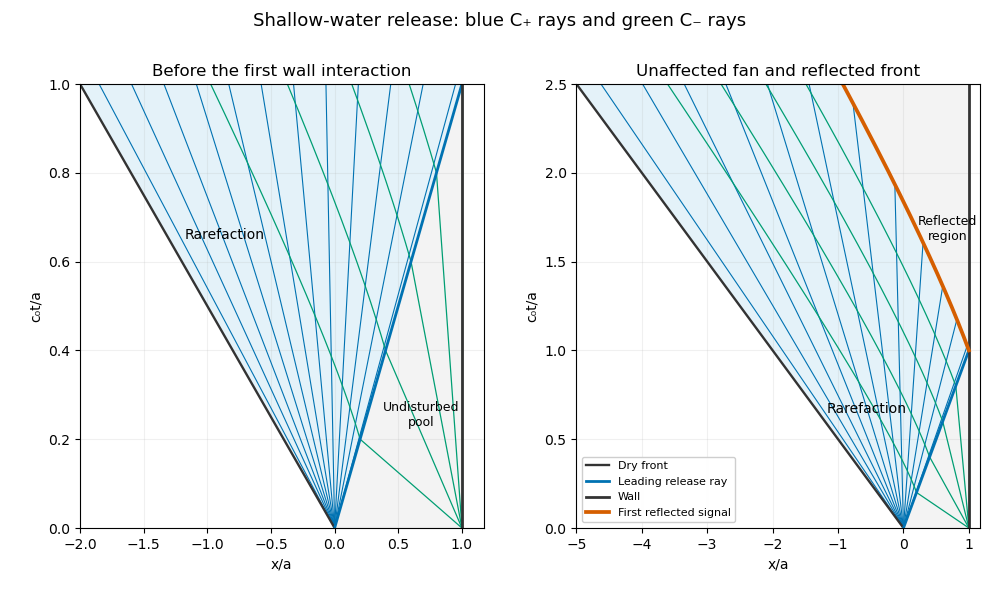
The release produces a rarefaction wave expanding into the dry region. Every incoming characteristic connects to the undisturbed pool, where , so throughout the simple wave . The outgoing rays emanate from and have . Solving givesThe depth is . At the right edge these formulas match the stationary pool; at the left edge and the fluid front travels at . Beyond it the bed is dry, so a fluid velocity need not be assigned. Values at are understood as one-sided limits of the fan.
The first wall interaction occurs at . The leftmost reflected signal follows a ray through . Until a point has encountered this signal it remains in the original fan. In that fan its speed is . ThusMatching at gives the reflected frontConsequently the same rarefaction formula remains valid for when . Between and the wall, information from the wall changes and the simple-wave relation no longer holds. In particular continuing the old formula to would give a negative velocity for , violating the no-penetration condition . The reflected region must accommodate both characteristic families; it is not another untouched part of the original fan.
Articles by others on the same topic
There are currently no matching articles.