With and , the Friedmann effective potential for pressureless matter isAlthough has one maximum, it is negative, so lies above it and never vanishes. An initially small expanding universe therefore expands forever. At large ,so the expansion approaches the exponential de Sitter scale factor in flat slicing. There is no turning point.
Write . For ,The potential is strictly increasing from to and crosses the energy line atThe expanding universe reaches this turning point, reverses, and ends in a Big Crunch. Thus a negative cosmological constant forces recollapse in this spatially flat pressureless model.
For and ,The unique maximum occurs atThe critical closed matter-cosmological-constant universe is obtained from :
If , then : the energy line lies above the barrier, and a universe expanding from passes over it and expands forever toward de Sitter behavior. If , the exact solution at is the Einstein static universe; the Big-Bang branch approaches it only asymptotically, while a separate branch can emerge from it and expand forever. If , the equation has two positive roots . The Big-Bang branch expands to and recollapses, while the disconnected large- branch contracts to and undergoes a Friedmann bounce for pressureless matter and positive cosmological constant. These are all qualitatively different possibilities.
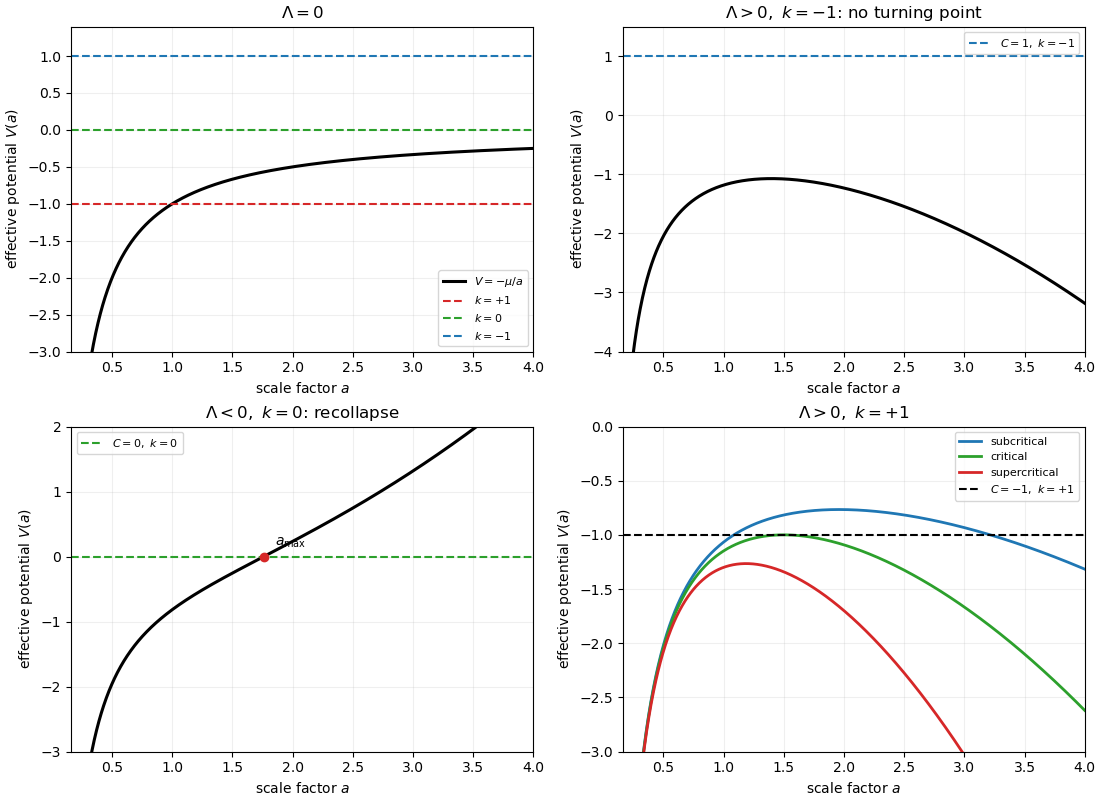
Friedmann effective potentials for pressureless matter
. Energy-line diagrams for zero, positive, and negative cosmological constant, including the subcritical, critical, and supercritical closed cases. Articles by others on the same topic
There are currently no matching articles.