For pairwise coprime integers , put . The Chinese remainder theorem states that reduction gives an isomorphismEquivalently, every system has one solution modulo .
For existence, let . Since , choose with . Thenhas every required residue: modulo , all terms except the th vanish and the remaining term is . For uniqueness, if and have the same residues, every divides . Pairwise coprimality then makes divide . Thus the simultaneous solution exists and is unique modulo .
Choose distinct primes . The moduli are pairwise coprime, so the Chinese remainder theorem supplies an integer satisfyingConsequentlyso but . By the definition of a squarefull number, is therefore not squarefull. Adding a sufficiently large multiple of makes positive without changing any congruence. The integers are the required consecutive integers.
Sperner's lemma says that if a triangle is triangulated, its vertices are labelled , and label is forbidden on the edge opposite vertex , then an odd number of small triangles have all three labels.
To prove it, count incidences with edges whose endpoint labels are and . Along the outer -edge, the labels begin at and end at , so the number of transitions is odd; no other boundary edge contributes. An interior edge contributes twice. A small triangle contributes an odd number precisely when its three labels are : a triangle using only contributes two, and every other non-tricoloured triangle contributes zero. The number of tricoloured triangles is therefore odd.
Now suppose the closed sets in the question existed. Let be the distance from a point to a closed set . Empty triple intersection makes , sois a continuous function from the large triangle to itself, where is the vertex opposite . Since the cover the triangle, at least one vanishes, so always lies on the boundary. On , its th barycentric coordinate vanishes, hence . Thus is face-preserving on the boundary; its boundary restriction is homotopic there to the identity by the straight-line homotopy. This would give a map from the triangle into its boundary whose boundary degree is one, contradicting the no-retraction theorem, the standard topological consequence of Sperner's lemma. Therefore the three closed sets must have a common point.
Let a memoryless source have probabilities , and let a uniquely decodable -ary code have word lengths and mean length . The Shannon source coding theorem statesand that some prefix code satisfies
For the lower bound, the Kraft inequality gives . Set . The Gibbs inequality, or nonnegativity of relative entropy, givesTherefore .
For achievability choose . Then , so the converse part of the Kraft theorem supplies a prefix code with these lengths, andHence the entropy is the optimal mean code length up to less than one code symbol.
The pumping lemma for context-free languages states that every context-free language has a pumping length such that every with can be writtenwith , , and for every integer .
This language is not context-free. Suppose it were, and define the homomorphismThen closure under inverse homomorphism and intersection of a context-free language with a regular language would makecontext-free. The equality holds because the midpoint of a square with four nonempty alternating runs must lie between its second and third runs.
Apply the pumping lemma for context-free languages to . A pumpable window of length at most meets at most two adjacent blocks. Pumping changes at least one block but cannot reach its equal-count partner two blocks away, so either the counts or the counts cease to agree. This contradiction proves the claim.
The equations force , , , and . Hence the language isIt is context-free; one explicit context-free grammar is
This language is not context-free. Let be a proposed pumping length and choose with . In any pumping decomposition of the unary word , pumping once more increases its length by an integer with . Butso the pumped length is not a power of three, contrary to the pumping lemma for context-free languages. This is also an instance of the fact that a unary context-free language is regular, whereas the powers of three are not ultimately periodic.
Take a context-free grammar for with start symbol , rename nonterminals if necessary, and add a fresh start symbol withEvery derivation concatenates finitely many words of , and every finite concatenation can be derived. The resulting grammar generates , proving closure of context-free languages under Kleene star.
Write for the request count on day . Both fits are Poisson regression models with independentIn model 1,where the variables are indicator variables for winter, weekend, bank holiday, and low or medium pollution; non-winter weekdays that are not bank holidays and have high pollution form the baseline. Model 2 imposesretaining only winter and weekend effects.
The models are nested, and the likelihood-ratio test statistic is the decrease in residual deviance,There are three restrictions. By Wilks theorem, under this statistic is asymptotically a chi-squared distribution with three degrees of freedom. Sincewe reject model 2 at the level in favour of model 1.
Multiply the birth-death master equation by and sum. Index shifts giveFor the second moment, a birth changes by and a death changes it by , soSince ,Together these are the moment equations of a linear birth-death process.
The deterministic equation has solution and is identical in form to the equation for the stochastic expected value. It therefore identifies only the net rateThe variance equation also contains the total event rate . Once and are inferred,The deterministic trajectory cannot distinguish frequent births and deaths that nearly cancel from infrequent events with the same net growth, whereas fluctuations can.
In the integral defining the Beta function, put and then . Symmetry givesThis proves the identity for . Both sides extend by analytic continuation to the same meromorphic function, equivalently by the beta--gamma identity and the Gamma duplication formula. The identity holds meromorphically for every ; both sides are finite for and have matching poles at the excluded points.
Start from the product of two Gamma function integrals:Use the sum-and-ratio substitution for gamma integralswhose Jacobian is . Absolute convergence for justifies the change of variables and separates the integral:Therefore
Use the first-order actionVarying with fixed endpoints and varying freely givesThe principle of stationary action therefore yields Hamilton's equations
For these become and . Along their Hamiltonian flow, is conserved andThus is an integral of motion exactly when .
Write its constant value as . The surfaces in extended -space giveUsing ,The sign of is fixed. In phase space, each energy orbit is one of the two branchesEach branch approaches and as and turns at .
Let , where a prime denotes differentiation with respect to conformal time . Multiplying the Friedmann equation by givesThe critical density is the value obtained when , so
Since , the pressure-free Raychaudhuri equation givesorDifferentiating and substituting this equation yields
For an expanding universe . The Einstein-de Sitter universe is an unstable constant solution: curves starting with decrease towards , while curves starting with rise away from and diverge as the closed model reaches maximum expansion. This is the Flatness problem.
Sincewe haveIts coefficient matrix is proportional towhose determinant is . By the two-qubit product-state determinant criterion, a product state would have determinant zero. Therefore is entangled.
This is superdense coding. To encode , Alice applies respectively to her half of . These local Pauli operators transform the shared state into the four mutually orthogonal Bell states , up to irrelevant global phases. Alice sends her one qubit to Bob. Bob now holds both qubits and performs a Bell-basis measurement, whose outcome identifies Alice's two-bit message with certainty. One transmitted qubit communicates two classical bits because one shared Bell pair was available beforehand.
For length- binary linear codes , their bar product of binary linear codes isThe map is injective and linear, soIf is the minimum distance of , thenFor this is at least ; for a nonzero word has weight at least . Words and attain these bounds, proving
A parity-check matrix for a code is a matrix satisfying . A pair belongs to exactly whenThus a parity-check matrix isThis is the parity-check matrix of a bar product.
The Reed-Muller code is the length- binary code obtained by evaluating every square-free polynomial in Boolean variables of degree at most on all points of . Equivalently,The square-free monomials form a basis, soA word in evaluates an affine function . The two constant functions have weights and . Every nonconstant affine function takes each value equally often, so all other codewords have weight .
A monomial of degree has weight . Hence every generator, and therefore every codeword, has even weight when . For , the monomial has weight one. All words have even weight exactly for .
Fix an effective enumeration of unary partial computable functions. The diagonal halting set isIt is a computably enumerable set: on input , simulate and accept if that computation halts.
Suppose were a computable set. A program could then halt on input exactly when the decider says . Let be its own index. If , the program does not halt, while if , it halts. Both alternatives contradict the definition of . Thus is computably enumerable but not computable.
A many-one reduction is a total computable function such thatIf is a computably enumerable set, compute and run a semidecision procedure for on that value. It halts exactly when , equivalently exactly when . Therefore is computably enumerable.
Let be the successor function. Define by primitive recursionInduction gives . Then defineby composition. Initial functions, composition, and primitive recursion produce primitive recursive functions, so and are partial recursive functions and are visibly defined for every . Both functions are total.
Let be the diagonal halting set and putIf were a computably enumerable set, then would many-one reduce to , making the complement of computably enumerable. Together with the computable enumerability of , that would make a computable set, a contradiction.
MoreoverIf this complement were computably enumerable, would again make computably enumerable. Thus neither nor its complement is computably enumerable.
Let total computable and witness and . DefineParity testing and integer division by two are computable, so is total computable. For every ,Therefore .
Writing for the survival function, the definition of the hazard function givesSince , integration yieldsThereforeThe exponent is the negative cumulative hazard.
Letbe the baseline cumulative hazard. Under the proportional hazards model,ThusIndependence makes the log likelihood
Fit a Poisson regression to artificial responses with meansWith the logarithmic link, this is the generalized linear modelwhere is a known offset. Its log likelihood, apart from constants, isThe differencedoes not depend on . The Poisson surrogate therefore has exactly the same maximum-likelihood estimate of . This is the Poisson surrogate for an uncensored proportional-hazards likelihood.
Insertinto the equation. Since and , use and integration by parts:The integral vanishes whenso, up to a constant and on a consistently chosen branch,The remaining contour condition isThis is the Laplace contour-integral method for a linear differential equation.
Because , the endpoint factor vanishes at the branch points . A finite contour may therefore run from to on either side of a chosen branch cut; the diagram shows contours bowing through the left and right half-planes.
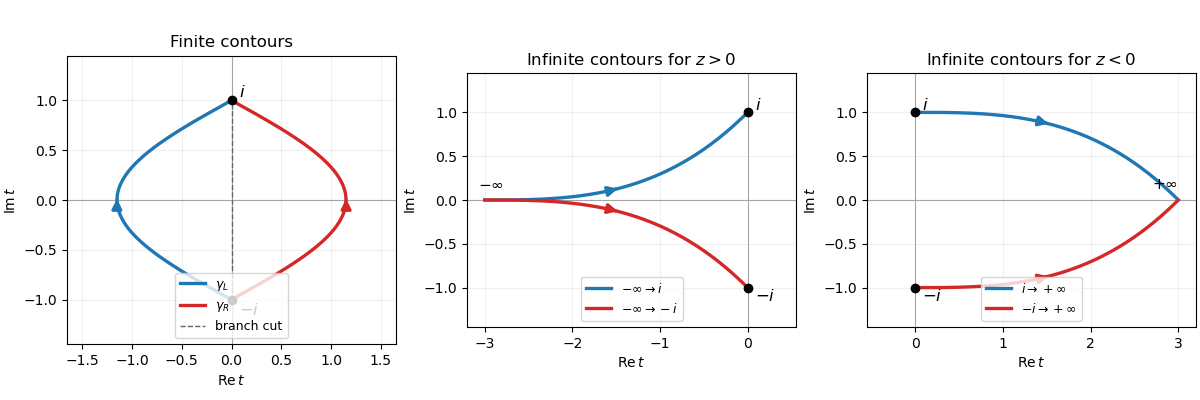
Contour choices for the Laplace transform
. For , is entire, so path independence makes either contour give, up to orientation,Hence a nonzero constant multiple gives the solution
For real , the exponential decays as , so two allowed contours run from to and from to . For real , it decays as , so reverse the construction: run from or to . These are the infinite contours in the diagram.
For their integrals arefor the corresponding orientation changes only an overall sign. Taking the sum of the two exponentials produces a solution independent of :Its nonzero Wronskian with on proves linear independence.
Differentiate the Friedmann equation:The scalar-field equation gives , henceBy continuity this also holds through isolated zeros of , so the Raychaudhuri equation is
Differentiating the ansatz givesThe Raychaudhuri equation therefore becomesSince , the requested specific solution takes the integration constant to be zero:Now , soand
Put . The hyperbolic cotangent double-angle identity givessoAlsoSolving the Friedmann equation for the scalar potential,therefore gives
Write . As ,so andBecause , the power lies in ; thus and the early expansion decelerates. As , and , givingso the late universe has accelerating expansion.
The transition satisfies . Substitution givesor . ThereforeThis is the transition described by the exact hyperbolic-sine scalar-field cosmology.
Ordinal exponentiation is defined by transfinite recursion:when is a nonzero limit ordinal. If , each successor step and each supremum show that is nondecreasing. If , transfinite induction strengthens this to strict increase: , and the value at a limit exceeds every earlier value.
Strict increase can disappear when the base changes. For example, with ,because for every positive finite , both finite powers have leading term , and taking the supremum gives .
We next proveApply transfinite induction to . The zero and successor cases follow directly from the recursive definitions and the associativity of ordinal multiplication. At a limit , continuity of ordinal multiplication in its right argument givesThe superficially similar identity is false: for , , and ,
Finally,For the first equivalence, bases zero and one fail, while strict increase embeds every countable ordinal into the powers of any base . For the second, immediately gives . Conversely, if , then . Every exponent below the first uncountable ordinal is countable, so each has cardinality at most ; the supremum of such ordinals still has cardinality at most and is therefore below the second uncountable ordinal .
WriteLet be an -free graph on vertices with edges, and choose a uniformly random set of vertices. Its induced subgraph is still -free, and each edge survives with probability . Henceso . Thus the normalized extremal number is nonincreasing and bounded below by zero, proving that
The Erdős-Stone theorem states that if the chromatic number of is , thenIf is a bipartite graph with at least one edge, its chromatic number is two, so and therefore
First consider a -free bipartite graph with parts , each of size at most , and edges. Count pairs in which is a -element subset of the graph neighbourhood of . Any vertices of have at most common neighbours, since common neighbours would form the complete bipartite graph . ConsequentlyIf the average degree of a vertex is bounded in terms of , then and the required result is immediate. Otherwise, convexity of and the preceding inequality giveand hence . Every graph has a bipartite spanning subgraph containing at least half its edges, obtained by choosing a random bipartition. Applying the bipartite estimate to that subgraph proves the Kővári–Sós–Turán theorem in the required form:
The stated "nice" subsets of the finite cyclic group are Sidon sets. Ifthen . Niceness forces ; the alternative pairing would force . Thus the ordered nonzero differences are distinct elements of the nonzero residue classes. Thereforeso
Let be the Galois group of a polynomial of the irreducible quartic. Irreducibility makes a transitive subgroup of . The three roots of the given cubic resolvent of a quartic correspond to the three partitions of the four quartic roots into two unordered pairs, and the kernel of the -action on these partitions is the Klein four-group . If the resolvent has Galois group , the image of in this action is all of . Among the transitive subgroups of the symmetric group on four points, only has this image. Hence
Now put . The Eisenstein criterion at proves that is an irreducible polynomial, and its cubic resolvent isIts discriminant of a depressed cubic isFor odd , the -adic valuation of is three because ; for , . Thus is never a square in .
By the rational root theorem, a reducible has an integer root among . Reduction modulo shows that the root is divisible by ; writing it as , with , givesThe only possibilities are and , corresponding to roots and . For every other prime, is irreducible with nonsquare discriminant, so its Galois group is and the criterion above gives the quartic group . For or , the reducible resolvent makes the quartic group a proper subgroup. Therefore
The commutator subgroup, or derived subgroup, isA linear character is afforded by a one-dimensional representation . Since is abelian, every commutator lies in , so
Let be the quotient map. Every irreducible representation of a finite abelian group is one-dimensional, so each irreducible character of the abelianization inflates to the linear character of . Conversely, the containment makes every linear character of factor uniquely through . Thus inflation of a group representation gives a bijection
Articles were limited to the first 100 out of 884 total.
Articles by others on the same topic
There are currently no matching articles.