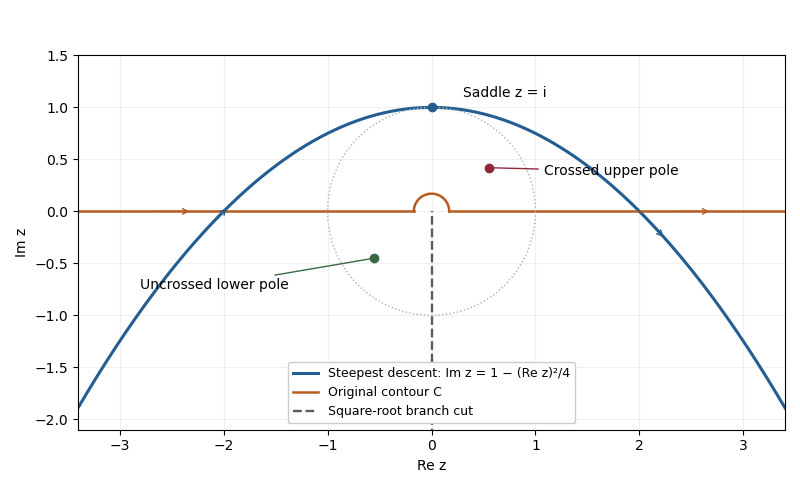
Choose the square root with , so the branch cut is the negative imaginary axis. The change of variable maps this sheet onto and gives . Writing the exponential function as , its phase becomes exactly quadratic:The saddle point is therefore , or . On the descending line , , the phase is . Its image is the parabolaThe contour runs from left to right, corresponding to decreasing from to . A contour deformation in the right half of the -plane moves the original indented contour to this line. The connecting tails vanish in the descending sectors, and no branch point or pole is crossed. Since , the Gaussian integral and the odd function giveHere the method of steepest descent actually gives an exact answer for , because the quadratic phase and linear transformed amplitude have no further even correction.

Articles by others on the same topic
There are currently no matching articles.