SubstituteThe two horizontal momentum equations separate immediately because the same factor multiplies every term. Hydrostatic balance givesThe buoyancy equation then givesDifferentiating this expression and using three-dimensional incompressibility together with the shallow-water mass equation yieldsThus each vertical eigenfunction supplies an equivalent depth or wave speed to an equatorial shallow-water system.
For the equatorial Kelvin wave, set . The zonal momentum and mass equations give . Meridional trapping selects the eastward branchfor whichThe westward algebraic branch would grow away from the equator and is rejected.
For , let . The zonal momentum and mass equations giveSubstitution in meridional geostrophic balance and use of the stated Hermite differential equation gives the trapped Equatorial Rossby-wave dispersion relationFor , define , , and takeThen
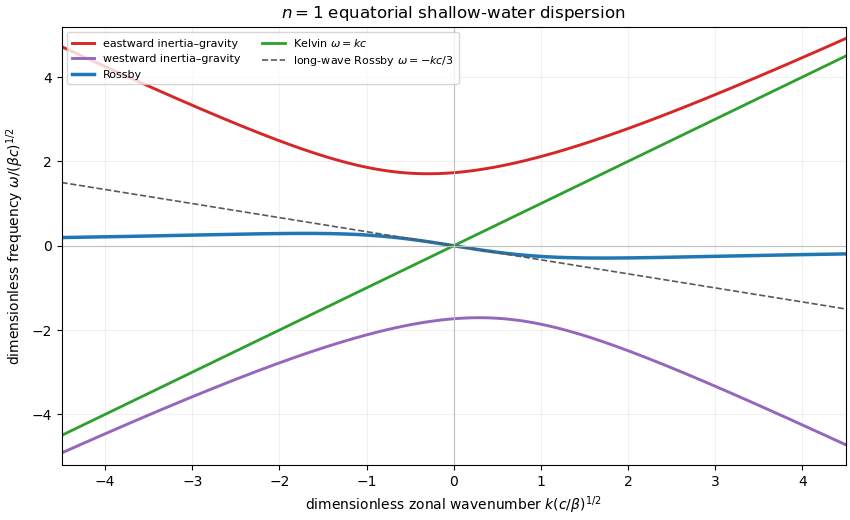
Without imposing meridional geostrophic balance, the equatorial shallow-water modes satisfy the Matsuno cubicA dispersion diagram therefore contains high-frequency eastward and westward equatorial inertia--gravity waves as well as westward equatorial Rossby waves, plus the separate straight equatorial Kelvin wave branch . The Rossby curves approach only in the long-wave limit and bend toward zero like at short wavelength. The geostrophic model retains the Kelvin and long-wave Rossby lines but filters the inertia--gravity modes and misses Rossby-wave dispersion at larger .

For a vertical plane wave , the vertical-mode equation givesConsequently the Boussinesq equatorial Kelvin wave and equatorial Rossby wave haveTheir meridional structures are those in part b with .
Let the positive forcing frequency be with . Upward radiation into requires for both responses. The Kelvin wave has andIts group velocity points up and right along a ray making angle approximately above the horizontal, so it occupies the region to the right of the localized source. Its phase propagates down and right.
The Rossby wave has andIts group velocity points up and left along a ray making angle approximately above the negative horizontal direction, so it occupies the region to the left. Its phase propagates down and left. Thus energy radiates upward and away from the source on both sides, while the vertical phase propagation is downward in both wave beams.
Articles by others on the same topic
There are currently no matching articles.