Assume a small Rossby number, a beta plane, and small fractional changesAt leading order, geostrophic balance givesExpanding the reciprocal depth in the shallow-water potential vorticity givesThis is the stated shallow-water quasi-geostrophic potential vorticity . The term is the parcel's relative vorticity, while is vortex stretching caused by free-surface displacement, whereis the barotropic deformation radius.
For , omit the irrelevant constant factor . The active PV anomaly isLinearizing about rest and using gives the Topographic Rossby-wave dispersion relationA northward displacement raises planetary PV when and raises topographic PV when the bottom rises northward, . PV conservation then requires anticyclonic relative vorticity, producing westward phase propagation. A negative slope opposes and reverses propagation when .
Under a rigid lid, is fixed but need not be close to . With , linearization of givesFor and over a region where , plane waves obeyThe planetary-vorticity gradient dominates when , while exponential depth variation dominates when . If the variation of across the region is retained, this is the corresponding local WKB approximation with effective gradient .
Let the thermal-wind basic velocity beso that . Assume constant , hydrostatic perturbations, independence, and normal modes proportional to . The linearized equations areIncompressibility gives . Eliminating yieldsThis quadratic in is positive for every orientation precisely whenOtherwise some disturbances grow monotonically through symmetric instability.
For the stable case, the minimum occurs atConstant-phase lines have slope , exactly the slope of the basic isopycnals . The minimum-frequency displacement follows an isopycnal, allowing buoyancy and Coriolis restoring forces to oppose one another. Its frequency is below the inertial frequency of an unstratified rotating fluid.
If is the counter-clockwise angle of the wavevector from the horizontal, , andFor , define . Taking , the incident wave with group velocity down and right hasA horizontal reflection preserves and but selects the other vertical wavenumber, soThe incident and reflected phase lines have slopes and , respectively. Their group velocities are perpendicular to these phase lines: the incident ray points down-right and the reflected ray up-right. The isopycnal slope lies between the two phase-line orientations.
The interior equation materially conserves three-dimensional quasi-geostrophic potential vorticity. At each rigid horizontal boundary, is proportional to the boundary buoyancy anomaly, so the other two equations express material conservation of that buoyancy.
A background streamfunction gives . Its interior PV is uniform. Writing and retaining first-order terms givesin the interior. Since , perturbation advection of the boundary buoyancy givesat . At the lower boundary this is replaced by
For a Fourier component with zero interior PV,Solving this boundary-value problem in terms ofgiveswhere, with ,The boundary equations consequently reduce toFor , defineThe determinant gives the Damped Eady-wave dispersion relation
For , the quantity under the square root is real:It is negative for small and positive for large . Therefore the Eady instability occurs for , whereand modes are neutral for .
For , and is exponentially small. HenceThese are two decoupled Boundary Rossby waves, one localized near each boundary. Their laboratory phase speeds lie just inside the basic velocities and because each propagates intrinsically against the local flow.
At , the real undamped part vanishes. PutThe neutral equation implies . The radicand is thereforeIf is chosen with , thenThus , and the plus branch hasFor this is exponential growth. Lower-boundary damping therefore destabilizes the formerly neutral cutoff mode, an example of dissipation-induced instability.
When , the boundary coupling is exponentially small. The two eigenvalues are therefore the diagonal boundary-wave speeds through order :The lower wave is damped at the imposed rate, while the upper wave is exponentially isolated from the lower boundary and remains neutral to algebraic order. Damping destroys the phase-locked counterpropagating-wave interaction at short horizontal wavelength rather than damping both waves equally.
SubstituteThe two horizontal momentum equations separate immediately because the same factor multiplies every term. Hydrostatic balance givesThe buoyancy equation then givesDifferentiating this expression and using three-dimensional incompressibility together with the shallow-water mass equation yieldsThus each vertical eigenfunction supplies an equivalent depth or wave speed to an equatorial shallow-water system.
For the equatorial Kelvin wave, set . The zonal momentum and mass equations give . Meridional trapping selects the eastward branchfor whichThe westward algebraic branch would grow away from the equator and is rejected.
For , let . The zonal momentum and mass equations giveSubstitution in meridional geostrophic balance and use of the stated Hermite differential equation gives the trapped Equatorial Rossby-wave dispersion relationFor , define , , and takeThen
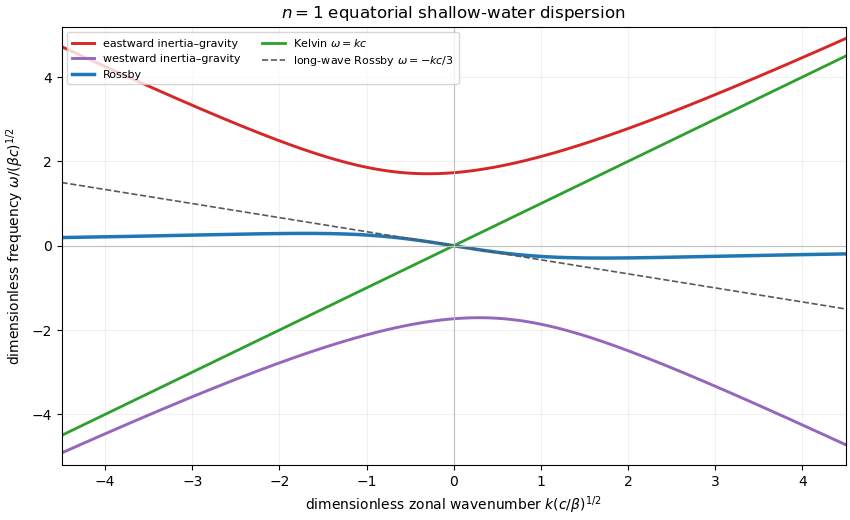
Without imposing meridional geostrophic balance, the equatorial shallow-water modes satisfy the Matsuno cubicA dispersion diagram therefore contains high-frequency eastward and westward equatorial inertia--gravity waves as well as westward equatorial Rossby waves, plus the separate straight equatorial Kelvin wave branch . The Rossby curves approach only in the long-wave limit and bend toward zero like at short wavelength. The geostrophic model retains the Kelvin and long-wave Rossby lines but filters the inertia--gravity modes and misses Rossby-wave dispersion at larger .

For a vertical plane wave , the vertical-mode equation givesConsequently the Boussinesq equatorial Kelvin wave and equatorial Rossby wave haveTheir meridional structures are those in part b with .
Let the positive forcing frequency be with . Upward radiation into requires for both responses. The Kelvin wave has andIts group velocity points up and right along a ray making angle approximately above the horizontal, so it occupies the region to the right of the localized source. Its phase propagates down and right.
The Rossby wave has andIts group velocity points up and left along a ray making angle approximately above the negative horizontal direction, so it occupies the region to the left. Its phase propagates down and left. Thus energy radiates upward and away from the source on both sides, while the vertical phase propagation is downward in both wave beams.
Articles by others on the same topic
There are currently no matching articles.