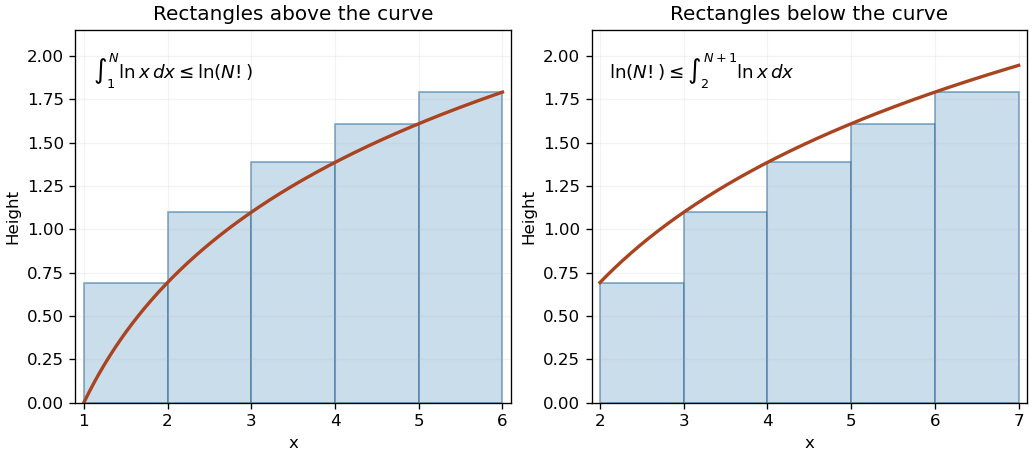
The logarithm turns the product defining the factorial into . Since is increasing, each term bounds integrals on its adjacent unit intervals:Summing from to proves the integral bounds for a logarithmic factorial:For , both sides and the empty sum are zero. For , the rectangle diagram gives the same inequalities geometrically. These bounds establish the leading growth, while Stirling's formula gives finer corrections.

Write . The two data points give the linear equations and . Subtraction and back-substitution giveor , to four significant figures. The six-decimal-place value here is the one printed in the original PDF. Retain guard digits for the estimates below. The fitted coefficients are close to the Stirling's formula values and but need not equal them because the fit absorbs finite- corrections.
Substituting into the fitted factorial logarithm givesThis is an estimate from the requested two-point fit, not an exact factorial evaluation.
For the stated , the leading term dominates the logarithmic correction . ThusThis uses the numerical value specified in the question; such a large logarithm can be computed without constructing the factorial itself.
Separate the even factors from :The double factorial therefore satisfies . Applying the same fit consistently gives
Articles by others on the same topic
There are currently no matching articles.