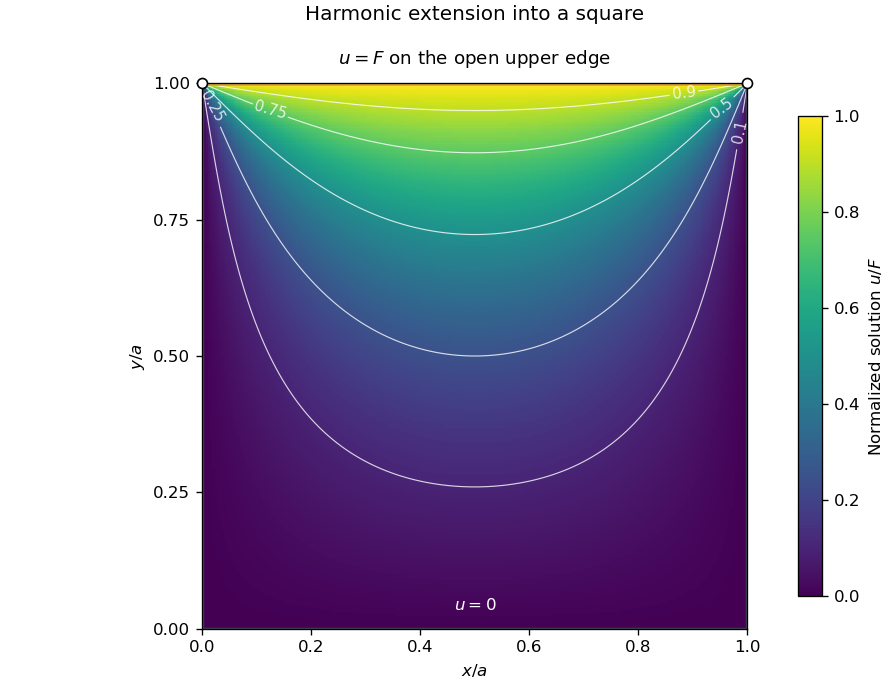
The zero values at select , and the zero value at selects . Expanding the constant upper-edge value as a Fourier sine series gives coefficients . The resulting harmonic function in a rectangle with one constant boundary value isEach term satisfies Laplace's equation and the three zero boundary values. At , the series equals for . On compact subsets of the interior it and its derivatives converge exponentially, which justifies the termwise equation.
For , the top-corner boundary prescriptions conflict: a corner cannot be both zero on a vertical edge and on the upper edge. The bounded interior solution has the specified limits along the open sides; it has no single continuous extension at those two corners. Values assigned only at the isolated corners do not change the interior solution.

Articles by others on the same topic
There are currently no matching articles.