Write . Its coordinates are , , so . For the given positive range of , this traces a segment of the first-quadrant hyperbola, moving rightward and downward:The complex conjugate is . It is the reflection in the real axis, tracing in the fourth quadrant, rightward and upward:Neither trajectory crosses either axis, because and remain nonzero. The left panel of the figure marks the endpoints and directions.
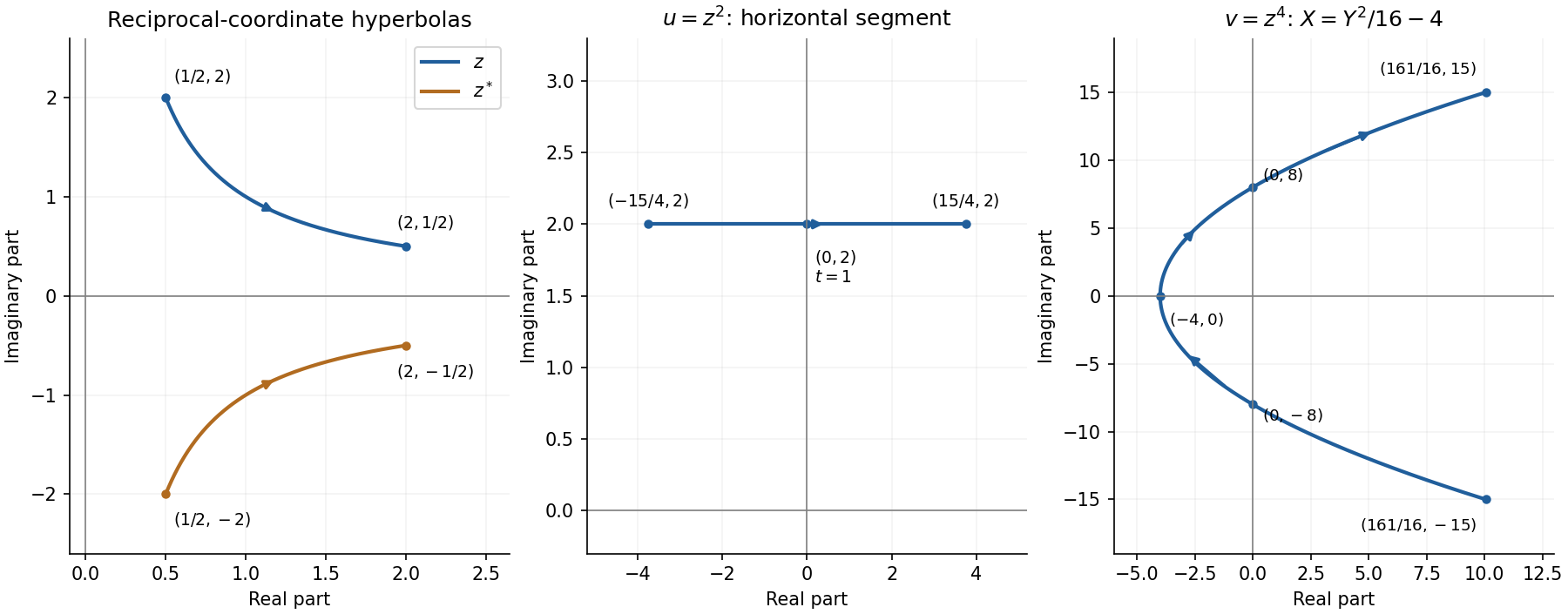
Trajectories under complex conjugation, squaring and fourth powers, with endpoints and axis crossings
. Details. 
Squaring givesThus is constant, while . The trajectory is the horizontal line segmentIt crosses the imaginary axis at , when , and never crosses the real axis. The middle panel shows the rightward direction.
Put . Part (b)(ii) gives , soThe parameter increases strictly from to . Therefore the imaginary part increases from to , while the real part is . The endpoints areThe real axis crossing is at , giving at . The two imaginary axis crossings satisfy , givingIn order, the trajectory passes from its lower endpoint through , then the leftmost point , then , to its upper endpoint. It is a right-opening parabola segment, traversed continuously upward as shown in the right panel.
From and , elimination of givesThis makes the real part a quadratic function of the imaginary part. There is no sign ambiguity because determines uniquely. The calculation illustrates power maps of a reciprocal-coordinate hyperbola.
Articles by others on the same topic
There are currently no matching articles.