Symmetric wetting means that both film boundaries prefer the same block: A at both, or B at both. Asymmetric wetting means opposite preferences, such as A at the substrate and B at the free surface. A neutral boundary has approximately equal interfacial free energies against A and B and therefore imposes no first-order preference between them.
These terms compare the substrate–polymer and atmosphere–polymer interfaces, not the volume fractions or molecular weights of the two blocks. A film can have one neutral boundary and one selective boundary; saying only that its top surface is neutral does not make both interfaces neutral. Surface preference competes with chain stretching and the energetic cost of A/B contacts in selecting a block copolymer morphology.
Symmetric wetting and an A-preferring substrate imply an A-preferring free surface as well. Parallel lamellae satisfy both preferences. For equal-width A and B domains, a thickness contains two repeats, with terminal A half-domains:The sequence is written from substrate to atmosphere. Its total thickness is , the total A and B thicknesses are each , and both interfaces contact A. A diagram using five full half-period domains would instead give and would not match the stated thickness.
The quarter-period end domains place an A-domain centre at each boundary in this ideal symmetric-lamella model. Real surface reconstruction and non-equal block fractions can change their detailed widths without changing the key requirement of identical terminations.
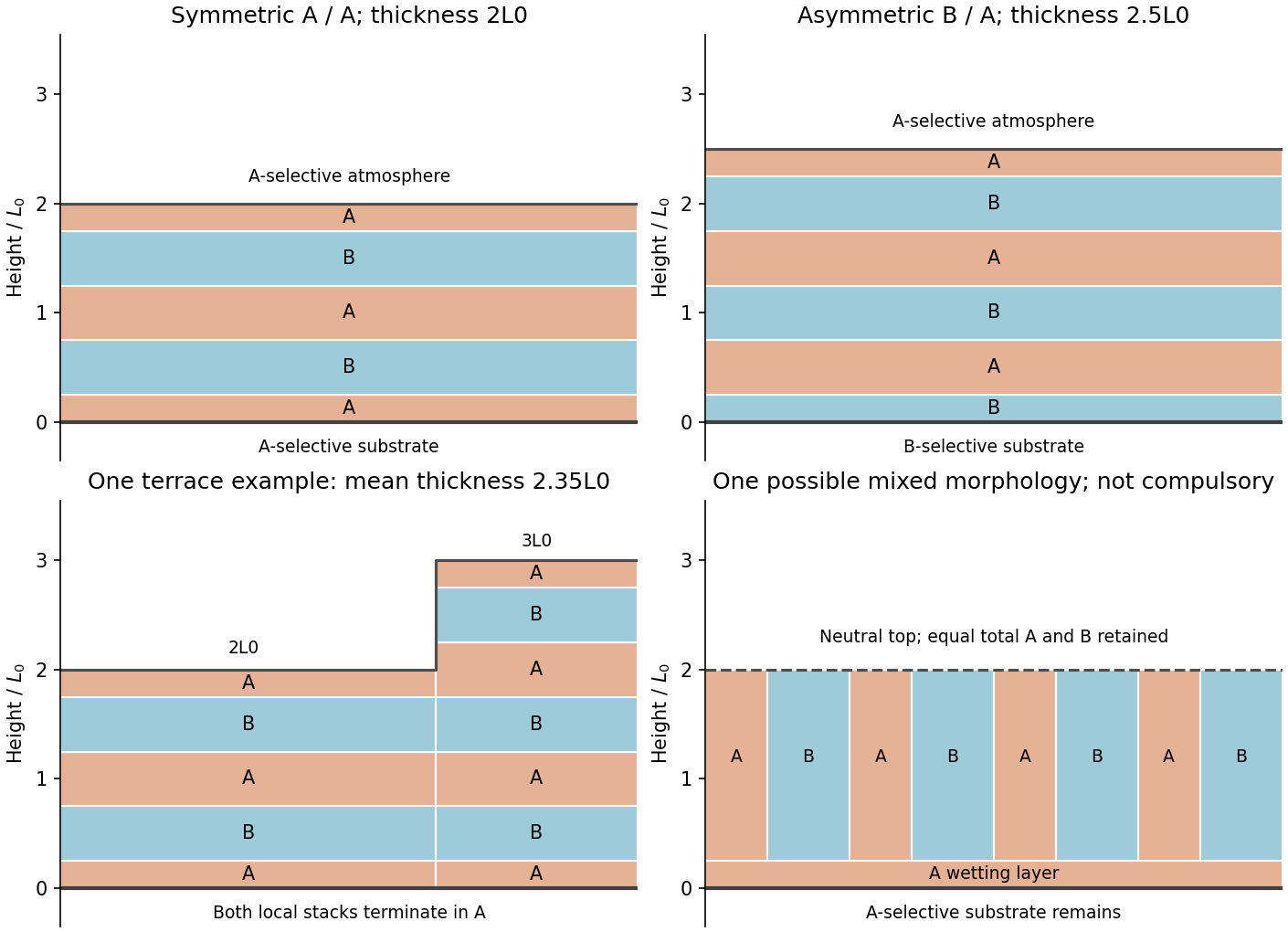
Lamellar terminations, thickness terraces and a single neutral boundary
. Original idealized equal-block diagrams. The neutral-top panel is one admissible mixed arrangement, not a unique prediction; the bottom surface still prefers A. Details.
An asymmetric film with a B-preferring substrate must have an A-preferring atmosphere interface. A parallel stack with half-integer thickness can terminate correctly at both surfaces. For equal block widths, one explicit sequence from bottom to top isThe thicknesses add to , with of each block. B contacts the substrate and A contacts the atmosphere, as shown in the accompanying schematic. The alternating widths in the interior reflect half-period domains, while the terminal domains are half of an interior domain in this idealized construction.
With identical A-selective boundaries, stress-free parallel stacks favour approximately integer multiples of . An arbitrary imposed thickness generally cannot preserve both the bulk period and those terminations everywhere.
A small mismatch can be accommodated by compressing or stretching the lamellae. A larger mismatch can favour terraces, islands or holes with locally commensurate heights, separated by steps of roughly . For example, a mean height can be assembled from regions of heights and , with area fraction at the larger height:The cartoon shows this volume-conserving alternative. Which response wins depends on elastic stretching energy, surface energies, lateral constraints, thickness mismatch and equilibration time. If the substrate and processing permit it, dewetting or a different domain orientation can also occur; an arbitrary thickness does not prove that a single specific terrace pattern must form.
Neutralizing the top boundary removes its preference for A, but the substrate still prefers A. The original integer-period constraint from two A-selective interfaces is therefore relaxed. The film can adjust its top termination without paying the same surface penalty, and thickness frustration can be reduced.
A possible morphology is an A-rich wetting layer near the substrate with lamellae turning towards a more perpendicular arrangement in the upper film, as schematically illustrated. A predominantly parallel stack is also possible if the substrate anchoring and thickness commensurability dominate. Neutrality of the top alone does not uniquely determine the orientation.
If both boundaries were neutral, perpendicular lamellae could expose comparable A and B areas without a selective-surface penalty and would avoid the same parallel-stack thickness constraint. That is a different boundary condition from the one given here. A correct sketch must retain the A preference at the bottom rather than silently replacing it with a second neutral interface.
Articles by others on the same topic
There are currently no matching articles.