Positive dielectrophoresis acts up the gradient of the squared RMS field, towards stronger-field regions; negative dielectrophoresis acts down that gradient, towards weaker-field regions. The sign is the sign of .
The force is not generally tangent to an electric field line. Field lines show the direction of the field itself, whereas describes how its strength changes in space. A spatially uniform field gives zero dipole-order dielectrophoretic force even when it is large. Reversing the field each half-cycle does not reverse this time-averaged force, because the relevant intensity-like quantity is quadratic.
At fixed material response, frequency and field-strength gradient,Thus the force is proportional to particle volume. Doubling the radius multiplies the force by eight, not two. This scaling assumes that the particle is small enough for the dipole approximation and does not substantially distort the prescribed field distribution. The mechanical drift speed need not scale with volume, because the hydrodynamic drag also changes with particle size.
For ordinary lossless dielectrics with positive real permittivities,The denominator is positive, soThe particle is more polarizable than the displaced medium and is driven towards the region where its polarization lowers the field-plus-source energy most effectively. If the two permittivities match, this ideal dipole contrast vanishes.
Under the same positive, real-permittivity assumptions,The particle is less polarizable than the surrounding medium and moves towards weaker-field regions. The sign describes the polarizability contrast, not a negative net electric charge. Conducting or lossy media require the real part of the full complex Clausius-Mossotti factor; a comparison of only the real dielectric constants is then insufficient.
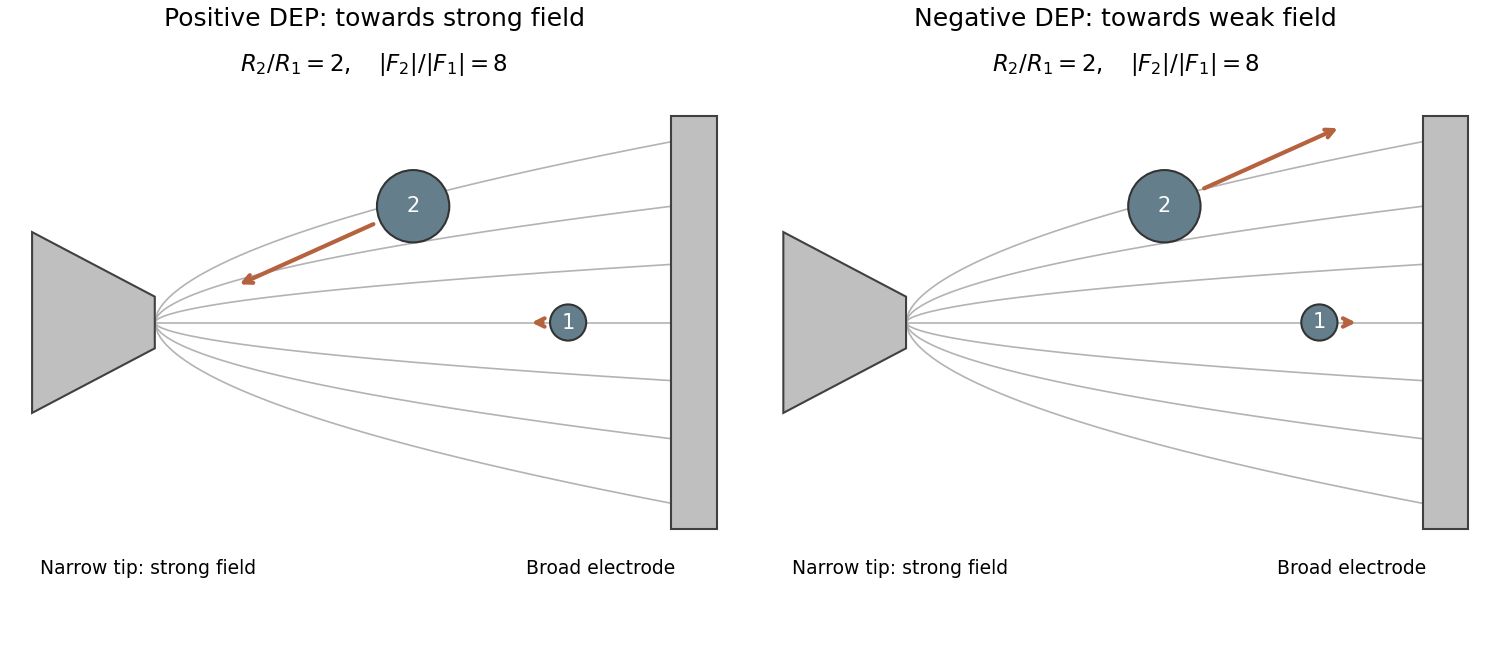
The narrow electrode tip concentrates field lines and produces the strong-field region. For positive dielectrophoresis, both particles move towards that region; for negative dielectrophoresis, both move away. Particle 1 is approximately on the central symmetry line, so its arrow is approximately horizontal. Particle 2 lies above it, so a qualitative gradient arrow points towards or away from the high-field tip rather than simply following its local field line.
The source drawing makes particle 2 approximately twice the radius of particle 1. With the explicitly stipulated equal gradient magnitudes and identical material,Accordingly, the second force arrow should be much longer in either sign case. The exact ratio should remain expressed through the drawn radius ratio because the figure supplies no calibrated particle dimensions. Exact off-axis force directions would require solving the electrode boundary-value problem; the drawing supports a qualitative strong-field/weak-field distinction.

Different materials have different frequency-dependent polarization and conduction. For an convention, a useful relative complex permittivity is . Substituting the particle and medium responses into determines whether each population undergoes positive or negative dielectrophoresis and with what magnitude.
Choose a frequency at which one population has and another has . A nonuniform electrode field then sends them towards different regions, allowing collection in separate channels or trapping one while the other passes. Alternatively, different positive-force magnitudes can produce different deflections in a flowing suspension. A crossover where can selectively suppress the force on one material.
The useful frequency depends on the surrounding medium as well as the particle. An unchanging, real-permittivity model would not by itself give frequency-selective separation; dielectric dispersion or conductivity contrast is needed. Particle size affects force magnitude, and heating, electro-osmotic flow and surface polarization can complicate a real separation.
Articles by others on the same topic
There are currently no matching articles.