With suitable atomic force microscopy feedback gains, the trace follows the accessible surface while maintaining the chosen oscillation-amplitude setpoint. The measured trench is narrower than the accessible opening because the finite tip encounters an edge before its apex reaches that edge's true lateral position. For an ideal tip flank angle relative to the tip axis and height change , the geometrical setback is per side.
The conventional tapered tip cannot recover the underside of the overhang, even when feedback is perfect: the first contact with the upper edge or shank limits access. This geometrical envelope must be distinguished from errors caused by feedback dynamics. The stated tip height is sufficient for the vertical range; it does not remove the lateral-access problem.
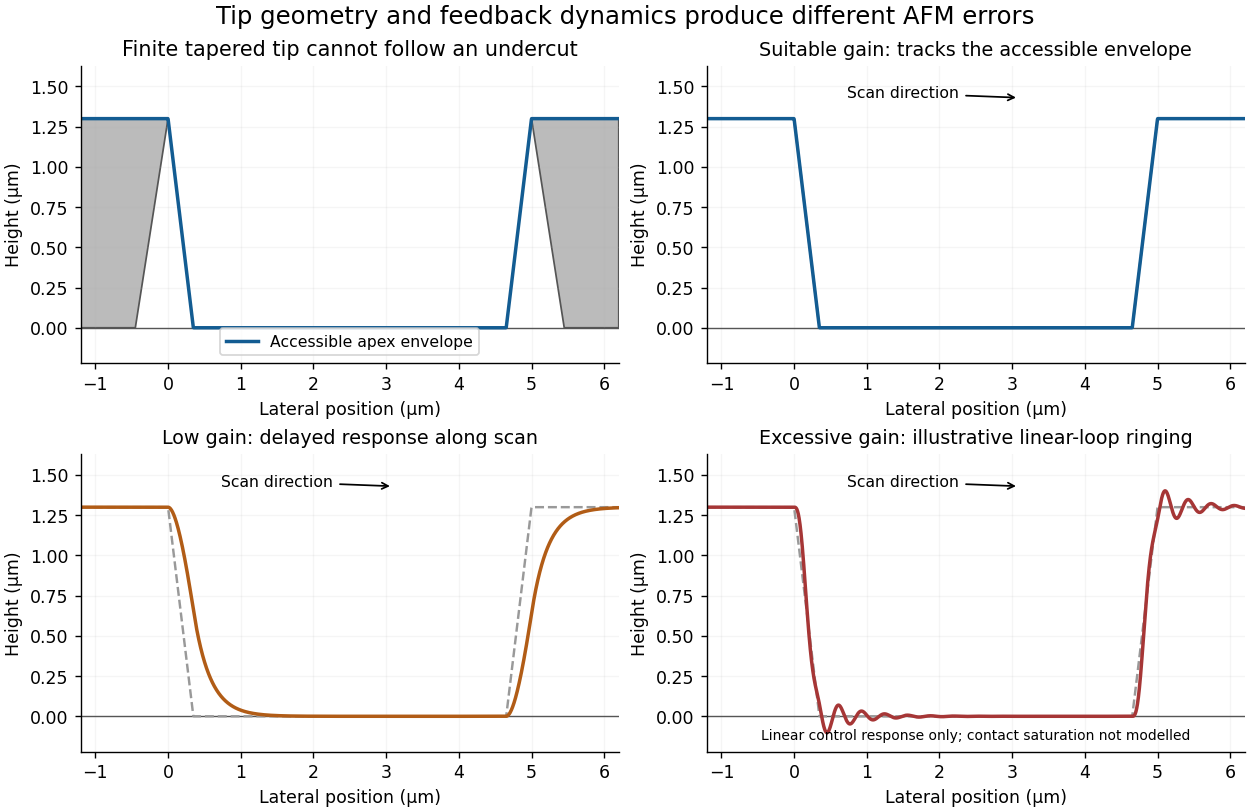
Illustrative AFM trace geometry and the effects of insufficient or excessive feedback gain
. Details. 
With gains too low for the scan speed, the vertical response lags the surface. On entering the depression during the left-to-right trace, the tip descends too slowly and the recorded edge rounds or extends into the trench. On climbing out, the tip can approach or contact the rising feature before the controller lifts it sufficiently, again distorting the edge. Thus the error depends on scan direction and can differ between trace and retrace. Slower scanning can reduce this bandwidth limitation, but it does not correct the geometrical inability to probe an overhang.
Excessive feedback gain can make the closed loop underdamped or unstable. Edge transitions then produce overshoot, ringing or oscillatory streaks in the recorded height. The apparent structure is a controller response rather than a real series of surface ridges. The exact amplitude and frequency depend on the actuator, cantilever, loop delay and controller settings; without those data one can sketch the qualitative ringing but cannot predict a unique quantitative trace.
Articles by others on the same topic
There are currently no matching articles.