For the Transverse-field Ising model, use dimensionless spin one-half operators, so has eigenvalues . At zero transverse field every aligned bond contributes . The two ground states areThey span an exactly two-dimensional ground space on the finite periodic ferromagnetic chain. Any linear combination is also a ground state; parity eigenstates are the symmetric and antisymmetric combinations. Choosing one ordered product state in the thermodynamic limit is spontaneous symmetry breaking.
For large positive field the leading term is . Its unique minimizing state isThe exchange has zero first-order expectation in this state and produces virtual spin-pair fluctuations at finite g. Thus the polarized product is the limiting wavefunction, not an exact finite-field ground state. Bulk perturbation theory gives . The field-polarized phase has no twofold ordered-state degeneracy.
Let and . The Jordan–Wigner transformation gives and . The canonical anticommutation relations implyConsequently the bondwise cancellation of a Jordan-Wigner string yieldsSubstitution therefore givesThe finite-ring parity qualification of an Ising quasiparticle gap matters here. For an exact periodic spin chain, the closing bond retains total fermion parity. The parity-dependent boundary condition of the Jordan-Wigner chain is , with . Fixing that parity determines the allowed Fourier grid, and the resulting many-body states must still have the chosen parity. Dropping this boundary issue preserves the thermodynamic energy density, but can lose a degeneracy or the correct finite-ring excitation gap. [ref]
Physics 215C: Quantum Field Theory, Part 3 by John McGreevy. §5.1, spin-chain fermionization and boundary sectors
With the specified Fourier transform convention, normal ordering giveswhere the possible constant vanishes on the complete lattice momentum grid. Antisymmetry of opposite-momentum pairs similarly givesHenceUse the Ising-chain Nambu spinor . Expanding its two diagonal terms uses , retaining the constant. The result isThis is a full-zone sum. Its opposite-momentum components are redundant; treating each matrix eigenvalue as an independent physical excitation would miss the factor of two in the quasiparticle energy. Self-paired momenta have zero anomalous term and are ordinary number levels.
Put . The matrix in the Ising-chain Nambu spinor has eigenvalues . A canonical Bogoliubov transformation, with paired angles satisfying and , diagonalizes it. Accounting for full-zone fermionic Nambu energy counting givesThus the bulk Ising-chain ground-state energy isExact finite-chain states additionally obey their fermion parity sector.
The Ising-chain quasiparticle dispersion has bulk gap , closing at the Ising-chain quantum critical point. Finite-system parity splittings and the bulk gap are distinct scales. The three requested limits are illustrated below.
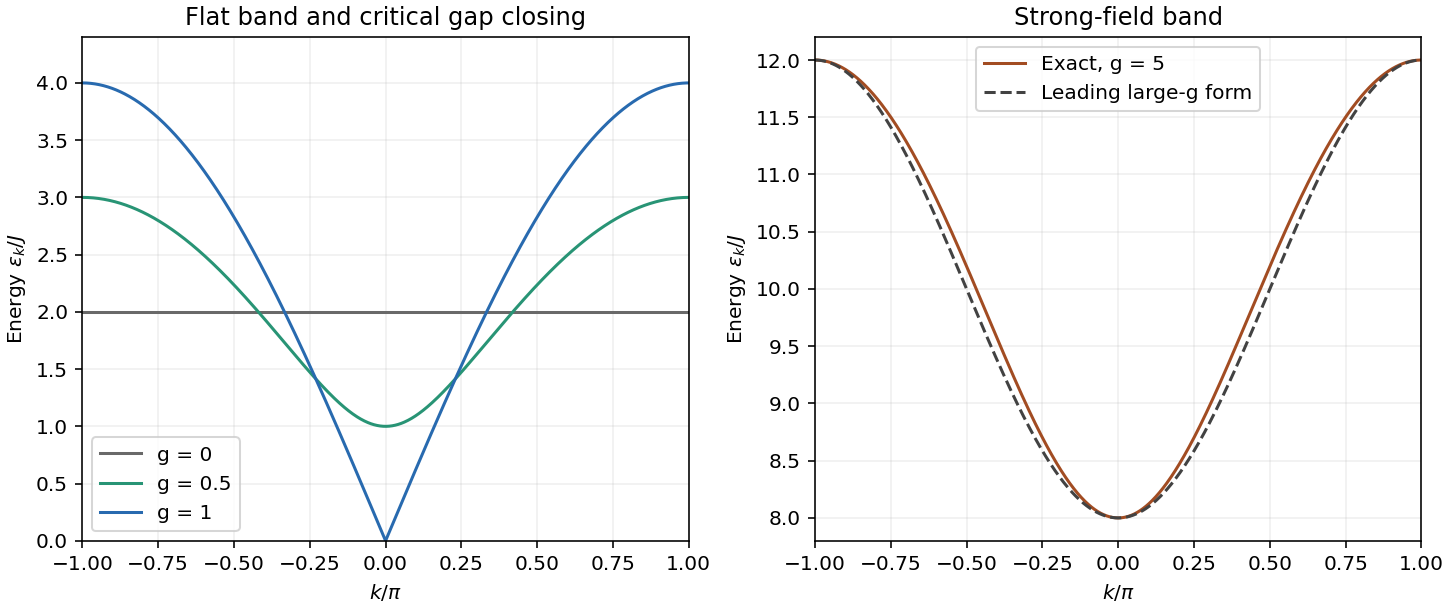
Ising quasiparticle bands
. Source. Details. 
At g=0, is flat. A domain wall costs 2J, but walls occur in pairs on a periodic spin ring. A single bulk quasiparticle is therefore not automatically the first physical finite-ring spin excitation.
At large positive g, . The gap grows as while the leading bandwidth remains 4J. The field-polarized vacuum is unique.
At g=1, . The gap closes at zero momentum and . With unit lattice spacing the critical velocity is .
The Hellmann–Feynman theorem applied to the source field normalization givesDifferentiating the Ising-chain ground-state energy, using , therefore provesThis is the Ising-chain field derivative and transverse polarization, not its spontaneous x-order parameter. It tends to zero at g=0 and to N/2 at large positive field. The critical transverse polarization of an Ising chain is finite: in the thermodynamic critical limit this gives . A zero-energy isolated momentum is treated by the appropriate limiting state, rather than by assigning a value to a literal 0/0 summand.
Articles by others on the same topic
There are currently no matching articles.