Use the Holstein–Primakoff transformation only on the physical occupation sector , with and . Acting on number states givesConsequently and , soThe endpoint factors keep the spin operators inside the physical sector. The square-root ordering matters; replacing it by an unrestricted linear oscillator would not give the exact finite-spin algebra.
For the even periodic chain, every classical Néel state has energy , with arbitrary unit vector . Thus there is a continuous sphere of classical orientations, not merely two Ising-like states. Opposite staggered directions are connected by a global spin rotation.
A quantum Néel product is not an eigenstate: transverse exchange flips opposite neighbouring spins. The ground state therefore contains quantum superpositions and zero-point spin waves, reducing the classical staggered moment. A finite isotropic balanced chain has a symmetry-invariant ground state; a symmetry-broken reference is an approximation for analysing fluctuations, not its exact finite-system eigenstate.
Rotate alternate sites by about a transverse axis so all local reference spins point up. Choosing the transverse axes to give positive anomalous coupling, the linear spin-wave approximation yieldsUse lattice spacing one and , with all momenta , , in . Then andReordering gives the requested Nambu form with constant . Its extra restores before diagonalization. This full-zone convention has no additional sublattice or half-zone factor.
For real even , the Bogoliubov transformation givesEquivalently, its Nambu matrix obeys . The bosonic canonical metric is preserved; need not be unitary in the ordinary positive-definite metric.
The inverse transformation has negative off-diagonal entries. Choosing removes anomalous terms and givesThere are gapless points at and the zone boundary; near zero, , a linear antiferromagnetic spin wave with velocity in the stated units. The zero modes are collective rotations: their divergent squeezing cannot be treated as ordinary normalized independent oscillator vacua. A finite-size cutoff or infinitesimal symmetry-breaking field regulates them.
As a constant-term check, the continuum spin-wave vacuum energy per site is . This is a spin-wave prediction, not an exact spectrum for every finite- one-dimensional chain.
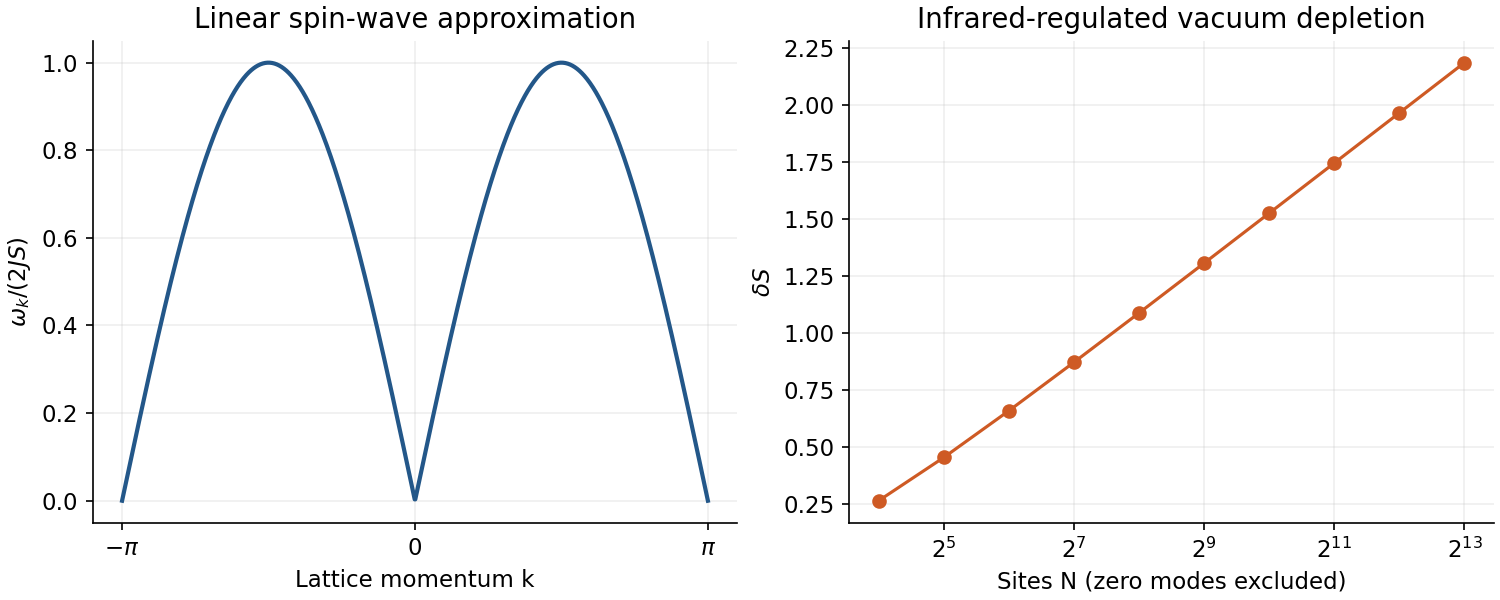
Linear antiferromagnetic spin-wave dispersion and logarithmically growing one-dimensional vacuum depletion
. Source. Details. Choose the reference staggered direction so its classical moment is positive. The Bogoliubov vacuum has , henceNear each soft point the integrand is proportional to , so the one-dimensional thermodynamic integral diverges logarithmically. The ordered-reference expansion fails; it does not predict a physical negative magnetization. Long-range Néel order is destroyed in this isotropic one-dimensional setting. The exact finite symmetric ground state also has zero staggered expectation without selecting a direction.
For linearly dispersing modes in dimensions, zero-temperature depletion behaves as and is infrared finite for , allowing order in suitable two- and three-dimensional antiferromagnets. Finite depletion is not a guarantee for every frustrated quantum magnet. At nonzero temperature, the extra Bose occupation changes the singularity to : short-range isotropic systems cannot sustain continuous-symmetry long-range order for . This thermal conclusion is distinct from the one-dimensional zero-point argument.
A Wick rotation changes real-time evolution into . At , taking the trace integrates equal endpoints:Thus temperature sets the imaginary-time circumference, and bosonic coordinate paths are periodic. The measure is fixed by the short-time propagator. The trace sums paths, not just a single stationary trajectory; a quadratic action is special because the saddle plus Gaussian fluctuations is exact.
Put and . With equal endpoints , the Euclidean classical path and its action areWrite , where . Sine modes have fluctuation eigenvalues . Relative to the free-particle determinant, their Gaussian integral contributesMultiplying the free prefactor gives the Euclidean oscillator diagonal kernelIntegrating this over the common endpoint is precisely the trace. All fluctuations here are Dirichlet fluctuations about a fixed-endpoint path; periodicity is imposed on the full trace after endpoint integration.
The endpoint integral is a Gaussian with coefficient . ThereforeIt agrees with , tends to at high temperature, and to at low temperature. The last limit retains the oscillator zero-point energy.
For unnormalized coherent states, , and . Insert this identity between short imaginary-time evolutions. The overlaps generate , while the normal-ordered symbol of givesHere runs from zero to ; the exponent is dimensionless. The bosonic trace makes the complex fields periodic, not antiperiodic.
The printed expression omits the explicit vacuum factor. It represents the full oscillator only if a symmetric/Weyl determinant prescription implicitly includes that factor. With the ordinary normal-ordered time-sliced coherent-state measure, it instead represents . The continuum formula alone does not specify the energy-zero convention.
Let , use time slices and . The exact normal-ordered coherent Gaussian has cyclic matrix , where shifts one slice. Its eigenvalues are andRestoring the constant energy givesconsistent with the coordinate path integral. Alternatively, pairing positive and negative Matsubara frequencies symmetrically yields a determinant proportional to . This symmetric prescription already incorporates the zero-point convention and must not receive the vacuum factor twice. A naive unregulated frequency product can hide this difference.
The real-time path integral sums over paths. In a classically forbidden region, the dominant semiclassical contribution is clearer after Wick rotation: the weight becomes and stationary paths obey , equivalent to motion in the inverted potential. A finite-action path joining degenerate minima is an instanton.
For , , zero Euclidean mechanical energy gives . ThusThe reversed trajectory is an anti-instanton.[ref] Expanding produces the fluctuation operator . Its translation zero mode is handled by integrating the collective centre , not by dividing by a zero determinant. The remaining determinant and Jacobian form an attempt-frequency prefactor .
When , well-separated events form a dilute gas with rate scale . Paths returning to the same well have an even number of events, while paths ending in the other well have an odd number. The sums yield and , givingThe ground state is the lower symmetric combination of localized well states: tunnelling lifts the apparent classical degeneracy. This splitting is nonperturbative in , beyond a power series about either minimum. In a metastable well a bounce, with a negative fluctuation mode, describes decay rather than the stable doublet splitting. Finite temperature, overlapping events or a low barrier require improvements beyond the dilute approximation.
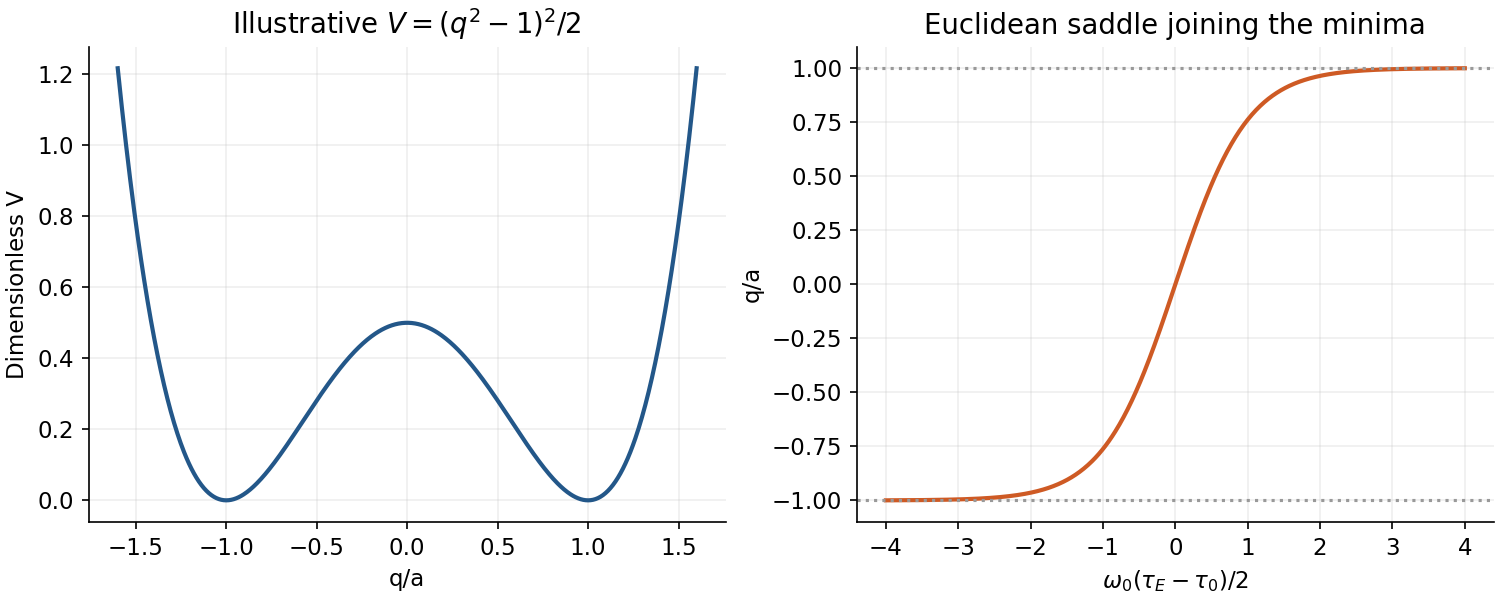
An original quartic double well and its Euclidean instanton trajectory
. Source. Details. A coherent state is an eigenstate of an annihilation operator. Bosonic unnormalized states have exponential overlap and the Gaussian resolution of identity used above; their overcompleteness supplies a phase-space integration measure, not an orthonormal state count. For a normal-ordered many-body Hamiltonian, coherent-state insertion gives the bosonic coherent-state path integralConstants in must be retained. The exact time-sliced prescription places creation and annihilation symbols on adjacent slices; discarding that prescription can change ordering corrections, as the oscillator example demonstrates. The derivative term is first order because the fields describe phase space.
Fermionic coherent states instead use Grassmann variables. Their Gaussian identity is , whereas complex bosons give . Anticommutation in the trace produces antiperiodic fields. Accordingly bosons have , fermions , in these inverse-energy time units.
For one mode of grand-canonical energy , the products give and ; convergence requires for the bosonic Gaussian. Correlation functions follow by source differentiation. Quartic interactions can be treated perturbatively or decoupled with a Hubbard–Stratonovich transformation; a saddle then describes an order parameter and quadratic fluctuations its collective modes. Such saddles require stability and an appropriate control parameter; the functional notation alone is not an exact solution of an interacting problem.
For a dilute three-dimensional weakly interacting Bose gas with repulsive short-range scattering, use a contact coupling and . In imaginary time , the grand-canonical action isThe uniform saddle has . Its real-time equation is the Gross–Pitaevskii equation; quantum depletion means condensate and total density need not coincide exactly.
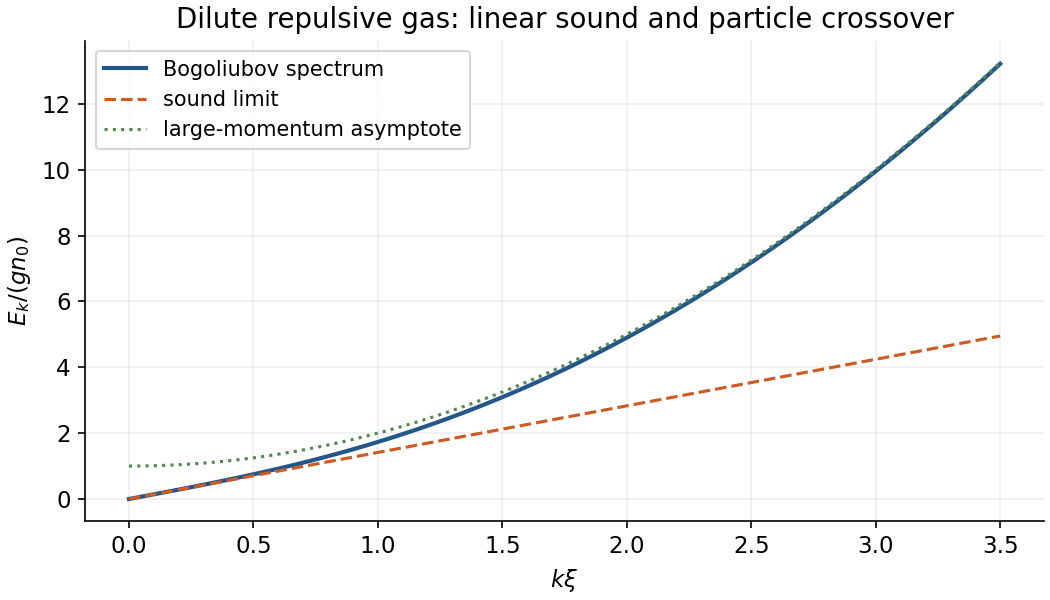
Writing and retaining quadratic fluctuations gives a Nambu kernel with diagonal , anomalous coupling and . The Bogoliubov quasiparticle dispersion isPhase and density fluctuations form the gapless sound mode associated with broken global symmetry. At large momentum the spectrum crosses towards particle behaviour; the healing length is . The depletion integral is finite in three dimensions and gives to leading order. The contact coupling denotes a scattering-length-renormalized interaction; naive ultraviolet zero-point integrals require renormalization.
The condensate phase gives superfluid velocity and quantized circulation . The Landau criterion, , gives for this homogeneous Bogoliubov spectrum. Boundaries and vortex nucleation can cause dissipation below that value, so it is not a universal measured critical speed. Condensation and superfluid stiffness are related but distinct; dimensional fluctuations can remove true condensate order while retaining superfluid responses.


Articles by others on the same topic
There are currently no matching articles.