The real-time path integral sums over paths. In a classically forbidden region, the dominant semiclassical contribution is clearer after Wick rotation: the weight becomes and stationary paths obey , equivalent to motion in the inverted potential. A finite-action path joining degenerate minima is an instanton.
For , , zero Euclidean mechanical energy gives . ThusThe reversed trajectory is an anti-instanton.[ref] Expanding produces the fluctuation operator . Its translation zero mode is handled by integrating the collective centre , not by dividing by a zero determinant. The remaining determinant and Jacobian form an attempt-frequency prefactor .
When , well-separated events form a dilute gas with rate scale . Paths returning to the same well have an even number of events, while paths ending in the other well have an odd number. The sums yield and , givingThe ground state is the lower symmetric combination of localized well states: tunnelling lifts the apparent classical degeneracy. This splitting is nonperturbative in , beyond a power series about either minimum. In a metastable well a bounce, with a negative fluctuation mode, describes decay rather than the stable doublet splitting. Finite temperature, overlapping events or a low barrier require improvements beyond the dilute approximation.
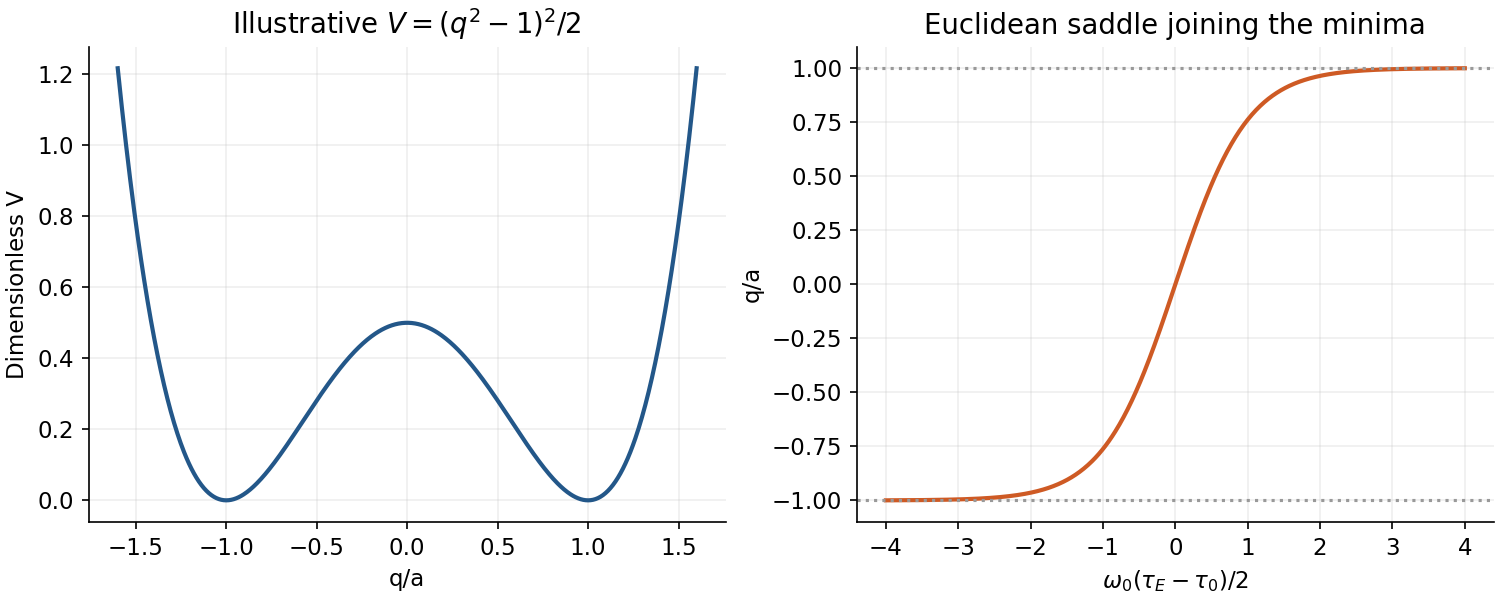
An original quartic double well and its Euclidean instanton trajectory
. Source. Details. A coherent state is an eigenstate of an annihilation operator. Bosonic unnormalized states have exponential overlap and the Gaussian resolution of identity used above; their overcompleteness supplies a phase-space integration measure, not an orthonormal state count. For a normal-ordered many-body Hamiltonian, coherent-state insertion gives the bosonic coherent-state path integralConstants in must be retained. The exact time-sliced prescription places creation and annihilation symbols on adjacent slices; discarding that prescription can change ordering corrections, as the oscillator example demonstrates. The derivative term is first order because the fields describe phase space.
Fermionic coherent states instead use Grassmann variables. Their Gaussian identity is , whereas complex bosons give . Anticommutation in the trace produces antiperiodic fields. Accordingly bosons have , fermions , in these inverse-energy time units.
For one mode of grand-canonical energy , the products give and ; convergence requires for the bosonic Gaussian. Correlation functions follow by source differentiation. Quartic interactions can be treated perturbatively or decoupled with a Hubbard–Stratonovich transformation; a saddle then describes an order parameter and quadratic fluctuations its collective modes. Such saddles require stability and an appropriate control parameter; the functional notation alone is not an exact solution of an interacting problem.
For a dilute three-dimensional weakly interacting Bose gas with repulsive short-range scattering, use a contact coupling and . In imaginary time , the grand-canonical action isThe uniform saddle has . Its real-time equation is the Gross–Pitaevskii equation; quantum depletion means condensate and total density need not coincide exactly.
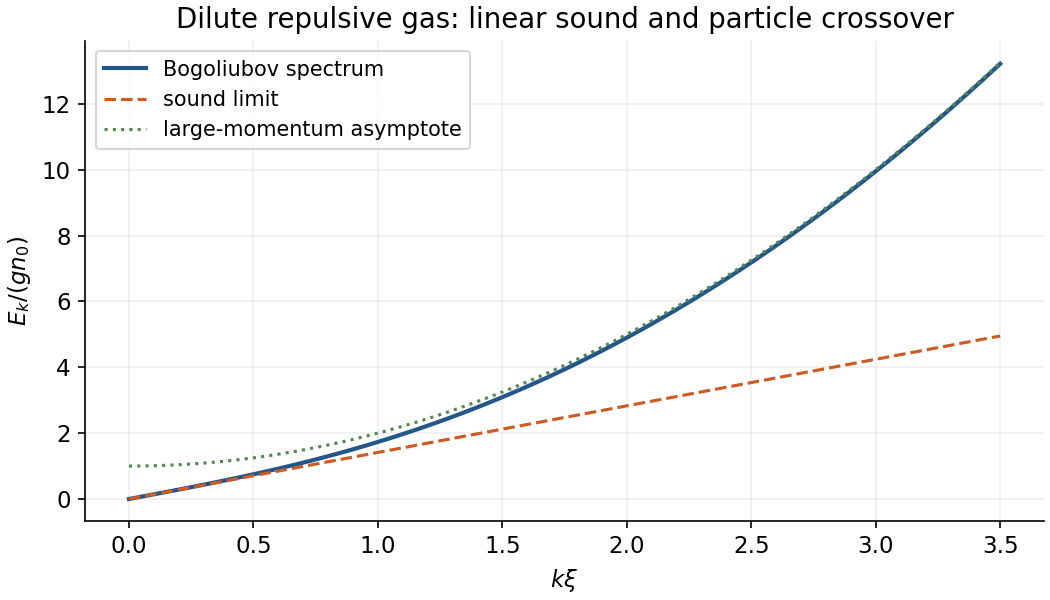
Writing and retaining quadratic fluctuations gives a Nambu kernel with diagonal , anomalous coupling and . The Bogoliubov quasiparticle dispersion isPhase and density fluctuations form the gapless sound mode associated with broken global symmetry. At large momentum the spectrum crosses towards particle behaviour; the healing length is . The depletion integral is finite in three dimensions and gives to leading order. The contact coupling denotes a scattering-length-renormalized interaction; naive ultraviolet zero-point integrals require renormalization.
The condensate phase gives superfluid velocity and quantized circulation . The Landau criterion, , gives for this homogeneous Bogoliubov spectrum. Boundaries and vortex nucleation can cause dissipation below that value, so it is not a universal measured critical speed. Condensation and superfluid stiffness are related but distinct; dimensional fluctuations can remove true condensate order while retaining superfluid responses.


Articles by others on the same topic
There are currently no matching articles.