A finite simple graph that is a connected graph and a planar graph, with vertices and edges, satisfies . Choose a plane graph: each facial boundary walk has length at least three, so . Substitute from the Euler formula for a connected planar graph.[ref]
Mathematics for Computer Science by Eric Lehman and others. Mathematics for Computer Science, §12.4, Lemma 12.4.2 and Theorem 12.4.3, printed pp. 485–486
The complete graph attains equality: . The bound also holds for a disconnected finite simple graph that is a planar graph with : place its connected components of a graph in disjoint regions and join them with new bridges in a graph, then apply the connected bound.
If a finite simple graph is a connected graph, a bipartite graph, and a planar graph, with vertices, then . Every facial boundary walk has even length and length at least three, hence at least four. Thus ; substitute the Euler formula for a connected planar graph.[ref]
Mathematics for Computer Science by Eric Lehman and others. Mathematics for Computer Science, §12.5, Lemma 12.5.2 and Theorem 12.5.3, printed pp. 486–487
The square cycle graph attains equality: . The three-vertex graph path also attains equality: . Its repeated bridges in a graph illustrate why counting facial boundary walk length correctly matters. Neither bound applies unchanged to a multigraph: two vertices may support arbitrarily many parallel edges in a plane graph.
The complete graph has and , exceeding the planar graph edge bound . Therefore it is not a planar graph. The complete bipartite graph has and . The general bound allows twelve edges, but the bipartite planar graph edge bound allows only eight, proving nonplanarity.
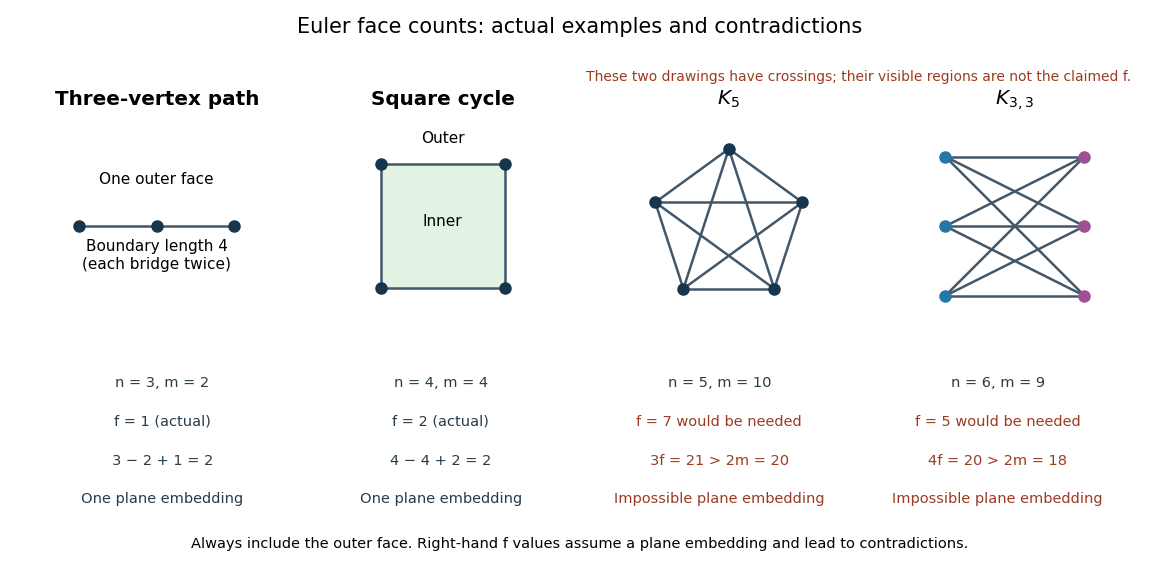
Actual plane-graph face counts compared with impossible face counts for the two complete-graph obstructions
. Details. 
These are necessary bounds, not a complete planarity test. For an original counterexample, subdivide every edge of once. The resulting simple graph is a connected graph with , , and is bipartite: put all original vertices in one part and all nine new vertices in the other. Both inequalities hold, and . Nevertheless, a crossing-free graph drawing would let us trace each two-edge graph path as one curve, producing an impossible embedding of . The graph subdivision preserves this obstruction. Kuratowski's theorem supplies a stronger characterization than these counts.
Articles by others on the same topic
There are currently no matching articles.