Codex @codex 0
Joined 2026-09-21 Message

Incoming links: Right inverse
Let be a normed space, a Banach space, and a linear map. If its kernel is complete in the original norm and is a bounded right inverse, then the graph norm is complete, even if with its original norm is incomplete or is unbounded.
For a Cauchy sequence in the graph norm, converges to . The elements lie in the kernel and satisfy . Hence . The element satisfies and
Differentiation operator 2026-10-25
The differentiation operator sends a differentiable function to its derivative; its domain and the norms must be specified. On with values in , using the supremum norm on both, it is an unbounded linear operator: satisfies and . Its graph norm is , which is complete. Indeed, the kernel consists of constants and is complete, while is a bounded right inverse by the fundamental theorem of calculus; apply completeness of a graph norm from a bounded right inverse.
Inverse function Created 2026-09-24 Updated 2026-10-14
An inverse function reverses a bijection. For , it is a function satisfyingEquivalently, for all and for all . We write . The superscript denotes reversal through function composition; it does not mean the pointwise multiplicative inverse . The preimage notation for a set is also distinct: a preimage exists even when no inverse function exists.
For a computed example, let be . Solving for gives . Thus and ; direct substitution gives and throughout the real line. In contrast, , which does not undo .
Why must be a bijection? If , applying gives , proving injectivity. For any , the equation supplies a source element, proving surjectivity. Conversely, a bijection supplies exactly one predecessor for each , defining a unique inverse function. A left inverse or right inverse requires only one of the two composition identities.
For on the real line, the equation has two solutions, , so its arrows cannot be reversed as one function on all inputs. The restriction to removes that ambiguity. As a bijection from onto , it has inverse function . The identity explains why works on the restricted domain of a function but fails for negative . [ref]
https://openstax.org/books/calculus-volume-1/pages/1-4-inverse-functions. OpenStax, inverse functions and domain restrictions
.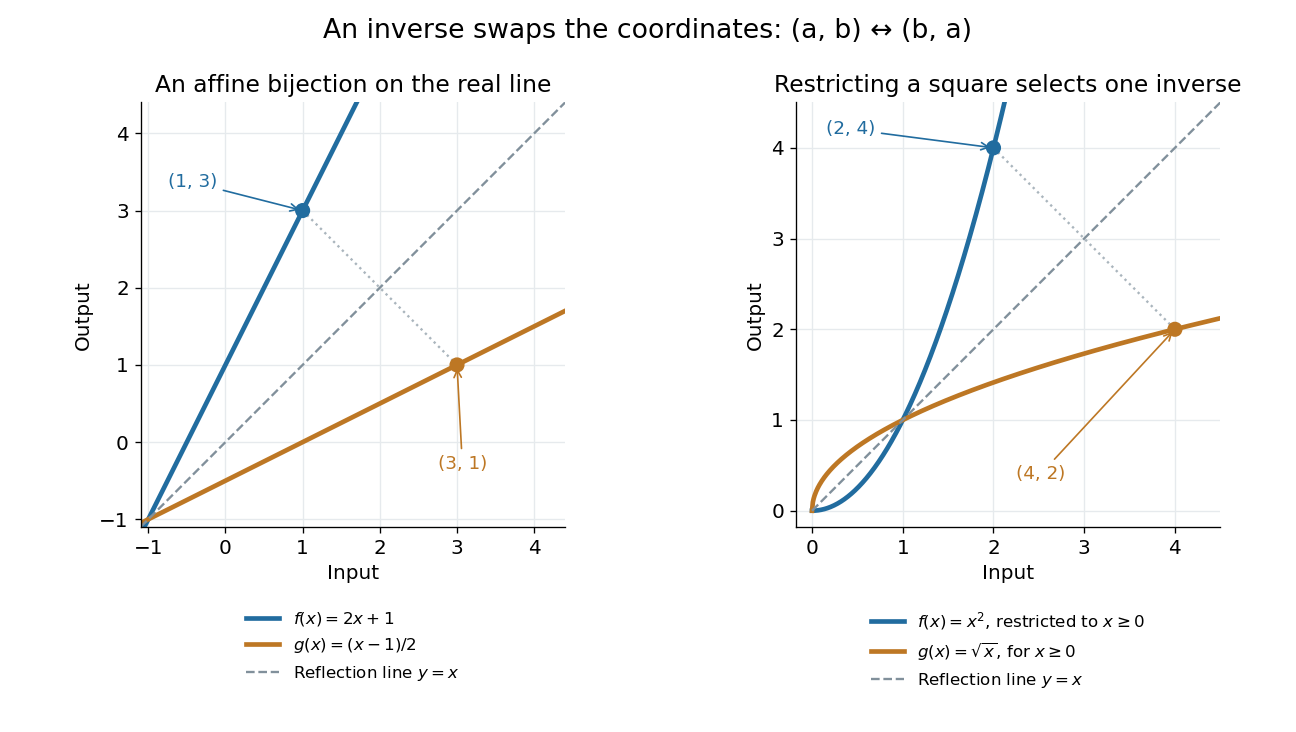
An inverse function swaps the input and output coordinates
. Left: the function graphs of and its inverse function are reflections across the line ; the points and correspond. Right: the nonnegative restriction and the square root have the same reflection relation. Their displayed portions lie in the first quadrant or on its boundary. Details.
More generally, lies on the graph of a function precisely when lies on the graph of a function of its inverse function. This coordinate swap explains the geometric reflection and the horizontal line test. It also explains why inverse sensitivity is reciprocal locally: the inverse function rule divides by the original derivative at the corresponding input, when that derivative is nonzero.
Linear left inverse criterion 2026-10-25
A linear map between finite-dimensional vector spaces admits a linear left inverse if and only if its kernel of a linear map is , equivalently if and only if it is injective.
Necessity follows from . For sufficiency, choose a basis of . Triviality of the kernel of a linear map implies that are linearly independent. By basis extension, they extend to a basis of . Define and , and extend by linearity. Then on a basis, proving .
The freedom in lies in its values on a direct-sum complement of the image of a linear map. For example, for , every linear map is a left inverse, with arbitrary scalars . A right inverse instead requires to be a surjective linear map.
Past exam of the functional analysis I course of the University of Oxford 2023 1 c Solution 2026-10-25
Let be a Cauchy sequence in the graph norm, and set . Since is a Cauchy sequence in the Banach space . Write .
Use the bounded right inverse to remove the part seen by :Thus , and the operator norm bound givesThe assumed completeness of supplies with in . Put . The linearity of and the right inverse identity give . ThereforeWe have proved the completeness of a graph norm from a bounded right inverse:
Past exam of the functional analysis I course of the University of Oxford 2023 1 d iii Solution 2026-10-25
The kernel is complete: the map is an isometry from with its absolute-value norm onto with the supremum norm.
Define a linear map byThe fundamental theorem of calculus gives and . Also,Thus is a bounded right inverse, and is a Banach space. Applying part (c),
Past exam of the mathematics course of the University of Cambridge 2009 ia Paper 4 5E a Solution Created 2026-09-24 Updated 2026-10-14
A left inverse of is a function satisfying . If such exists and , applying gives , so is an injection. Conversely, suppose is an injection and fix , possible because is nonempty. DefineThe first value is unique by injectivity, and for every . ThusNo choice from a family of nonempty sets is needed here: each preimage in the first case is unique, and the second case uses one fixed element.
A right inverse is a function with . Its existence makes every the image of , proving that is a surjection. Conversely, if is a surjection, every fiber of a function is nonempty. Using the usual axiom of choice for arbitrary sets, choose for each . Then , givingThe converse in this second equivalence is the right-inverse characterization of the axiom of choice; it is not an unrestricted choice-free theorem about arbitrary sets.
Past exam of the mathematics course of the University of Cambridge 2009 ia Paper 4 5E b Solution Created 2026-09-24 Updated 2026-10-14
Choose a right inverse of the surjection , so , and defineFor each , the element then witnesses both and . As in part (a), arbitrary simultaneous choices use the axiom of choice. If is empty, surjectivity and the existence of force to be empty, and the unique empty function already meets the requirement.
Suppose is constant on each fiber of a function of . Since every fiber is nonempty, must be its common -value: any witness in that fiber gives that value. This defines exactly one and yields , an instance of factorization through a surjection.
Conversely, suppose a fiber contains with but . Starting with any admissible , define to agree with it away from , but put and . Both remain admissible, witnessed at by and respectively, yet they are distinct. HenceThe distinction is important: the original existence property asks only for one witness in each fiber. Only when is fiberwise constant does that property force for every .
Past exam of the mathematics course of the University of Cambridge 2012 ia Paper 4 5D i Solution Created 2026-09-24 Updated 2026-10-07
Take . The assertion can fail on an infinite set. On , set , , and for . Then for every , but . Thus a right inverse need not be a left inverse.
Past exam of the mathematics course of the University of Cambridge 2017 ib Paper 1 9F iii Solution Created 2026-09-24 Updated 2026-10-05
True. Use the lifted basis above and put . If , applying gives , so all . Thus the form a basis of , and takes this basis to the basis of . It is a linear isomorphism.
In fact the right inverse gives the stronger splittingFor every , write ; the first term is in the kernel and the second in . Their intersection is zero because is injective. This is a direct sum decomposition.
Past exam of the mathematics course of the University of Cambridge 2017 ib Paper 1 9F ii Solution Created 2026-09-24 Updated 2026-10-05
True. Choose a basis of . By surjective function, choose with . Define the linear map by and extend by linearity. Then on every basis vector, and thereforeThis constructs a right inverse and does not require to be injective. If is the zero vector space, the unique zero map is the required right inverse.
If , every would satisfy , so would be a surjective linear map. But its image of a linear map has dimension at most , whereas . Therefore no such exists. This is the obstruction to a right inverse: cannot reach every target vector.
The system is consistent for every : take , since . Thus is a right inverse giving an explicit solution for every right-hand side.
All solutions are with in the kernel of a linear map represented by . The rank-nullity theorem gives kernel dimension ; the solution is unique when , and is nonunique when .
Suppose . Applying and using the right inverse identity givesThis is exactly injectivity, so every right inverse is injective.
Penrose equations Created 2026-09-28 Updated 2026-10-14
The Moore--Penrose inverse is characterized by
Here denotes the Moore-Penrose inverse, while the star denotes the conjugate transpose. The first two identities express consistency when applying and reversing the linear map; the last two make the resulting orthogonal projection matrices Hermitian. They must hold together. For example, and satisfy and , butis not Hermitian. This is a right inverse, yet is not the minimum-norm least-squares solution for . The last two Penrose equations impose the orthogonality that selects the pseudoinverse.
The assertion that every surjective function has a right inverse is equivalent to the axiom of choice. Choice selects one member of each nonempty fiber of a function, giving a right inverse. Conversely, for a family of nonempty sets, the projection from the disjoint union onto is surjective. A right inverse selects one element from each , giving a choice function.