Consider a stipulated synchronous shared computer bus, rather than a timing claim about any named hardware protocol. Assume a 32-bit data bus, a 100 MHz clock, and one four-byte payload transfer per bus cycle during the data phase. Both initiators A and B request at time zero. A has one four-transfer write bus burst and B one two-transfer write bus burst, to an immediately ready target in computer memory. Each bus burst pays one bus cycle for bus arbitration and one for its starting address and command; subsequent addresses advance implicitly. The arbiter chooses A first, owners finish their entire bus bursts, and no phases overlap. There are no bus wait states, retries, extra completion cycles, direction changes or intervening requests. Payload is counted when each data phase completes; the observation interval starts at the first bus arbitration cycle and ends at the last payload completion.
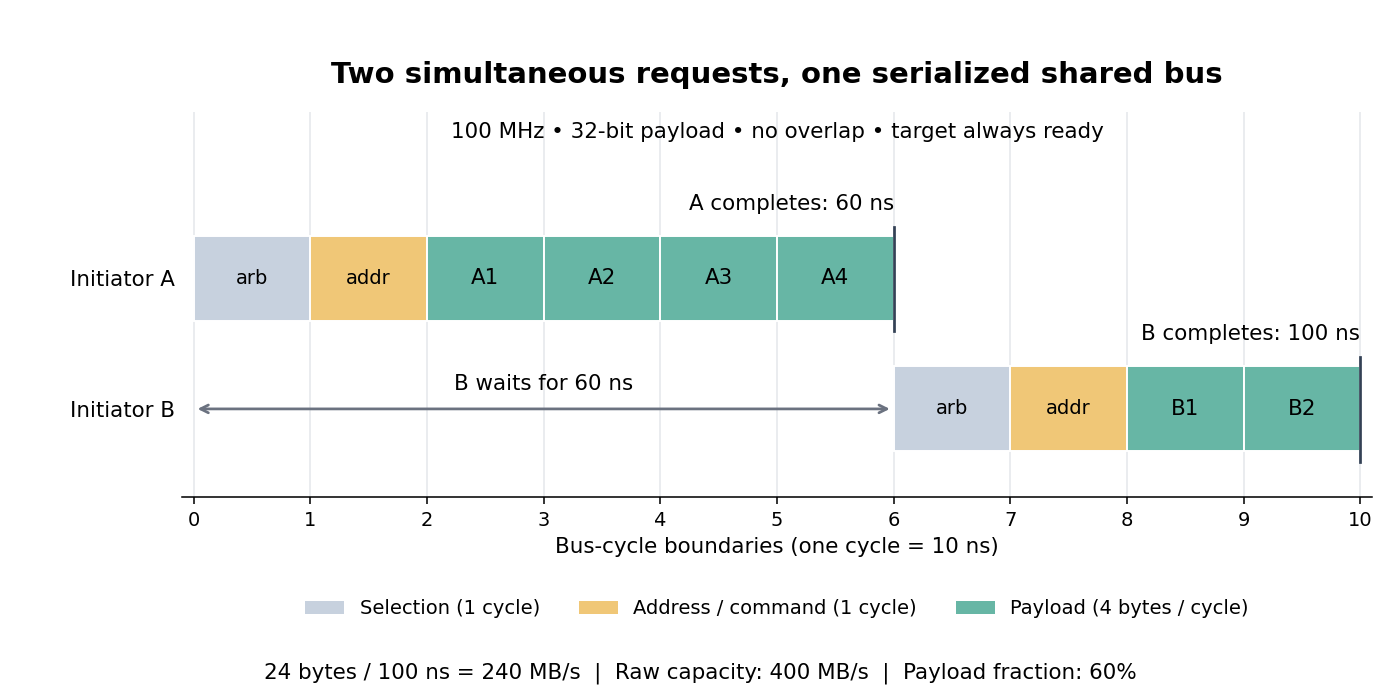
Stipulated bus arbitration and payload timing for two competing bus bursts
. Details. 
A bus cycle lastsThe timeline uses half-open intervals of bus cycles: A has bus arbitration on [0,1), address and command on [1,2), and four payload transfers on [2,6). Then B has bus arbitration on [6,7), address and command on [7,8), and two payload transfers on [8,10). Their final payload completions are at 60 ns and 100 ns respectively. B waits 60 ns before its own selection cycle even though both requests arrived together.
T=100×106 s−11=10 ns.
The six payload transfers contain 24 bytes. Ten bus cycles take 100 ns, giving finite-interval bus throughputwhere MB means 106 bytes. The raw data bus rate is 4 bytes×100×106 s−1=400 MB/s. Payload occupies 6/10=60% of the interval. If this same pair repeats with no gaps, its long-run bus throughput equals the finite-interval value; isolated observations need not predict a later workload.
R=100 ns24 bytes=240×106 bytes/s=240 MB/s,
Reverse the bus arbitration order, keeping these assumptions. B finishes after four bus cycles, at 40 ns; A finishes at 100 ns. Aggregate bus throughput stays 240 MB/s, but B's request-to-completion time falls from 100 ns to 40 ns and A's rises from 60 ns to 100 ns. Scheduling changes who waits without changing the available payload capacity in this example.
For an independent perturbation, retain A first and add two bus wait states before B's final payload transfer. The interval grows to 120 ns with the same 24 bytes, so bus throughput falls to 200 MB/s. For another workload, one initiator sends all six transfers in a single bus burst: the stipulated overhead is paid once, giving eight bus cycles, 80 ns and 300 MB/s. This latter comparison assumes one combined request is valid; combining different initiators' operations is not automatically permitted.
There are no discussions about this article yet.
Articles by others on the same topic (NaN)
There are currently no matching articles.