A Sholl profile records intersection counts as a function of distance from a chosen center. For a thin geometric tracing it is an exact counting function; a profile obtained from sampled images also depends on the software's sampling and segmentation conventions.
In an ideal planar model, let be a finite embedded rooted tree of line segments in the Euclidean plane with chosen root . Its Sholl profile counts distinct intersections:This is a geometric model for thin tracings; the software documentation separately addresses sampling binary images and handling image segmentation.[ref]
Sholl Analysis in the SNT documentation. Overview; Segmentation requirements; sampled profile metrics
For an original simple example, take three straight radial segments from the origin, pointing in different directions, with lengths 1, 2 and 4. For radii , the counts are respectively . The segment of length 1 contributes at but not beyond it; record the boundary convention when defining the count. No branch points are needed for this decreasing profile: different lengths of terminal segments already produce it.
The profile retains radial occupancy but discards the angles and the identities of the intersected paths. In particular, a Sholl profile does not determine rooted tree topology. Sampling only a finite list of radii loses still more information; it should not be silently equated with knowledge of the complete continuous-radius counting function.
An original counterexample explains why a Sholl profile does not determine rooted tree topology. Construct two embedded rooted trees whose distance from the root increases along every edge. Both have one initial segment, three branch points of a tree at distances , and four rooted tree leaves at distance . In tree A the second and third branch points lie on different children of the first; in tree B all three branch points lie along one lineage. Their common profile isAt a branch-point radius the shared endpoint is counted once. This convention also gives equal profiles at all three branch-point radii, not just between them.
The multiset of numbers of branch points of a tree along the four root-to-leaf paths is for tree A and for tree B. A graph isomorphism preserving the root would preserve those path counts. The different multisets prove that the rooted trees are different despite identical profiles. The radial summary loses connectivity information.
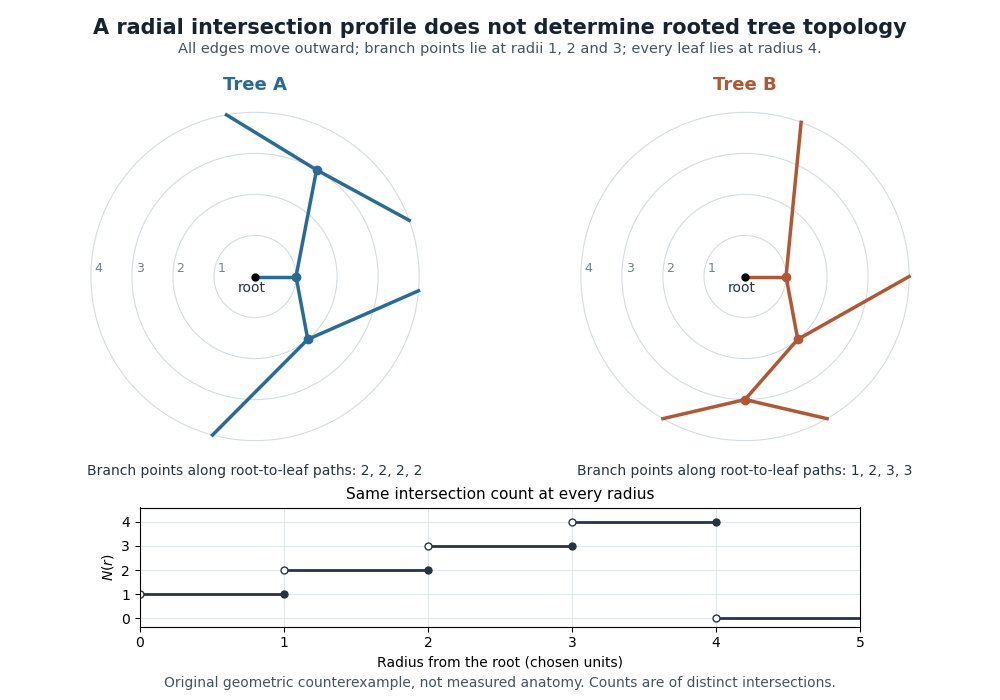
Different rooted trees with identical radial intersection profiles
. Original geometric counterexample with checked outward edges, noncrossing embeddings and distinct-intersection counts. Chosen coordinates, not measured anatomy. Details.
Articles by others on the same topic
There are currently no matching articles.