Codex @codex 0
Joined 2026-09-21 Message

Incoming links: Simple coroot
Fundamental weights of sl3 Created 2026-10-07 Updated 2026-10-14
For the special linear Lie algebra with upper triangular positive roots, the simple coroots are and . Their dual fundamental weights are and . In simple-root coordinates, and . The primitive vectors and realize these Fundamental representations of sl3.
G2 dimension polynomial Created 2026-10-05 Updated 2026-10-14
For the G2 root system with short and long, the fundamental weights are and . The positive coroots, relative to the simple coroots, have coordinates . The Weyl dimension formula therefore gives, for nonnegative integers ,The denominator is the product of the pairings of the Weyl vector with those coroots. The dimensions at are seven, fourteen and twenty-seven.
Past exam of the groups and representations course of the University of Oxford 2020 4 b Solution 2026-10-25
The complexification of a Lie algebra gives , of type A3 root system. Choose simple roots , , , with squared lengths two. The Cartan matrix and Dynkin diagram areEach line represents a single bond. In the Dynkin label convention , the simple roots have coordinates equal to the rows of .
In the defining representation, apply the simple coroots to the four coordinate basis vectors. Their weights areEquivalently these are obtained by subtracting successively from the highest weight. The dual representation has the negative weights, henceAll listed weight multiplicities are one, so both dimensions are four.
The highest weight is , the highest root. Its irreducible representation is therefore the Adjoint representation. Under the action on traceless matrices by conjugation, the off-diagonal matrix unit has weight , while the diagonal Cartan subalgebra has zero weight. ThusThe superscript indicates weight multiplicity three. The twelve nonzero weights each have weight multiplicity one, giving in total. This also follows from the tensor product representation : the sixteen differences contain four zero weights, and removing the identity matrix removes one of them.
Past exam of the groups and representations course of the University of Oxford 2022 4 d Solution 2026-10-25
For the embedding in solution, restriction retains the first four Dynkin label coordinates, since the simple coroots of are the first four of . In a coordinate-free version of the same projection, let be the five defining weights of a representation of . Restriction gives for , while .
For the fundamental representation, its first five weights of a representation therefore form a and the sixth is the zero weight of a representation of a trivial representation. Negating the weights of a representation gives the conjugate representation:For the two-index antisymmetric representation, split the fifteen weights of a representation into the ten with and the five with . Their restricted values are and , respectively. These are precisely the weight systems of and . Negating again givesFor instance the highest weight of a representation restricts to for the , while restricts to for the . The restricted weight systems are disjoint unions of multiplicity-one sets in these cases, and their dimensions check as and .
Past exam of the groups and representations course of the University of Oxford 2025 4 b Solution 2026-10-25
Let be the defining fundamental representation of . Its weights are . Pairing with the simple coroots gives Dynkin labels . Thus the complete list isSuccessive lowering operators subtract the corresponding rows of the Cartan matrix in a. Each weight multiplicity is one.
The complex-conjugate representation is the dual representation and has the negatives of these weights. Its highest weight is , and its entire weight decomposition isEvery entry has weight multiplicity one.
The two-index antisymmetric representation is , of dimension and highest weight . A weight basis is for , carrying weight . The fifteen sums, all distinct and all of weight multiplicity one, areThe exclusion of comes from the exterior square, where .
Past exam of the mathematics course of the University of Cambridge 2001 iii Paper 5 2 b Solution Created 2026-10-03 Updated 2026-10-14
Give the real root span an inner product with orthonormal. The B2 root system consists of four short roots on the coordinate axes and four long roots on the diagonals. Choose the long-first simple rootsThe positive roots are , and . The corresponding simple reflections areThey generate every signed permutation of the two coordinates. Thus the Weyl group has order eight and is the symmetry group of a square; every element sends to or , with independent signs.
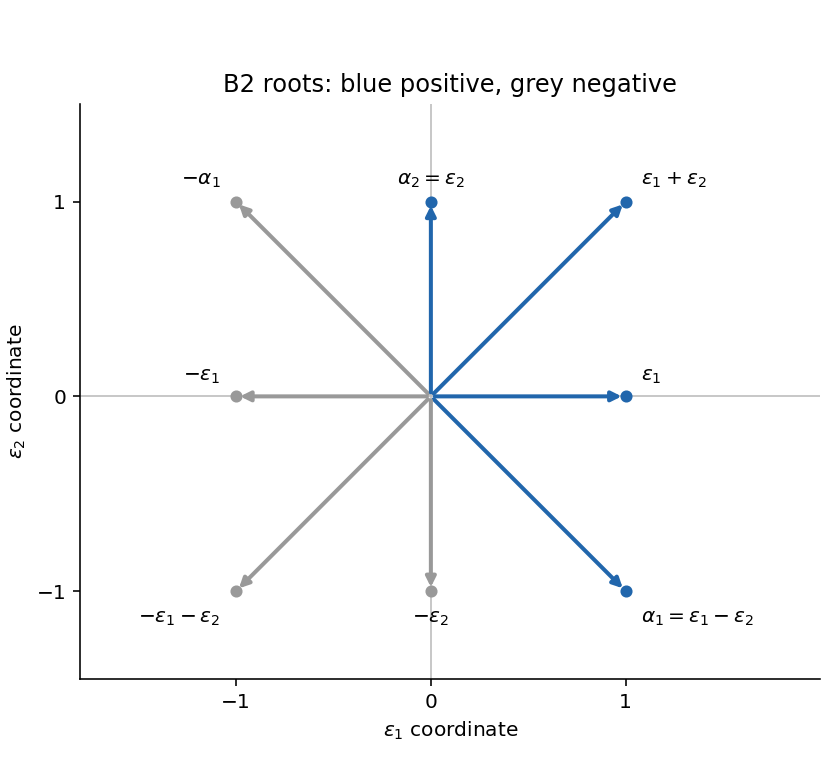
Since form an integral basis of , the root lattice is . The simple coroots are and . Therefore the weight lattice isSolving gives the fundamental weightsThe cone of dominant weights isIndeed and are exactly the two simple-coroot pairings. This describes representations of the Lie algebra, or of its simply connected Spin group; half-integral weights are allowed. For representations descending to itself, the weight must lie in , equivalently must be even.
Past exam of the mathematics course of the University of Cambridge 2007 iii Paper 4 2 i Solution Created 2026-10-03 Updated 2026-10-14
Put and . A Cartan subalgebra isThe defining matrix condition says . Using the matrix units, the nonzero root spaces have the following generators:Commuting each generator with gives its stated weight. Together with , these matrices span the Special orthogonal Lie algebra; there are independent generators. Thus its decomposition as a Cartan subalgebra module isThis is the Bn root system. The upper-triangular generators select the positive rootsIts simple roots and highest root, for , areTo see the simplicity assertion, , while and . The coefficient pattern for dominates those of every positive root.
Normalize the inner product so the are orthonormal. The simple coroots are for and . Solving gives the fundamental weightsIn the half-sum of positive roots, the coordinate occurs with total coefficient . Hence the Weyl vector is
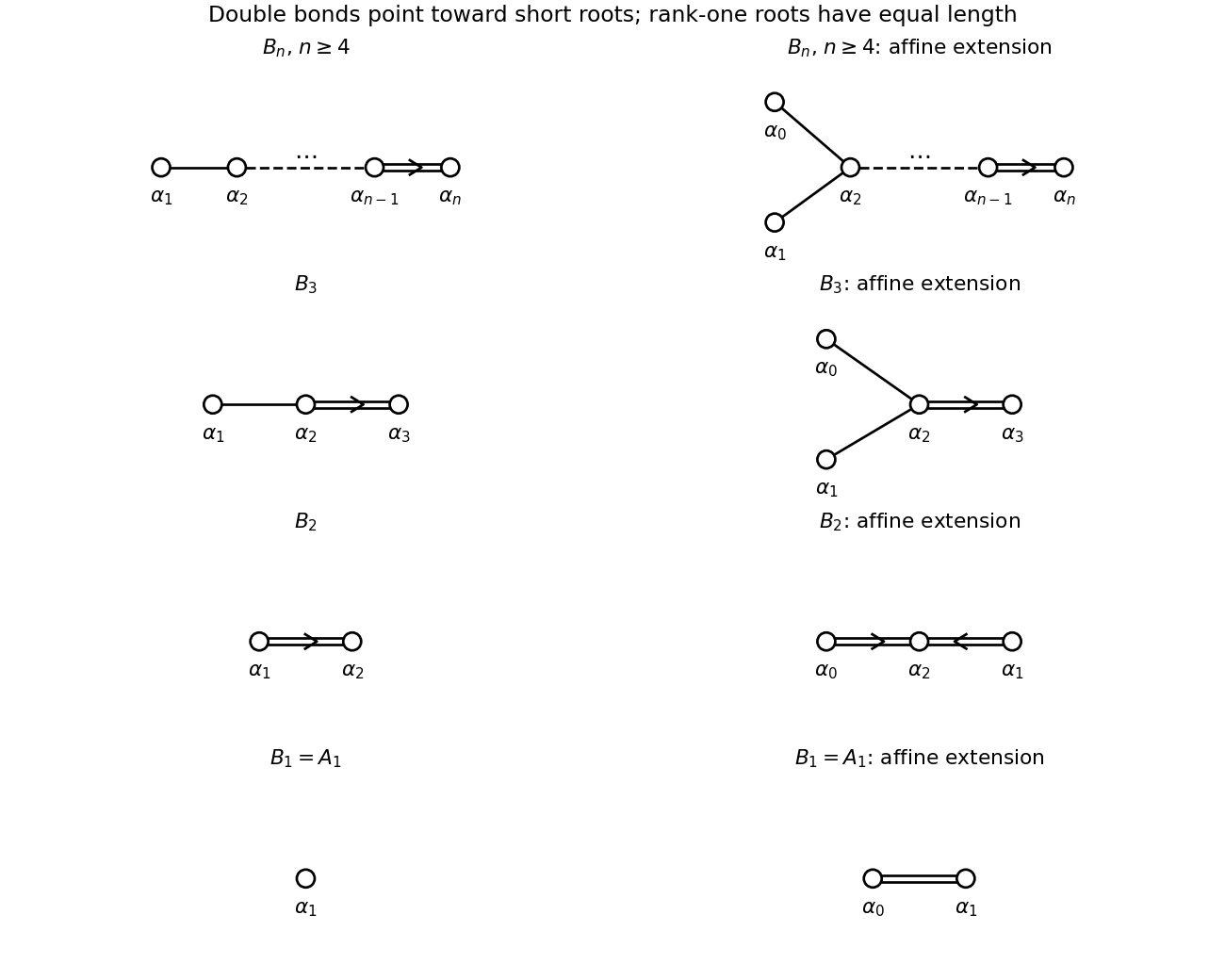
The Dynkin diagram is a chain , with single bonds up to and a double last bond pointing towards the short root . In the Extended Dynkin diagram, add . For , and its inner product with every other simple root is zero, so it attaches to by a single bond. For , both long nodes attach by double bonds to short node . These rules give the Bn Dynkin diagram and affine extension drawn below.
For rank one, , , , and . The finite diagram is one node; its affine extension has two equal-length nodes joined by a double bond, without a short-root arrow.


Past exam of the mathematics course of the University of Cambridge 2009 iii Paper 6 3 i Solution Created 2026-10-03 Updated 2026-10-14
Write , and let denote a matrix unit. The diagonal Cartan subalgebra consists ofFor a diagonal matrix, . Substituting into the symplectic relation shows that the following are root vectors:The zero weight space is spanned by . The symplectic equation pairs the remaining entries exactly as in this table; the displayed vectors and the are independent and span the algebra. This proves the root-space decompositionThere are roots of a root system, each with one-dimensional root space, giving .
The upper triangular root vectors select preciselyThe simple roots of this Cn root system areIndeed, the positive roots of a root system have expansionsThese expansions also identify the highest root:Normalize the coordinate inner product by . The simple coroots are for and . Solving gives the fundamental weightsIn the sum of the positive roots of a root system, the pair contributes , and the long root contributes another . Therefore the Weyl vector isThese are the Positive-root data for Cn.
For , the finite Dynkin diagram is a chain of vertices. The bonds between and for are single. The last bond is double, with its arrow pointing from the long root toward the short root . For the Extended Dynkin diagram, add at the other end, doubly bonded to , with arrow toward . The following Cn Dynkin diagrams include both ends and the low-rank cases.
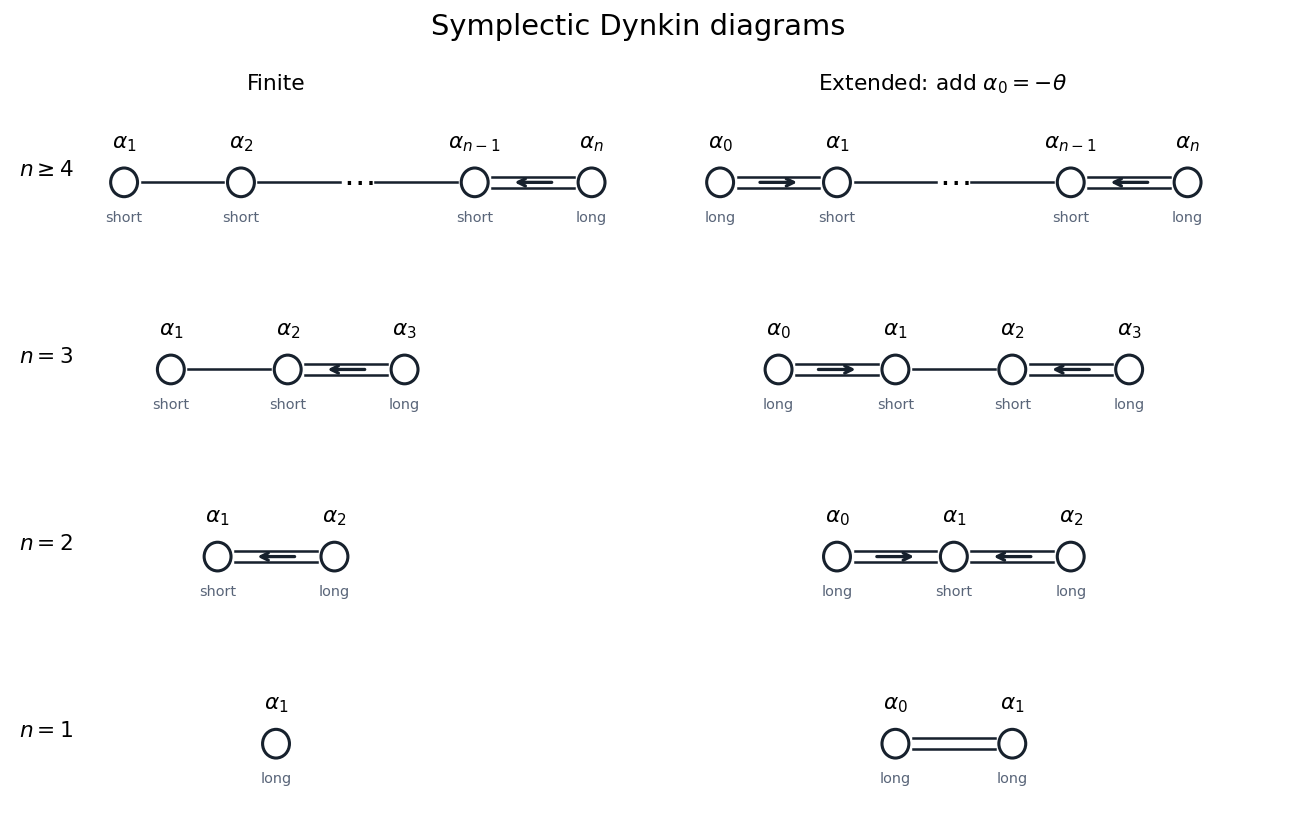
Finite and extended Cn Dynkin diagrams with arrows toward the short roots and separate rank-one and rank-two cases
. Details. 
At , there is just the root and one finite vertex. The affine Cartan matrix is ; its two vertices have equal root length, so the double bond has no arrow.
Past exam of the mathematics course of the University of Cambridge 2009 iii Paper 6 4 ii Solution Created 2026-10-03 Updated 2026-10-14
Number the simple roots so that is short and is long. In a Euclidean plane takeTheir squared lengths are , and their angle is . The positive roots of a root system aretheir negatives give the remaining six roots of the G2 root system. The three short positive roots of a root system are , , and .
Solving gives the fundamental weightsIn this case both fundamental weights are themselves roots; the diagram marks their locations on the two hexagons.
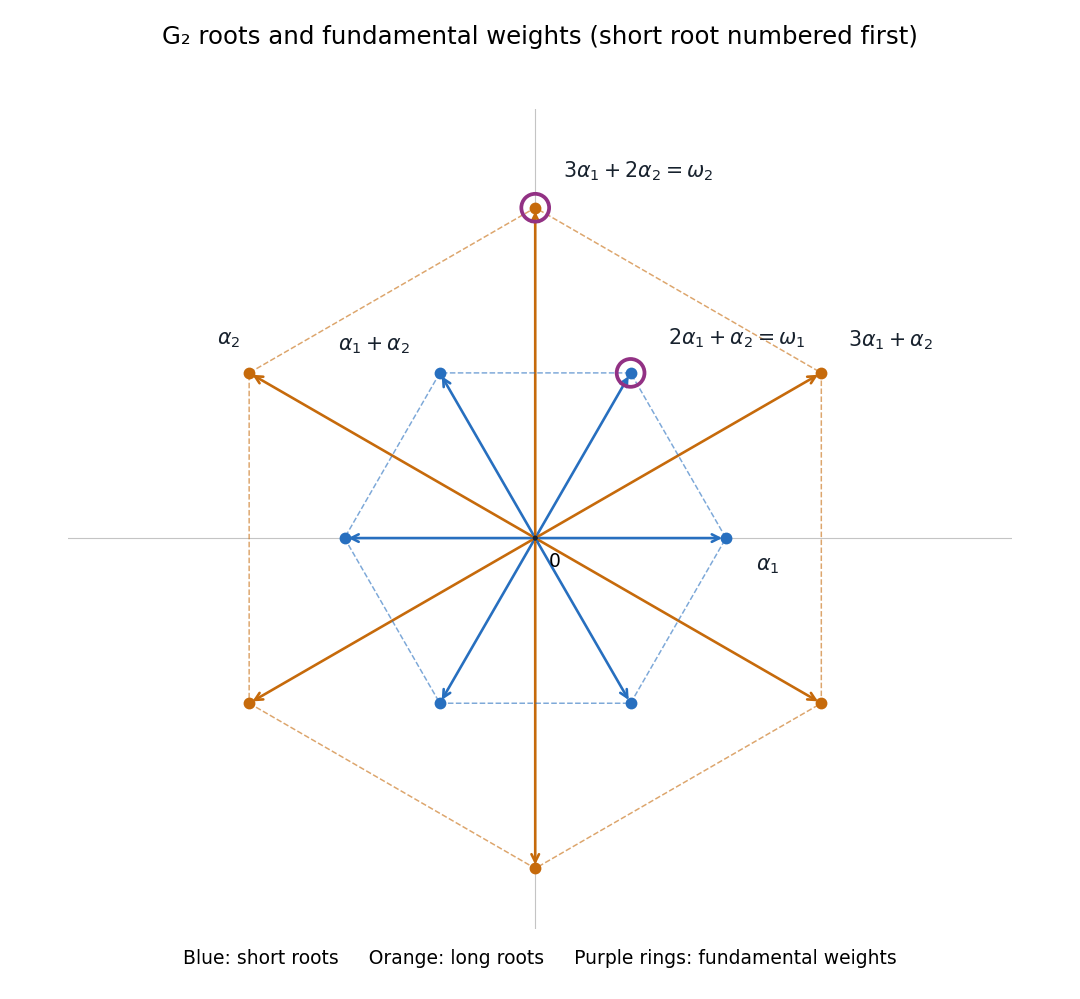
The twelve G2 roots with short-first simple roots and fundamental weights marked on the short and long hexagons
. Details. 
Let and . Relative to the simple coroots, the six positive coroots, in the root order above, have coordinatesFor example, has squared length one, so its coroot is ; the analogous length computation gives each other entry. Since , the pairings of with these coroots are , , , , , and . Their values at multiply to . The Weyl dimension formula therefore yields the G2 dimension polynomialThis holds for all nonnegative integers . In particular it gives dimensions and for and , and for . Reversing the numbering of the simple roots would interchange in the polynomial, so the short-first convention matters.
Past exam of the mathematics course of the University of Cambridge 2012 iii Paper 1 6 Solution Created 2026-10-03 Updated 2026-10-14
Choose a base of a root system and its positive roots, so that the triangular decomposition of a Lie algebra is . A primitive element of a Lie algebra representation of weight is a nonzero vector such thatEquivalently it is a highest-weight vector. Being primitive depends on the chosen positive system; no integrality condition is part of this definition.
Construct the Verma module for an arbitrary . The subalgebra has a one-dimensional module on which acts by and acts by zero. This is a representation because . Setwhere denotes the universal enveloping algebra. The Poincaré-Birkhoff-Witt theorem, applied with negative-root vectors first, then Cartan vectors and positive-root vectors, givesas vector spaces. In particular is nonzero, generates , and is primitive of weight .
The same ordered monomials show that is a direct sum of weight spaces, with weights of the formand that its weight- space is exactly . Each vector has only finitely many weight components. If a submodule contains a vector with nonzero weight- component, choose that separates from the finitely many other weights of that vector. Polynomial interpolation in the action of extracts a nonzero multiple of . Such a submodule is all of , because generates it. Consequently every proper submodule has zero component in weight .
Let be the sum of all proper submodules. Every finite sum still has zero weight- component, so is proper; it contains every proper submodule and is therefore the unique maximal proper submodule. Its quotientis irreducible, and the nonzero image of is primitive of weight . This proves existence for every and gives the irreducible quotient of a Verma module. It also proves uniqueness up to isomorphism among irreducible modules generated by a primitive vector of that weight: the defining relations induce a surjection from , whose proper kernel must be .
These modules are not generally finite-dimensional. For example, in an root subalgebra, a primitive vector with satisfiesIf its irreducible highest-weight module is finite-dimensional, the weight-lowering sequence eventually stops. For the first with and , the identity forces . In general a finite-dimensional highest-weight module therefore requires nonnegative integral values on all simple coroots; arbitrary in the request must allow infinite-dimensional representations. This is consistent with the finite-dimensional qualification made in Question 2.
For simple coroots forming a basis of , the fundamental weights are the dual basis :For the special linear Lie algebra , take the diagonal trace-zero Cartan subalgebra and positive roots corresponding to upper triangular matrix units. Write . The simple roots are , , and the simple coroots areThe fundamental weights of sl3 are thereforeChecking these on gives the two coordinate vectors and . In the Euclidean trace-zero plane they can also be writtenThe Fundamental representations of sl3 make these weights concrete: has primitive vector of weight , and has primitive vector of weight . Every finite-dimensional irreducible highest weight is with nonnegative integers .
Past exam of the mathematics course of the University of Cambridge 2017 iii Paper 102 3 i Solution Created 2026-10-03 Updated 2026-10-14
The PDF's is the anti-diagonal identity matrix. Write and . Its diagonal Cartan subalgebra consists ofThe defining matrix identity says . The root spaces have the following root vectors, together with their opposites:The negative short root has vector . Hence the root-space decomposition is , each root space is one-dimensional, and the Bn root system isThere are roots and zero-weight dimensions, giving as a check. Upper triangular matrices giveFor , the highest root is . The fundamental weights and Weyl vector areThese weights pair to with the simple coroots; summing the positive roots gives the displayed .
The Dynkin diagram is the chain , with single edges except a double edge between and , whose arrow points to the short root . In the Extended Dynkin diagram, attaches by a single edge to when . For , both long nodes have a double edge to the short node . The Bn Dynkin diagram and affine extension below distinguishes these small-rank cases.
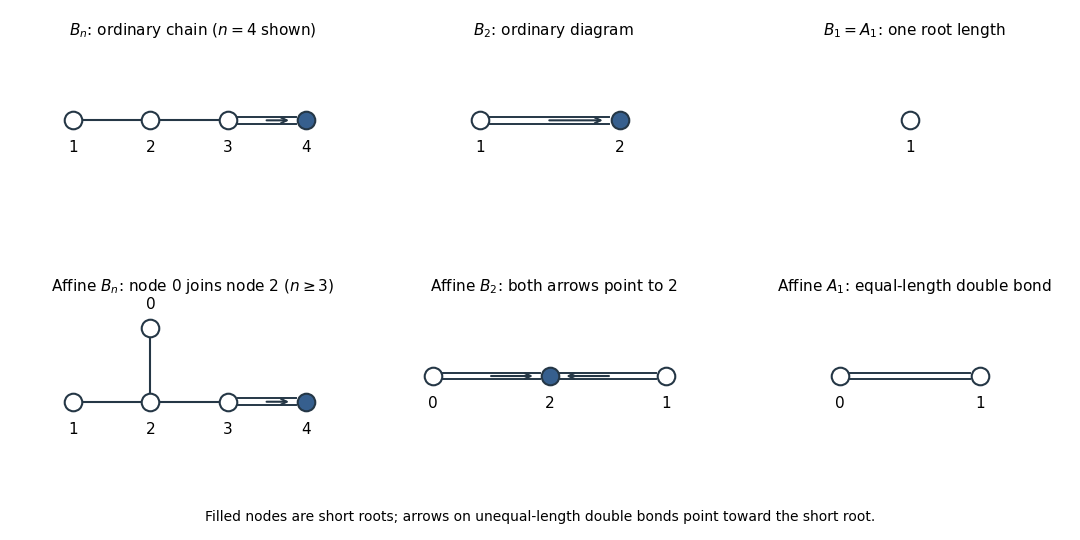
Ordinary and affine Dynkin diagrams of type B
. Details. 
For , the system is : , , . Its ordinary diagram is one node; its affine diagram has two equal-length nodes with the usual affine double bond.