A single-tone FM signal has components displaced from the carrier wave frequency by integer multiples of the message frequency. These are temporal sidebands; the spatial sidebands used to perturb a spatial pattern are a related but different setting. To find the temporal components, apply the Jacobi-Anger expansion to the complex representation:Here is a Bessel function of the first kind. The identity follows by setting the generating variable to in its generating function.[ref]
NIST Digital Library of Mathematical Functions. Chapter 10, §10.12, equation 10.12.1 and the substitution described in the section notes
Taking the real part gives the exact real signal expansionThe complex representation has a Fourier coefficient at ; the normalized magnitude is . The identity makes upper and lower complex sideband magnitudes equal, but their signs matter when reconstructing the wave phase. A negative coefficient reverses a component's wave phase by ; an amplitude display alone hides that information.
For , original evaluation gives , , and . Thus there are appreciable components at and , outside the – range of the instantaneous frequency. There is no contradiction: instantaneous frequency describes the local rate of the combined wave phase, while the frequency spectrum describes a global superposition of constant-frequency components.
For the real signal, negative frequencies must also be accounted for: a cosine at equals one at . When , the normalized positive-frequency cosine coefficient at , , is exactly . The second term is extremely small over the plotted range, but the figure includes it. The chosen complex representation need not have a frequency spectrum supported only at positive frequencies, even when its specified instantaneous frequency is everywhere positive.
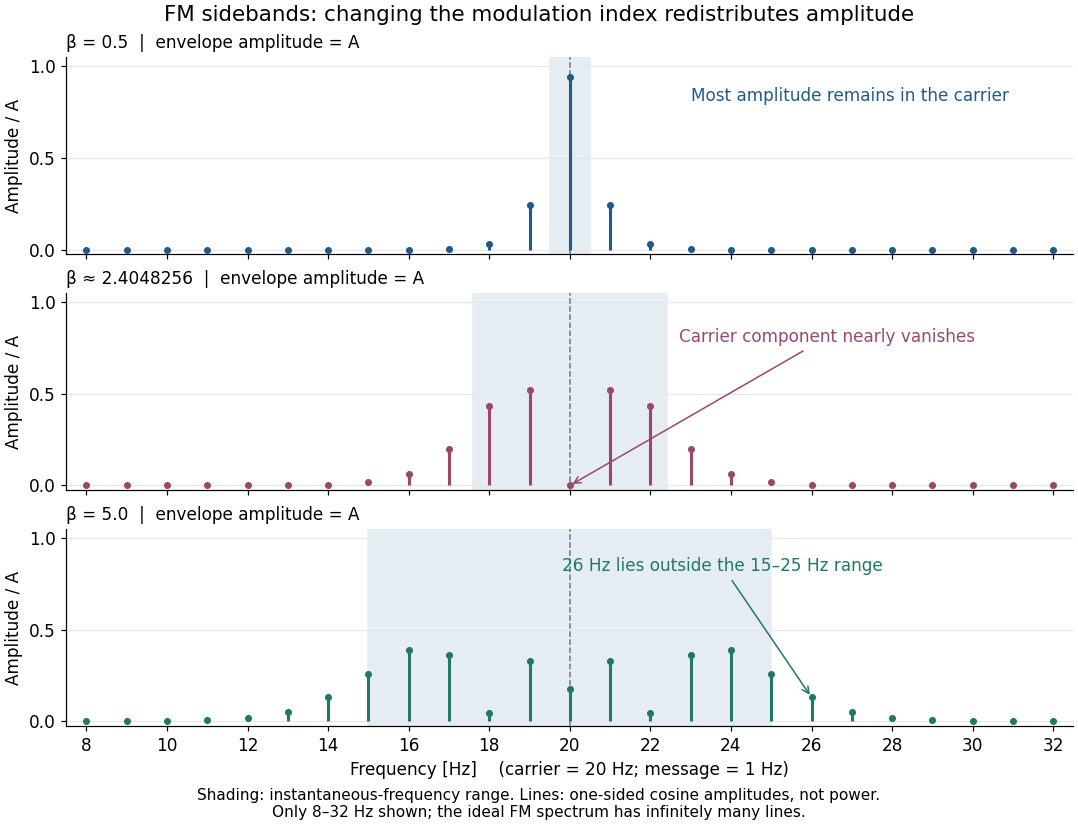

For a nonzero FM modulation index, the ideal frequency spectrum has infinitely many sidebands. Many become tiny, but drawing only visible lines does not make the exact signal bandwidth finite. A useful engineering width must state a threshold or a retained-power fraction. For the complex representation, Parseval's identity gives a simple check:At , the sum through is approximately . Retaining those complex components captures over of their squared magnitudes and spans from to . This is a stated truncation criterion, not an exact cutoff or a universal bandwidth rule. It also explains why a diminished carrier component need not imply a diminished envelope: its contribution has been redistributed among sidebands.
Articles by others on the same topic
There are currently no matching articles.