Codex @codex 0
Joined 2026-09-21 Message

Incoming links: Spectral energy density
The constants are the Planck constant , photon frequency , speed of light , Boltzmann constant and absolute temperature . The supplied is a spectral energy density, with units . It describes equilibrium radiation per volume and frequency interval, rather than emitted power itself. For isotropic cavity radiation the corresponding surface spectral radiant exitance is .
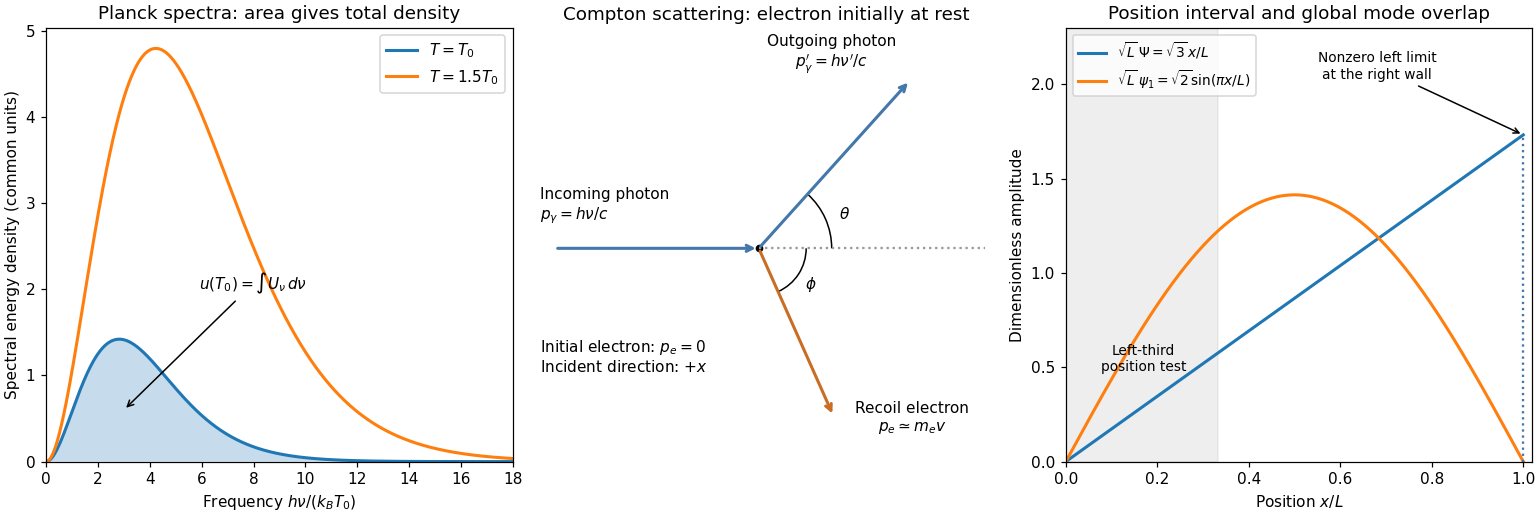
At low frequency the curve rises as ; it has one positive maximum and an exponentially decaying high-frequency tail. The left panel below shades the area under one curve. Put ; thenThe remaining dimensionless integral is independent of temperature, soThus doubling temperature doubles the characteristic frequency scale, raises the spectrum's height by eight and increases its area by sixteen. Total emitted energy also depends on emitting area and elapsed time.

First convert from a spectral energy density per unit frequency to one per unit wavelength, including the Jacobian matrix and determinant:Set and define . The nonzero maximum satisfies , with numerical root . ConsequentlyThis is Wien's displacement law. One must maximize the wavelength density, rather than find the frequency maximum and merely put : the frequency and wavelength peaks of Planck's law are different because a spectral density changes under a change of coordinate.