Equilibrium emittance obeys
ϵx=Cqγ2I5/(JxI2), with
I5=∮H(s)∣ρ∣−3ds,
H=γxη2+2αxηη′+βxη′2. Thus reduce both bend
angles and the dispersion invariant inside bends, rather than merely focusing to
a small beam
size elsewhere. The
damping partition can also be adjusted within stability constraints.
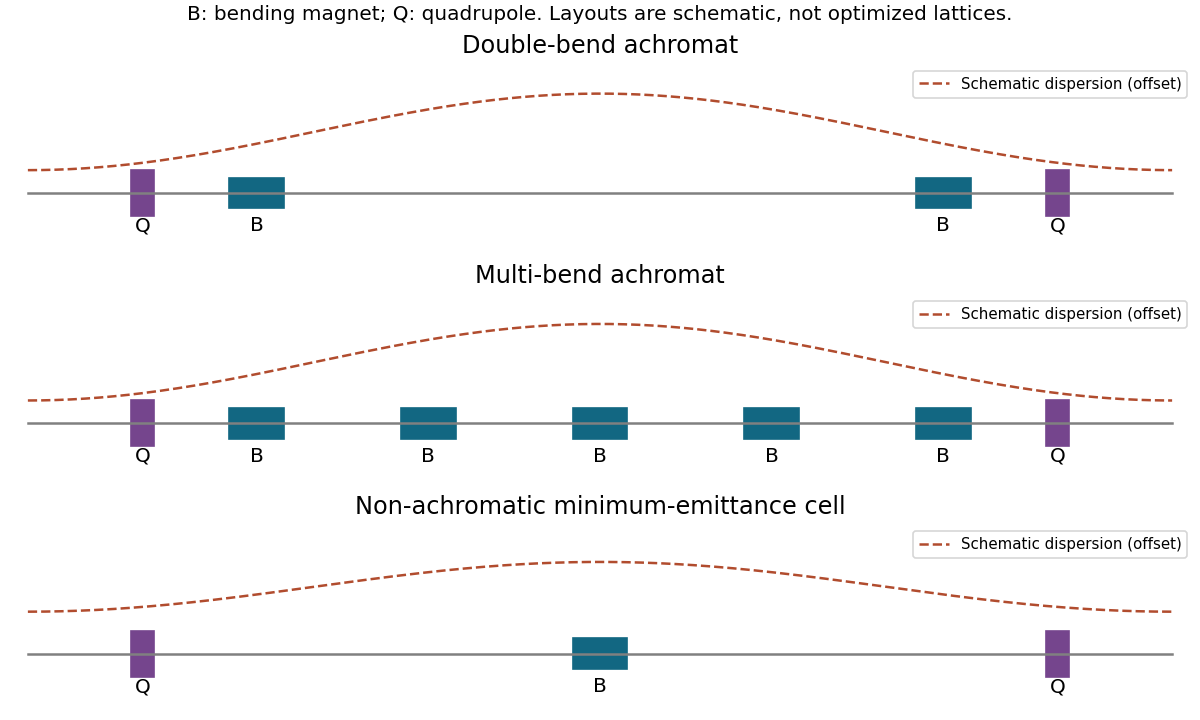
A DBA
uses two bends and
quadrupoles to return dispersion and its
slope to zero at the
cell boundaries; this provides dispersion-
free insertion straights, at some emittance cost.
A multi-bend achromat distributes the total
angle over more weak bends and carefully controls the interior dispersion.
A non-achromatic theoretical-minimum-emittance
cell permits nonzero boundary dispersion and chooses the
beta function and dispersion near
a bend'
s optimum; longitudinal-
gradient or reverse bends offer further control of
radiation integrals.
Strong focusing and dispersion suppression can increase natural
chromaticity and sextupole demands, compromising
dynamic aperture and
momentum acceptance.