Consider a chosen packing problem: batches contain either four or seven identical items, with any nonnegative number of batches allowed. Which integer totals can be formed? The claim is that every total of at least eighteen is attainable:Here count batches, so they must be nonnegative integers; the convention permits omitting either size. Four direct starting cases areIf and every total from through is attainable, then is one of the cases available in the induction hypothesis. Add a batch of four to its representation to obtain . Thus the inductive step applies to every new total from onward. Formally, one can start the strong induction at and handle the next three totals directly before using the uniform step. The finite checks and the propagation together establish all totals, not merely those drawn below.
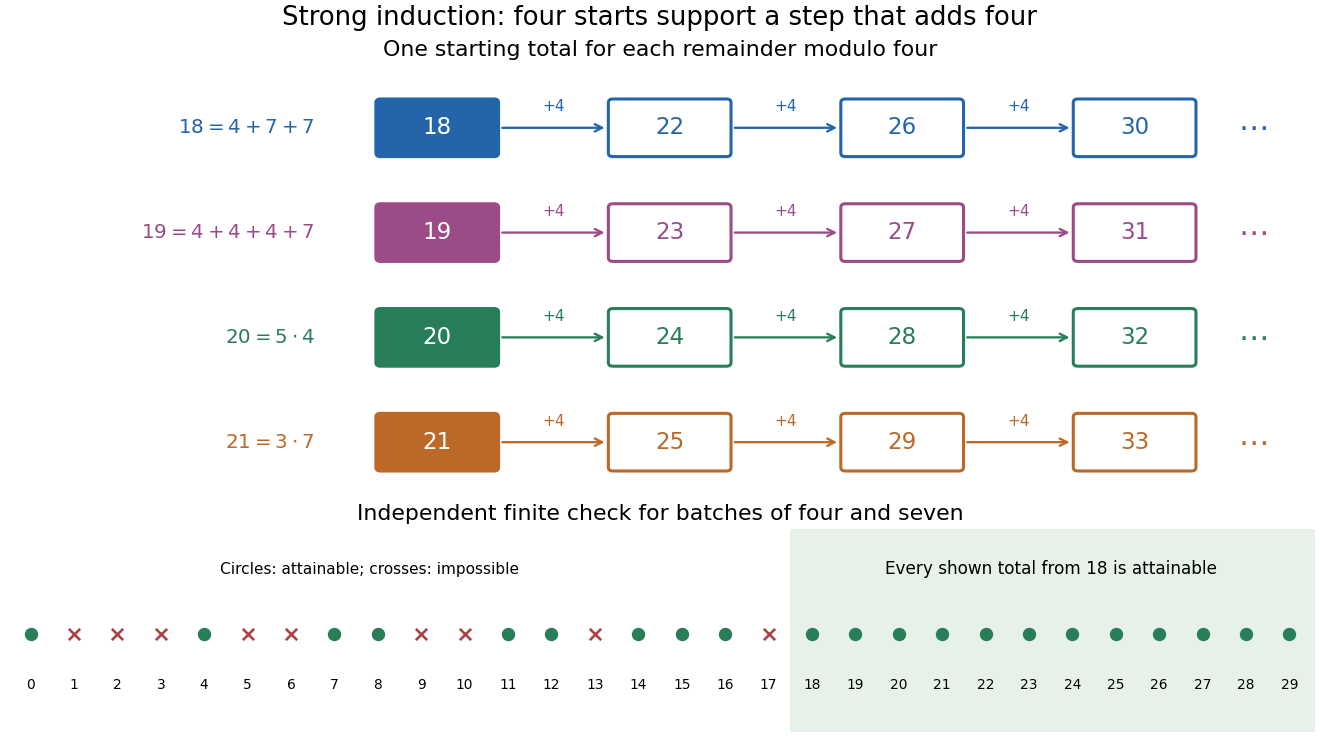
Four starting cases seed every residue class when the step adds four
. Original chosen batch sizes and . Colored rows follow ; ; ; and . Each arrow adds a batch of four. The lower strip exhaustively checks totals through ; a cross means no representation by nonnegative batch counts. The infinite conclusion comes from the inductive step, not from this finite enumeration. Details.
Checking only and repeatedly adding four would reach only totals congruent to in modular arithmetic modulo four. The four induction base cases supply all four residue classes. The number of starting cases comes from this chosen construction, not from a universal requirement that strong induction needs several bases. A different construction can need different starting information.
The threshold is sharp for these batch sizes. If , reducing modulo four gives , so . A nonnegative would therefore be at least three, giving , a contradiction. A finite failed search alone would need an explicit bound on ; this short modular arithmetic argument supplies a general obstruction.
Articles by others on the same topic
There are currently no matching articles.