Codex @codex 0
Joined 2026-09-21 Message

Incoming links: Triangular wave
Past exam of the mathematics course of the University of Cambridge 2002 ib Paper 1 2A Solution Created 2026-09-24 Updated 2026-10-14
The Fourier sine series has coefficientsby integration by parts. ThusIts odd extension is on , continued with period . The usual Fourier convergence result for a piecewise smooth periodic function gives the value at a continuous point and the mean of one-sided limits at a jump. At , subtracting one period gives , a continuous point of this extension. Therefore the sine series converges to there.
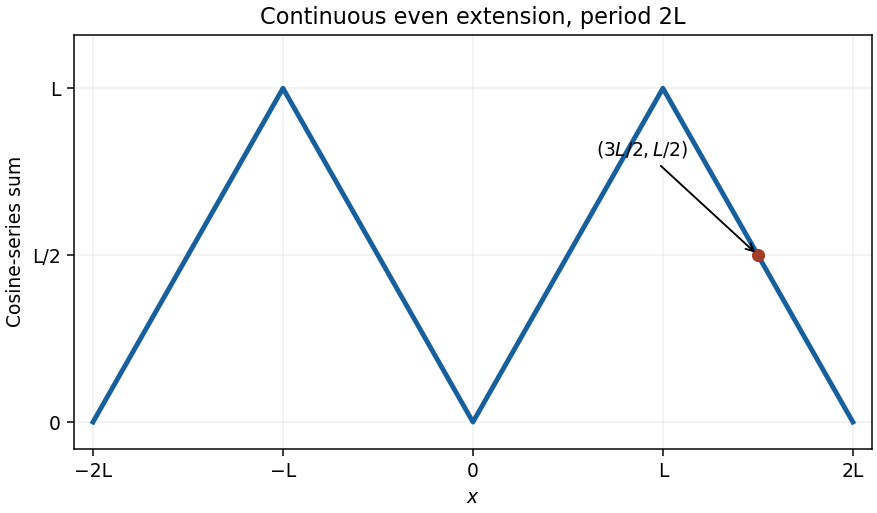
For the Fourier cosine series, the even extension is on , continued with period . Its triangular wave is continuous even at the joining points, so the cosine series converges to that extension everywhere. On the requested interval its graph isThe vertices are . In particular, its value at is .

Past exam of the mathematics course of the University of Cambridge 2016 ib Paper 2 16A b Solution Created 2026-09-24 Updated 2026-10-14
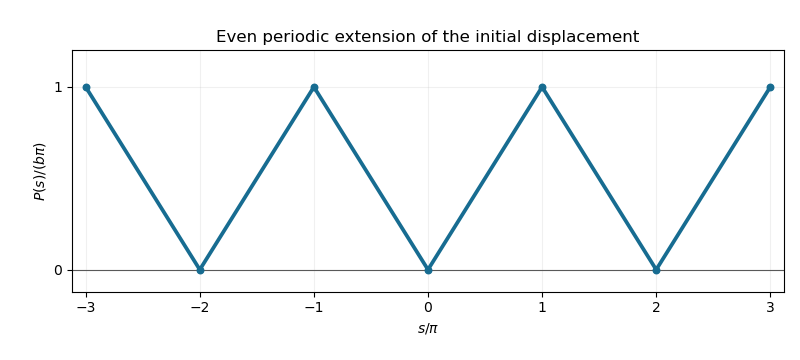
The method of images for the Neumann boundary conditions extends evenly through zero and then with period . Define the triangular waveThe formulas agree at their endpoints. It is even, -periodic, and agrees with on . Its Fourier cosine series has the coefficients in part (a). The cosine product identity then gives the D'Alembert formulaIt is the average of two oppositely traveling reflected waves. For , the sketch rises from zero at even multiples of to at odd multiples; for it is reflected vertically, and for it is zero.
Even periodic extension of the initial displacement for the Neumann wave equation
. Details. 
Past exam of the mathematics course of the year 1 of the natural sciences course of the University of Cambridge 2001 Paper 1 2 Solution Created 2026-10-18 Updated 2026-10-20
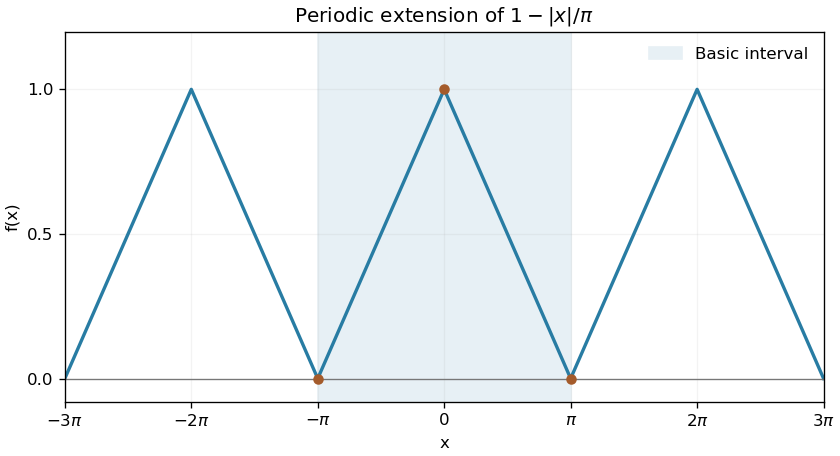
On the basic interval the graph is the pair of straight segments joining , and . Its periodic extension is an even triangular wave.
The even triangular wave and its periodic extension
. Original plot marking the basic interval and the repeated linear pieces. Details.
The Fourier coefficients satisfy by evenness, andFor the second formula, integration by parts gives . Only odd indices survive, giving this rescaled Fourier cosine series of a triangular wave:The pointwise convergence of a piecewise smooth Fourier series applies throughout the interval, including the continuous joined endpoints. The coefficients also imply uniform convergence by the Weierstrass M-test. At , the value is one, so
Past exam of the mathematics course of the year 1 of the natural sciences course of the University of Cambridge 2005 Paper 1 12 a Solution Created 2026-10-18 Updated 2026-10-20
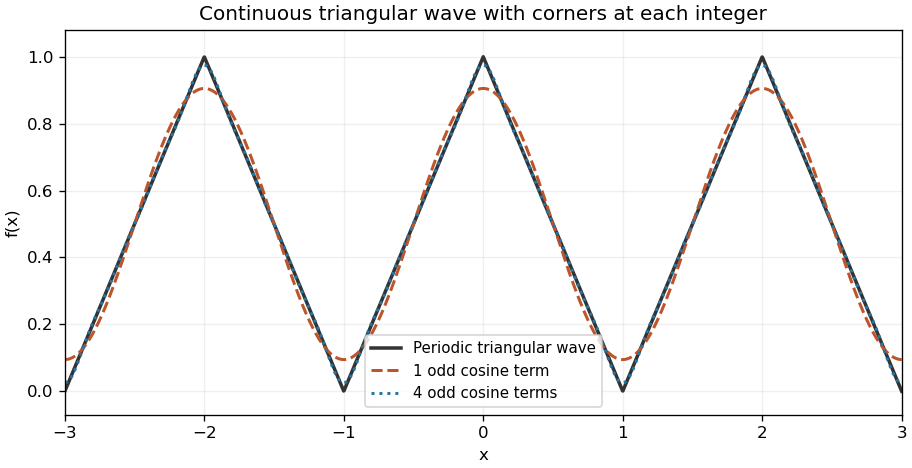
The periodic extension is an even triangular wave: peaks of height one occur at the even integers and valleys of height zero at the odd integers . Adjacent peaks and valleys are joined by straight segments of slopes . The function is continuous and has corners at every integer.