A sequence of functions converges uniformly to , where is a metric space with metric , precisely whenFor real numbers, use the absolute value . Compare the universal quantification and existential quantification:The decisive change is whether can depend on . Uniform convergence implies pointwise convergence.[ref]
6.1 Pointwise and uniform convergence. Basic Analysis: Introduction to Real Analysis, Volume I by Jiří Lebl, §6.1.2, Definition 6.1.6 and Proposition 6.1.7
For functions taking values in real numbers on a nonempty domain of a function, the supremum error is , allowing . Then uniform convergence is equivalent to . The supremum need not be a maximum: pointwise strict bounds below only give , so use tolerance when proving this equivalence. This single error bound controls every possible input, including one chosen after seeing the index.
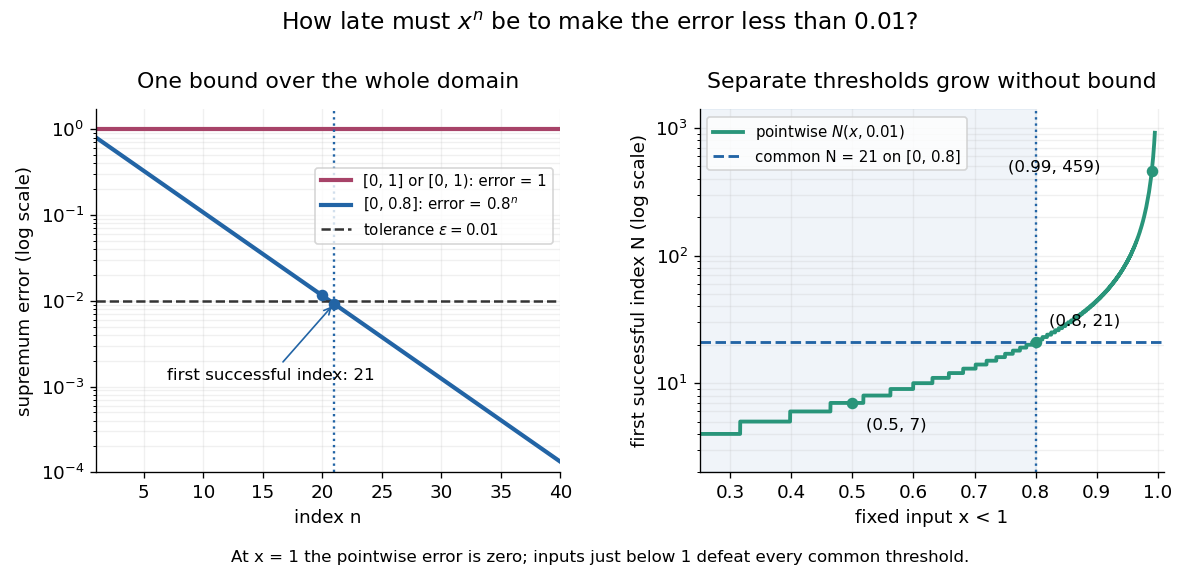
For and its pointwise limit on , the error is zero at one but approaches one as from below. Consequentlyfor every positive integer . This supremum is never attained: below one the error is , and at one it is zero. Deleting the endpoint leaves the same supremum error on . To disprove uniform convergence directly, choose : for any proposed , take and . The error equals , violating the strict tolerance. Thus a moving input defeats every proposed common threshold.
On the smaller interval , for a fixed , the pointwise limit is zero andFor and , the exact first successful common threshold isThe logarithm and floor function turn an infinite approximation statement into a finite stopping rule. At , fails tolerance , while succeeds. At and , the ratio is exactly three: is necessary because equality is insufficient. For , every error is zero. The domain of a function determines whether one threshold can certify every input.
For another explicit stopping rule, let on . Its uniform limit is zero and its supremum error is . For every , works, using the ceiling function. Unlike on , it controls even the endpoint.
The practical beauty of uniform convergence is that one quantitative bound can survive further operations: the uniform limit theorem preserves continuity, and uniform convergence preserves integrals on a compact interval controls accumulated error. Differentiation needs additional hypotheses, such as uniform derivative convergence with an anchored value. These results distinguish an approximation that looks accurate at selected inputs from one that justifies replacing a whole function in a calculation.
An unbounded function can multiply a series while preserving uniform convergence. On , let . The geometric series givesThe equality follows because increases up to . Both the first term and the sum are unbounded, while their difference after sufficiently many terms is uniformly small. Uniform convergence controls approximation errors; boundedness of each individual function is a separate property.
If real polynomials converge by uniform convergence to on all of the real line, then for some and constants , for every , with convergent. Indeed, a common uniform error below one gives everywhere. A bounded polynomial on the real line is constant, since every nonconstant polynomial grows in absolute value at infinity. Evaluating at zero identifies the limit of a sequence of constants, so is a polynomial. This conclusion depends on the entire real line being the domain.
If sequences of functions and have uniform convergence on the same domain and each term is a bounded function, their products converge uniformly to . The two families are uniformly bounded families of functions: one late term and the Uniform Cauchy criterion bound the entire tail, while finitely many early terms have a finite common bound. Write and take the supremum norm to obtain the displayed estimate. The boundedness hypothesis cannot be dropped: and converge uniformly on , whereas fails to converge uniformly to zero.
A sequence of functions has a uniform limit if and only if, for every , there is such that for every and every . Necessity follows from the triangle inequality. For sufficiency, completeness of the real numbers first gives a pointwise limit . Letting in the bound with tolerance gives uniformly in . The same proof works for a complete metric space as codomain; completeness is essential.
The continuity assertion for sums of continuous functions in the Cours d'analyse by Augustin-Louis Cauchy, Chapter VI, §I. Under a modern pointwise reading the assertion needs stronger control: on has a discontinuous pointwise limit. Uniform convergence supplies a sufficient hypothesis through the uniform limit theorem.
For functions taking values in real numbers on a nonempty domain of a function , the supremum error is the supremum of the absolute value of the approximation error over all inputs. It may be infinite and need not be attained. When finite, it is the supremum norm of ; uniform convergence is exactly . Bounding this one quantity gives an accuracy guarantee for every input, including inputs that change with .
On the half-line, , but . The change of variable shows why: the decreasing amplitude is spread over an increasing interval. Uniform convergence controls integrals on finite-measure domains; it does not alone control total mass on an infinite-measure domain.
If Riemann integrable functions converge by uniform convergence to , then is Riemann integrable andThis concerns one fixed compact interval, with finite length.[ref]
Here is a proof outline that also establishes Riemann integrability of the uniform limit. Assume , and put and . One bounded and finite show that is a bounded function. For any partition of an interval , its upper Darboux sum and lower Darboux sum satisfyGiven , choose with , then a partition of an interval with . The displayed gap is below , proving Riemann integrability. Finally, and monotonicity of the Riemann integral give the stated error estimate. When , every integral is zero.
For the polynomial functions on , direct integration and the uniform bound giveAt , the exact integral is approximately , while the general error bound is approximately . The bound certifies the result without an exact antiderivative. On , these same integrals still tend to zero, although there is no uniform convergence: sufficient conditions need not be necessary. On an unbounded interval, even uniform convergence can fail to control total area, as uniformly vanishing functions can retain a nonzero integral shows.
Uniform convergence alone also fails to preserve derivatives: converges uniformly to zero on , while . The small amplitude does not control the slopes of the sine oscillations.
Suppose continuous functions converge by uniform convergence to on a domain of a function , and with all these inputs in . The uniform limit theorem makes a continuous function, and the triangle inequality givesThe first term handles the changing approximation and the second handles the changing input. For on , the inputs instead give , , and . Pointwise convergence cannot supply the first uniform bound, and this pointwise limit also lacks continuity at one.
Let be continuously differentiable functions on an interval . If by uniform convergence on and at one fixed , then converge locally uniformly to a continuously differentiable function with . If is bounded, the convergence is uniform on all of .[ref]
6.2 Interchange of limits. Basic Analysis: Introduction to Real Analysis, Volume I by Jiří Lebl, §6.2.3, Theorem 6.2.10 and the unbounded-interval observation following its proof
The anchor fixes the additive constant that a derivative cannot see. By the fundamental theorem of calculus, defineThe uniform limit theorem makes a continuous function, so the fundamental theorem of calculus gives . The displayed estimate proves uniform convergence wherever has a common finite bound, and therefore proves locally uniform convergence on any interval.
For example, on take . Its derivative is , with supremum error from , and . The reconstructed uniform limit is ; the exact supremum error is , equal to the bound above. Without an anchor, the constant functions have zero derivatives but no finite pointwise limit. On the real line, has convergent anchored values and uniformly convergent derivatives, but its supremum error from zero is infinite. The bounded-distance condition has a real role.
On a finite-measure measurable set, a sequence of measurable functions converging pointwise almost everywhere converges uniformly outside a set of arbitrarily small measure. For tolerance , the sets on which every index after has error at most increase to full measure as . Choose with exceptional measure at most and intersect the good sets. Countable subadditivity bounds the discarded measure, and the resulting tail estimates prove uniform convergence. Finite measure is essential: on is a counterexample.
A uniform limit of continuous functions is a continuous function. No compactness assumption on the domain of a function is required.[ref]
For a proof, fix an input and tolerance . Uniform convergence supplies one with . Its continuity at supplies with for allowed inputs satisfying . The triangle inequality givesOne approximating function controls both endpoints of this estimate. Under pointwise convergence, selecting an index for supplies no common control at nearby . This explains why the polynomial functions can have a discontinuous pointwise limit on .
Dini's theorem says that a monotone sequence of continuous real-valued functions on a compact space that converges pointwise to a continuous function converges uniformly.
A sequence converges locally uniformly to when every point has a neighbourhood on which the convergence is uniform.
The compact-open topology on a space of functions is generated by uniform control on compact subsets. For scalar-valued functions, its basic seminorms are as ranges over compact subsets of the domain.
For a compact exhaustion and positive summable weights , use the bounded metric transform on each compact supremum norm. The resulting series defines a metric on continuous functions and realizes local uniform convergence on compact subsets. The triangle inequality is termwise. For convergence, control finitely many compact seminorms and then the uniformly bounded weight tail; conversely a vanishing metric controls each fixed seminorm.
A locally uniform limit of continuous real-valued functions is continuous. Moreover, local uniform convergence is uniform on every compact subset: choose finitely many neighbourhoods from the local uniformity cover and take the largest of their convergence indices.
Articles by others on the same topic


Uniform convergence is a concept in mathematical analysis that pertains to the convergence of a sequence (or series) of functions.