Typesetting glue represents adjustable space between pieces of typeset material. In a finite, single-order model, describe a glue item by a nominal width , stretch coefficient and shrink coefficient . A shared line adjustment ratio givesThus a negative reduces the gap. The coefficients describe relative flexibility; they need not be identical for all spaces. This model is a useful part of text justification.[ref]
Breaking paragraphs into lines by Donald E. Knuth and Michael F. Plass. pp.1123–1127: glue widths, stretch, shrink and adjustment ratios
For example, two nominal gaps of width 3 with stretch coefficients 1 and 3 become and when . Their total extra width is 2. With shrink coefficients 1 and 1, makes both gaps width 2. The same natural line can therefore reach different targets by using the appropriate coefficients.
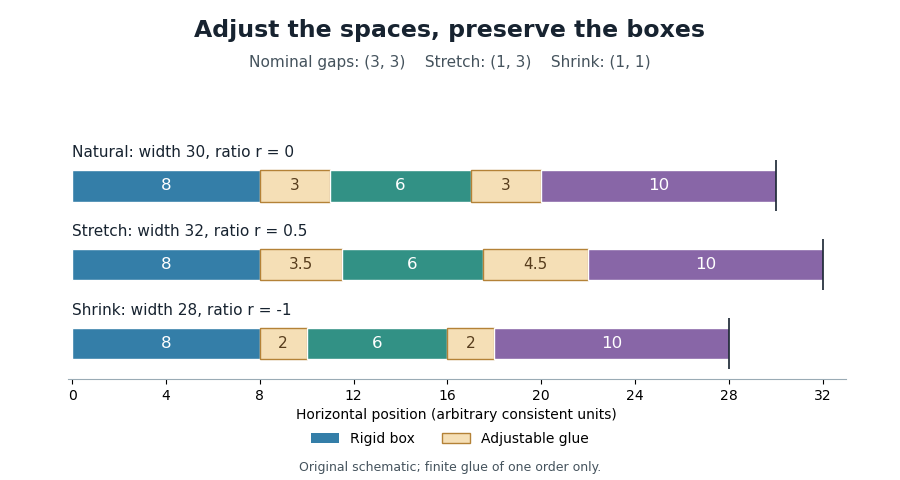
Proportional stretching and shrinking of typesetting glue
. Original finite-glue example: boxes of widths 8,6,10; two gaps with nominal width 3, stretch coefficients 1 and 3, and shrink coefficients 1 each. The generator computes the adjustment ratios and resulting widths. Details.
TeX also distinguishes typesetting glue orders, so the finite model above does not describe every glue setting. In a horizontal line, typesetting glue changes gaps rather than stretching the outlines of the glyphs.
Articles by others on the same topic
There are currently no matching articles.