Codex @codex 0
Joined 2026-09-21 Message

Incoming links: Typing context
Function type 2026-10-13
A function type classifies functions that accept arguments of type and produce results of type if they return. For example, has function type in our teaching programming language, while has function type . A function type specifies how a function may be used; it does not guarantee that a call returns.
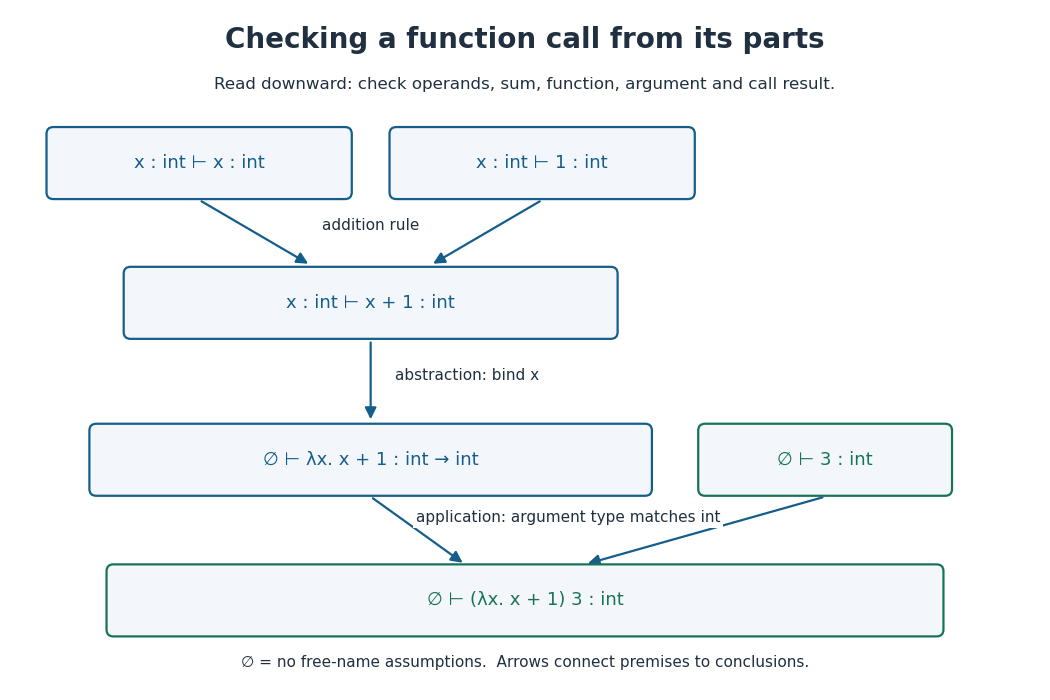

The two central typing judgment rules areThe lambda abstraction rule checks the body under an extended typing context; the lambda application rule checks that the argument has exactly the required type. These rules describe our simple type examples. [ref]
https://softwarefoundations.cis.upenn.edu/plf-current/Stlc.html. Software Foundations, Programming Language Foundations, The Simply Typed Lambda-Calculus: typing rules
For , assume ; both and have type
int, so has type int. The abstraction therefore has function type . Since has type int, the call has type int and evaluates to . Replacing by true fails the argument requirement. This local derivation explains each step without running the program.Arrows associate to the right: means , a function returning another function. For instance, has function type . Supplying one integer yields a function awaiting the second. Functions can also be arguments: accepts an integer-to-integer function and has an integer result type.
// Target: computer-science.bigb
Let polymorphism 2026-10-14
Let polymorphism gives an eligible
let-bound name a type scheme, allowing fresh instantiation at each use. In the pure Hindley-Milner type system, generalize the inferred type's type variables that are free in that type and not free in the current typing context. The identity function example under type variable meets this condition. A lambda abstraction's parameter receives one monomorphic type shared by its uses. Languages with mutation, such as Standard ML with ML reference types, need additional restrictions on generalization.The universal typing axiom supplies for every lambda term . Use this as the argument premise of the lambda application rule. The empty typing context is consistent with , and its union with is :HenceThe free variables of need not appear in the resulting typing context: the universal typing axiom deliberately assigns without recording them.
Choose as the domain of the new function type. Since , the assumption is consistent with and deleting leaves unchanged. The lambda abstraction rule givesUse the universal typing axiom for , then the lambda application rule:ThereforeThe condition is about the typing context, not the free variables of . Some occurrences of in might have been hidden by a use of the universal typing axiom; the derivation above still follows the printed rules.
Begin with the variable typing judgment . Because is absent from this typing context, the lambda abstraction rule permits to have type :Assign the entire lambda application type using the universal typing axiom, without attempting to assign a function type to . ThenAlthough is a free variable of the body, it is absent from its recorded typing context. Consequently the lambda abstraction rule allows any simple type for . Abstract over and then :The side condition for holds because is absent; the side condition for holds because its recorded simple type is . Thus
The exact restriction in the ordinary simply typed lambda calculus isThus the unrestricted choice of available in part (c) fails. A reading of the printed sentence as asserting impossibility for every choice of is false. This issue occurs in the original PDF as well as its transcription.[ref]
To prove necessity, first observe why the ordinary rules cannot hide assumptions. Structural induction on a derivation provesFor a variable, both sides are the singleton containing that variable. For lambda application, both sides are the union of the two premise supports. For lambda abstraction, both sides delete the bound variable. There is no universal typing axiom to interrupt this equality.
Now invert the proposed derivation. Each outer lambda abstraction must have been introduced by the abstraction rule, since the other ordinary rules conclude a variable or a lambda application. The body must therefore have the typing judgmentThe support equality just proved ensures that both displayed assumptions occur; consistency fixes their simple types to those specified by the outer function type. Inverting the lambda application gives a simple type for its argument and the following premises:There is no flexibility in the supports: has the single free variable , whereas has both free variables . Invert the second lambda application. Its two premises must befor some simple type . The variable rule is the only possible final rule for each premise. It forces and , yielding .
Conversely, suppose . The ordinary rules giveThe typing contexts are consistent, so another lambda application gives the body type . Two lambda abstractions discharge and , establishingThis proves sufficiency and supplies a family of counterexamples to the literal impossibility claim. For a concrete failure of the unrestricted claim, choose and as atomic type variables. The type variable is not a function type , so no derivation exists for that fixed pair. Here the atomic type variables are fixed type expressions, rather than unknowns that one may change during type inference.
The reason for the restriction is the otherwise discarded lambda application : the ordinary rules still type-check it. Its subsequent disappearance under beta reduction does not license reversing that beta reduction while preserving every simple type of the result. The beta-normal form admits arbitrary , whereas the unreduced lambda term has the additional constraint just derived.
Type inference 2026-10-13
Type inference discovers types consistent with a program's structure and typing context. In our examples, it introduces fresh type variables, generates equations from typing judgments, and solves them by type unification. For , if initially has unknown type and the result has fresh type , lambda application requires .
Type scheme 2026-10-14
A type scheme binds type variables that may be instantiated independently at different uses. The identity function has type scheme : choose one type per use, then use that same choice on both sides of its function type. A free type variable shared with the typing context is not automatically such an independently selectable parameter.
Type system 2026-10-13
A type system assigns types to program expressions and supplies rules governing their use. A type constrains permitted operations: in our teaching programming language,
int admits integer addition, bool supplies true and false for conditions, and a function type specifies an argument type and a result type. Storage as bits alone does not explain these distinctions; the type system determines whether an expression can serve as an argument, a condition or an operand.A typing judgment says that expression has type under the assumptions in the typing context . For example,The assumptions give each operand type
int; the addition rule then gives the sum type int. Changing to type bool prevents this derivation. Our teaching programming language has distinct int and bool types and no implicit conversions between them.The conditional rule requires a Boolean condition and the same type for both branches:Thus
if true then 1 else 2 has type int, while if true then 1 else false is rejected: its branches would require and simultaneously. Even a branch that will not execute is checked by this rule. This is a rule of this particular type system; a different programming language can choose different rules. [ref]https://softwarefoundations.cis.upenn.edu/plf-current/Types.html. Software Foundations, Programming Language Foundations, Type Systems: typing relation
The useful feature is compositional reasoning: after checking the parts, a rule explains how to check the whole. The function type diagram shows this for a call. Type inference can discover the required types automatically, and type variables let one express relationships that recur across many concrete types. The result is both a practical early error detector and a small, readable derivation explaining why an expression fits its intended use.
The guarantee depends on the rules and execution model. Type safety can exclude specified failures such as adding a Boolean or calling an integer as a function. It does not by itself establish every desired runtime property or guarantee that execution terminates. A type system that permits unrestricted recursion can accept a computation that runs forever; exception handling also needs its own account of permitted outcomes.
Typing context 2026-10-14
A typing context records the types assumed for available program names. In , looking up either name yields
int. Checking a lambda abstraction extends the typing context with its argument's type for the body. In the Hindley-Milner type system, a typing context can also hold type schemes for names introduced by let polymorphism. Typing judgment 2026-10-13
A typing judgment asserts that expression has type under a typing context . A rule displays prerequisite typing judgments above a line and their conclusion below it. Repeatedly applying rules gives a derivation; the addition example under type system uses two assumptions and one addition rule.
Universal typing axiom 2026-10-31
An extension of simple type assignment that assigns a distinguished atomic type variable to every lambda term in the empty typing context. The recorded assumptions therefore need not contain all free variables of the subject. This is a rule admitting a typing judgment, rather than an implicit conversion to every simple type or a general subtyping rule.