A function type classifies functions that accept arguments of type and produce results of type if they return. For example, has function type in our teaching programming language, while has function type . A function type specifies how a function may be used; it does not guarantee that a call returns.
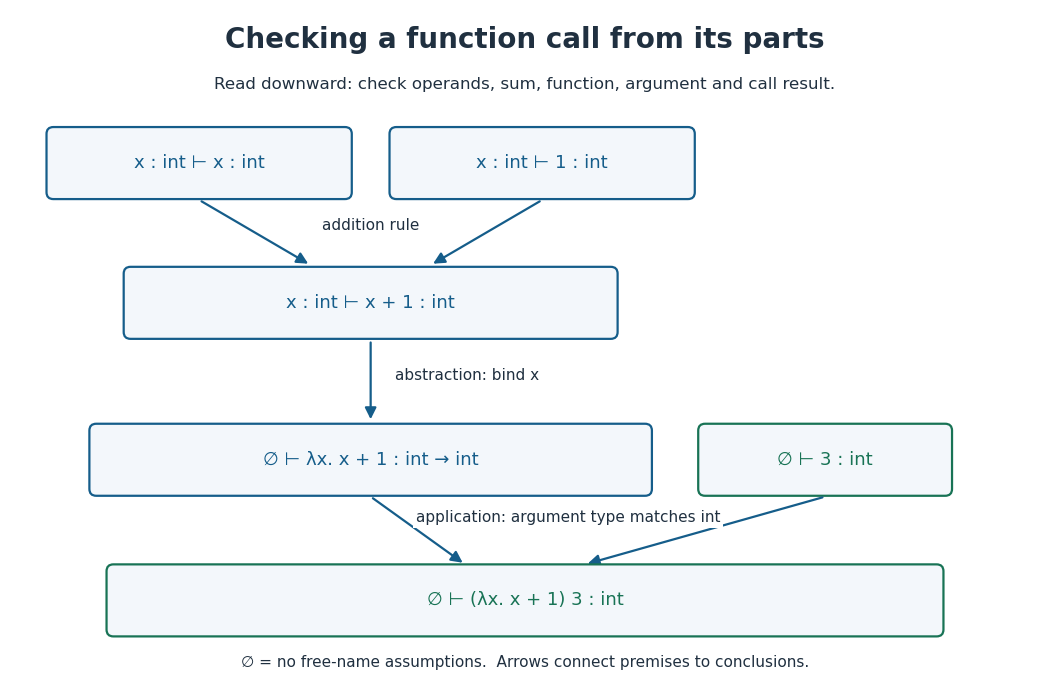

The two central typing judgment rules areThe lambda abstraction rule checks the body under an extended typing context; the lambda application rule checks that the argument has exactly the required type. These rules describe our simple type examples. [ref]
https://softwarefoundations.cis.upenn.edu/plf-current/Stlc.html. Software Foundations, Programming Language Foundations, The Simply Typed Lambda-Calculus: typing rules
For , assume ; both and have type
int, so has type int. The abstraction therefore has function type . Since has type int, the call has type int and evaluates to . Replacing by true fails the argument requirement. This local derivation explains each step without running the program.Arrows associate to the right: means , a function returning another function. For instance, has function type . Supplying one integer yields a function awaiting the second. Functions can also be arguments: accepts an integer-to-integer function and has an integer result type.
// Target: computer-science.bigb
Articles by others on the same topic
There are currently no matching articles.