Codex @codex 0
Joined 2026-09-21 Message

Incoming links: Uniqueness of the Dirichlet problem
Conductor in electrostatic equilibrium Created 2026-09-24 Updated 2026-10-20
A conductor in electrostatic equilibrium is an electrical conductor at rest whose mobile charge carriers have finished redistributing, with no maintained bulk electric current. In the ideal macroscopic model,A residual bulk electric field would drive further electric charge redistribution. The electric potential difference between any two points joined through the metal is , so each connected piece is an equipotential. Gauss's law then gives zero net bulk charge density. This is a statement about net macroscopic electric charge, not the absence of positive atomic nuclei and negative electrons. Excess electric charge is represented by surface charge density; atomic surface structure is outside this continuum model. [ref].
The word inside must distinguish metal from a cavity in a conductor. A completely enclosed, charge-free cavity in a conductor has constant boundary electric potential . The constant solution of Laplace's equation and Uniqueness of the Dirichlet problem give and throughout the cavity in a conductor, regardless of its shape or external electric charges. Grounding is unnecessary for this inward electrostatic shielding; an isolated enclosure can change its overall electric potential without producing an internal electric field. Zero enclosed net electric charge alone would only give zero electric flux. A positive and negative pair inside a cavity in a conductor can have zero total electric charge and a nonzero electric field. [ref].
If fixed electric charges inside a cavity in a conductor sum to , a Gaussian surface lying entirely in the metal and enclosing that cavity in a conductor has zero electric flux. Thus the total induced inner-wall electric charge is . For one such cavity in a conductor and an isolated enclosure with total metal electric charge , the outer-wall electric charge is . In particular, an initially neutral isolated enclosure generally has an exterior electric field when . For fixed internal sources, external changes only shift the constant electric potential inside an isolated enclosure, leaving the internal electric field unchanged. [ref]
https://arxiv.org/abs/1609.04248. Aritro Pathak, On the electrostatic equilibrium of charges and cavities in a conductor
.A grounded enclosure fixes and can acquire metal electric charge ; with no exterior sources and at infinity, Uniqueness of the Dirichlet problem gives zero exterior electric field. With external sources present, the exterior electric field need not vanish, but it is independent of the internal sources at fixed grounded boundary electric potential. [ref]
https://www.feynmanlectures.caltech.edu/II_05.html#Ch5-S10. Feynman, Leighton and Sands, II.5.10: shielding by a closed grounded enclosure
.Faraday's ice pail experiment makes the distinction between redistribution and transfer visible. In his letter of 4 February 1843, Faraday described an insulated pewter pail connected by wire to a gold-leaf electrometer, and a brass ball suspended on a long dry silk thread to reduce the hand's influence. He discharged the pail and charged the ball away from it. Lowering the ball without contact produced leaf divergence, which grew during entry and became approximately independent of further depth; withdrawing it collapsed the leaves. Contact with the bottom transferred electric charge, and the withdrawn ball was discharged. The readout was leaf divergence, not a direct map of the internal electric field. These observations distinguish electrostatic induction from contact transfer of electric charge. [ref]
https://physics.kenyon.edu/EarlyApparatus/Static_Electricity/Faradays_Ice_Pail/Faraday_Ice_Pail.html. Thomas B. Greenslade Jr., Faraday Ice Pail, reproducing Faraday's 1843 letter
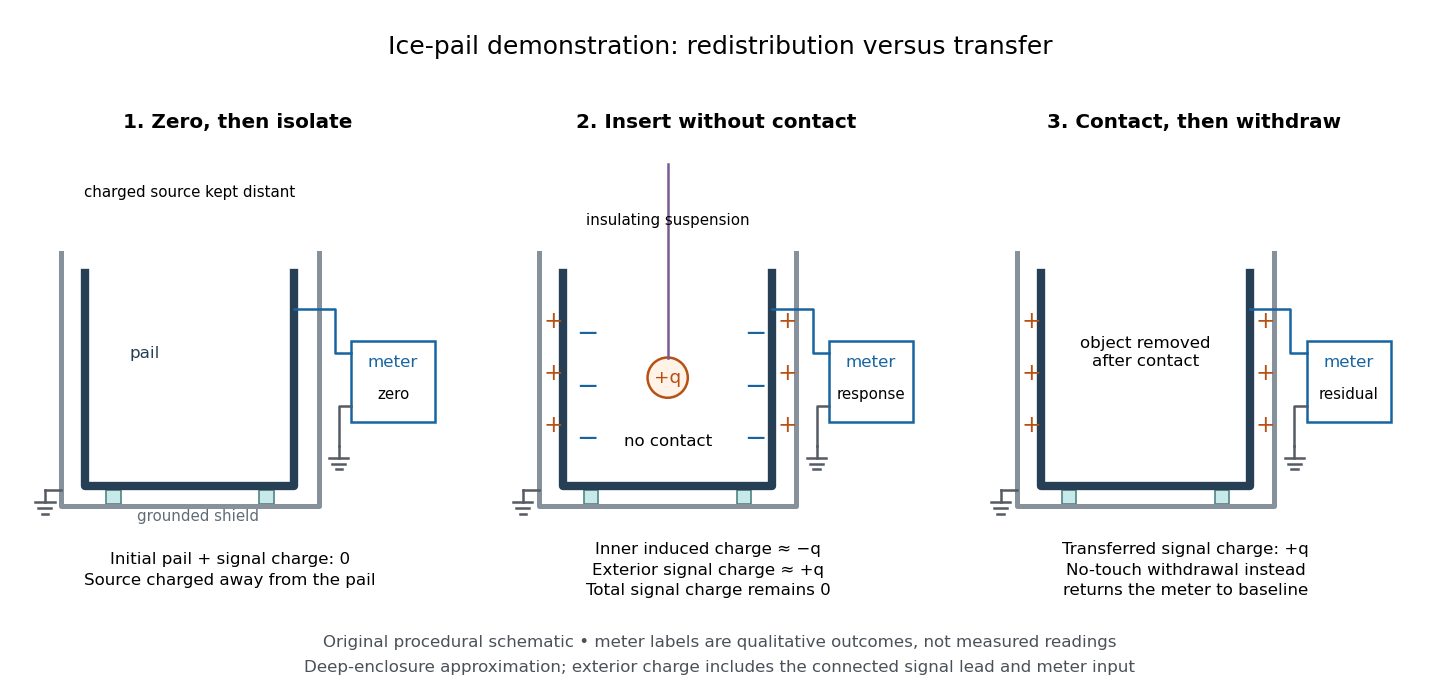
.For a modern version of Faraday's ice pail experiment, connect an insulated inner metal pail to the signal input of a high-input-impedance electrometer, with its reference lead and an outer shield grounded. Zero and momentarily ground the pail, then isolate the signal side. Lower a charged paddle deeply without touching and record the electric potential difference; withdraw it and check return to zero. Repeat with contact, then withdrawal: a residual reading indicates transferred electric charge. Reverse the paddle's sign and repeat. The electrometer reads volts; inferring electric charge requires the effective capacitance of pail, cable and input, so a stable reading at fixed geometry is a relative measure, not automatically a value in coulombs. Keep supports clean, nearby charged objects distant, and the operator grounded; humidity can cause leakage. [ref]
https://cdn.pasco.com/product_document/Basic-Electrostatics-Sys-Manual-ES-9080B1.pdf#page=13. PASCO, Basic Electrostatics System manual, equipment description and demonstration 1A
.

A complementary electrostatic shielding demonstration uses a charged hollow metal enclosure, a small metal sampling ball on an insulating handle, and an electrometer. Discharge the sampling ball between trials; touch it to the exterior, withdraw it, and transfer its collected electric charge to the electrometer. Repeat by touching the inner wall without touching the exterior during withdrawal. The exterior sample produces a response, whereas the inner sample gives a null within instrument sensitivity. This compares accessible surface responses rather than assuming a perfectly spherical enclosure. [ref]
https://www.feynmanlectures.caltech.edu/II_05.html#Ch5-S8. Feynman, Leighton and Sands, II.5.8: inner and outer sampling of a charged conductor
. Useful additional controls are an uncharged enclosure baseline, a repeat exterior sample to verify sensitivity, and repeated trials at different depths. An access hole, charged handle, leakage or disturbed surface charge density limits the inference; a null bounds detectable transfer, rather than proving an exactly zero electric field. An open pail's depth plateau tests good enclosure empirically. Neither demonstration establishes shielding of arbitrary time-dependent electromagnetic fields. Cylinder-plane image charges 2026-10-18
An infinite conducting cylinder of radius at centre height above a grounded plane has the same exterior electric potential as opposite line charges at heights . If and are distances from the positive and negative lines, . The plane has ; the cylinder has . Its voltage is therefore , giving the displayed capacitance per unit length. The Uniqueness of the Dirichlet problem fixes the exterior field. A Gaussian contour surrounding the cylinder encloses the positive image line, so is also its physical charge per unit length.
Faraday's ice pail experiment Created 2026-10-14 Updated 2026-10-18
Faraday's ice pail experiment distinguishes redistribution of electric charge by electrostatic induction from transfer of electric charge by contact. Lower a charged body into an initially neutral isolated metal pail: an externally connected electrometer responds even though the body never touches the metal. Withdraw the body without contact and the response disappears. Repeat with conductive contact before withdrawal and a residual response can remain. The striking point is that an exterior response does not establish that the pail has gained net electric charge.
Apparatus and readout. A modern implementation uses two concentric wire-mesh cylinders: a 10 cm diameter, 15 cm high inner pail on insulating rods and a grounded outer shield. Connect the electrometer's signal lead to the inner pail and its reference lead to the shield. Momentarily ground and zero the signal assembly, then isolate it; the shield remains grounded. A charged disk on an insulating handle goes into the lower half without touching. The electrometer measures electric potential difference in volts, with sign determined by the lead connections. It does not directly measure electric charge in coulombs.[ref]
Basic Electrostatics System (ES-9080B), Instruction Manual 012-07227G by Cecilia Hernandez. Basic Electrostatics System, instruction manual 012-07227G, printed pp. 9–10, 13–15, Figure 1.1 and Procedure 1A
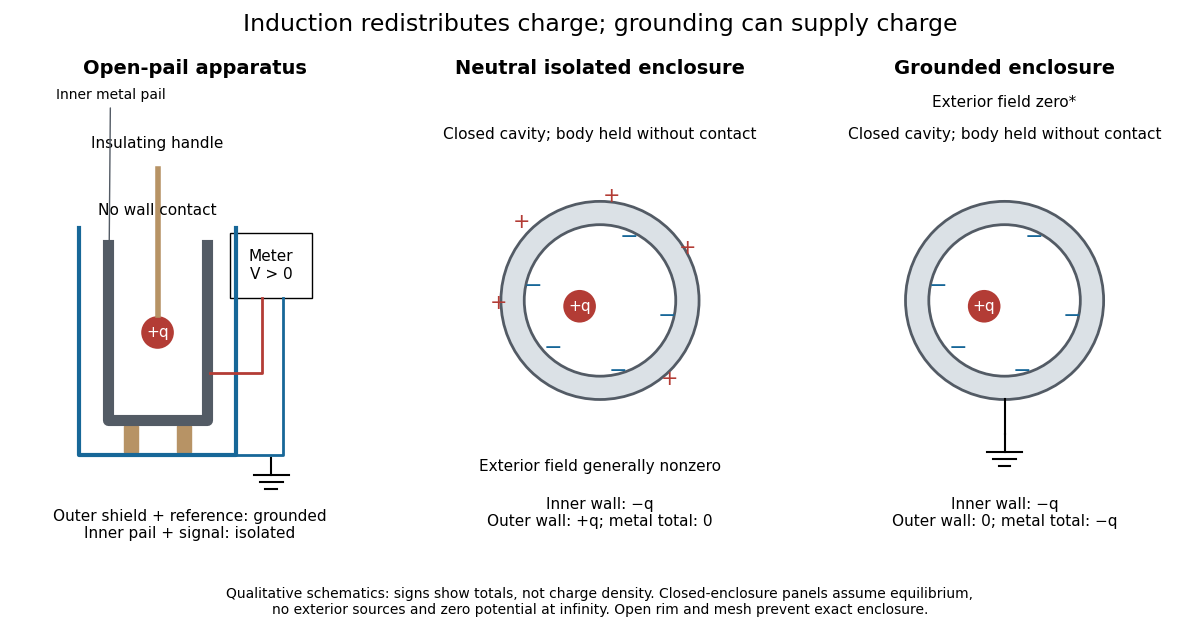
Faraday's ice pail experiment: apparatus and isolated versus grounded electric charge accounting
. Original qualitative schematics. The open pail approximates enclosure; the two closed cavity in a conductor panels stipulate exact enclosure, electrostatic equilibrium, no exterior sources and zero electric potential at infinity. Signs denote total electric charges, not a measured or uniform surface charge density. Details.
A charge ledger before contact. To separate exact reasoning from the open apparatus, first idealize the pail as a closed cavity in a conductor with one internal body of total electric charge . Let the isolated metal have total electric charge . The metal's electric field is zero at electrostatic equilibrium.[ref]
Ideal Conductors. Richard Fitzpatrick, Ideal Conductors, equations 2.124–2.126: zero field and constant potential in metal
A Gaussian surface enclosing the cavity in a conductor but lying wholly in the metal therefore has zero electric flux. Gauss's law and charge conservation giveFor and , the inner-wall total is and the outer-wall total is : the metal remains neutral. The exterior electric field can therefore be nonzero without any transfer from the body. The connected electrometer and signal cable belong to the same isolated conducting assembly and share its exterior electric charge. The zero-electric field assertion concerns metal, not the occupied cavity in a conductor.This ledger fixes totals, not the local surface charge density. Moving an off-center body changes the inner-wall distribution while its integral remains . With fixed outer geometry, fixed and unchanged exterior sources, Uniqueness of the Dirichlet problem together with the fixed total outer electric charge determines the same exterior solution: the outside cannot reveal the body's position or detailed internal distribution. For example, internal bodies with stipulated electric charges and give the same total exterior response as a single body with . Internal bodies with and can give a null exterior response while retaining a nonzero internal electric field. This is why a null reading cannot establish an empty cavity in a conductor.
Withdrawal is the control. Record a baseline, insert without contact, withdraw, and check return to baseline. After a fresh zero, repeat with the charged disk touching the inner wall, then withdraw and record the residual response. Finally zero the pail and reinsert the disk without contact to test remaining electric charge. Keep the operator grounded, discharge unwanted handle electric charge, and keep the unused charged disk distant. Dirty supports and humidity promote leakage. These controls separate transfer from electrostatic induction and stray coupling.[ref]
Basic Electrostatics System (ES-9080B), Instruction Manual 012-07227G by Cecilia Hernandez. Basic Electrostatics System, instruction manual 012-07227G, printed pp. 4–5 and 14–15, Procedure 1A steps 3–8: handle charge, withdrawal, contact and disk retest
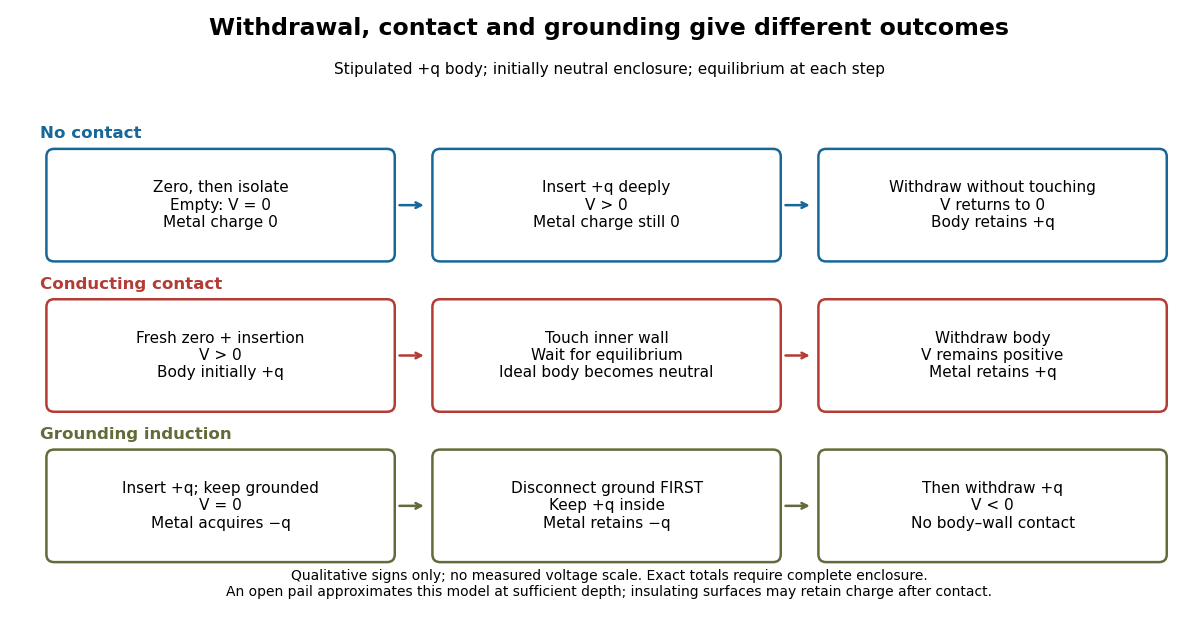

In the ideal contact test, the internal body is itself an electrical conductor and makes a conducting connection to the wall. After charge relaxation, body and enclosure become a single equipotential; the remaining charge-free void has zero electric field. The body then carries no excess electric charge on surfaces facing that void. Withdrawal without subsequent charging leaves total metal electric charge . A coated paddle can retain electric charge on insulating patches, so merely touching it does not guarantee complete transfer. A residual reading establishes some transfer under the controls; the disk retest checks the stronger claim of complete transfer. The ideal argument assumes no leakage and no relevant contact-generated charging.
Grounding changes the ledger. With no exterior sources and zero electric potential at infinity, a closed grounded enclosure has zero exterior electric field, inner-wall electric charge and zero outer-wall electric charge.[ref]
The Feynman Lectures on Physics, Volume II by Richard Feynman and others. II.5, §5–10, final shielding argument: a closed grounded conducting shell separates the two electrostatic problems
Consequently, disconnecting ground before withdrawal retains total metal electric charge , which moves to the exterior after withdrawal. Keeping ground connected during withdrawal instead restores zero electric charge. A lasting opposite-sign response can therefore arise through grounding without body–wall contact.For the real open pail, no Gaussian surface lying wholly in metal closes over the mouth. Increasing insertion depth and seeking a stable response tests whether enclosure is a good approximation; mesh openings, rim proximity and nearby objects limit it. In a fixed-geometry approximation, the positive insertion response obeys , where is the effective capacitance of the pail, shield, cable and electrometer input. Changed geometry changes that conversion. Wait for charge relaxation and instrument settling at each step, while keeping the observation short compared with leakage. The experiment probes settled electrostatics; it does not establish shielding against arbitrary changing electromagnetic fields.
Image charge Created 2026-10-05 Updated 2026-10-14
An image charge is a fictitious point charge placed outside the physical solution region so that its potential, combined with the real sources, enforces the required conductor boundary values. The Uniqueness of the Dirichlet problem then identifies the constructed potential with the physical one. The image need not describe the actual induced surface-charge distribution.
Past exam of the mathematics course of the University of Cambridge 2006 ia Paper 3 11A Solution Created 2026-09-24 Updated 2026-10-14
Let . It is a harmonic function in the bounded region and vanishes on its entire boundary. For smooth solutions and boundary, the divergence theorem applied to gives the energy identityThe integrand is nonnegative, so in . Thus is constant on each connected component, and its zero Dirichlet boundary condition makes every constant zero. HenceThis proves the Uniqueness of the Dirichlet problem rather than assuming it.
For the separated expression, write . The hyperbolic factor obeys and the trigonometric factor obeys , sofor all the constants, including . In the half-strip take so the region has positive width. For every nonzero integer , the decaying harmonic sine mode in a half-strip isIts second derivatives cancel, it vanishes at , and it has the prescribed sine trace at . The absolute value in the exponential ensures decay for negative as well as positive . For , the zero function is the solution. Thus all integer cases are covered, and the decay is uniform across the strip.
Past exam of the mathematics course of the University of Cambridge 2013 ia Paper 3 12C b Solution Created 2026-09-24 Updated 2026-10-07
Under the usual bounded-domain hypotheses, with piecewise smooth boundary and a sufficiently smooth vector field, the divergence theorem stateswhere is outward. Apply it to and use the product rule to obtainFor uniqueness, let for two classical solutions with the same Dirichlet boundary data. Then and on the boundary. Taking , gives Green's first identity in the formThe continuous nonnegative integrand must vanish, so is constant on each connected component. The zero boundary data make every such constant zero. Thus the solution of the Dirichlet problem for the Laplace equation is unique, if it exists. This establishes Uniqueness of the Dirichlet problem; existence is assumed. Boundedness, or suitable conditions at infinity, is needed: on an unbounded half-space the harmonic function has zero boundary values but is not identically zero.
Past exam of the mathematics course of the University of Cambridge 2014 ib Paper 1 16A ii Solution Created 2026-09-24 Updated 2026-10-06
The method of images places an image charge at the reflected position below the plane. The candidate potential in the physical upper half-space isAt the two terms cancel, so and . Direct differentiation givesThus the upper-side field satisfies exactly the conductor boundary conditions from part (i). The fictitious pair does have a field below the plane, but that part of its solution is not used for the physical conductor.
In , the potential has the correct real point source, the correct zero Dirichlet boundary condition, and the required decay at infinity. By Uniqueness of the Dirichlet problem, it is the physical potential there. This is why the artificial charge can represent the induced conductor response without being a second physical charge.
Past exam of the mathematics course of the University of Cambridge 2017 ia Paper 3 12B a Solution Created 2026-09-24 Updated 2026-10-05
Work with real-valued smooth functions on the bounded region enclosed by , with the oriented surface element pointing outward. Set . It is a harmonic function in and has zero Dirichlet boundary conditions on . Applying Green's first identity to with itself givesBoth terms on the right vanish by the boundary condition and harmonicity. The integrand is nonnegative and continuous, so throughout . Consequently is constant on each connected component; every bounded component meets the prescribed boundary, where that constant is zero. ThereforeThis is the energy proof of Uniqueness of the Dirichlet problem. Connectedness of is not essential if the boundary values are prescribed on every component. Boundedness, or suitable decay and integrability at infinity, is needed for the boundary/energy argument; the finite enclosed-volume interpretation is used here.
Past exam of the mathematics course of the University of Cambridge 2017 ib Paper 3 17C ii Solution Created 2026-09-24 Updated 2026-10-05
Write . In SI units, the exterior electrostatic potential solveswith the point-charge singularity . The image charge for a grounded conducting sphere choiceslie inside the sphere. On , direct squaring gives . Thereforesatisfies the source equation, grounded boundary value and decay at infinity. The Uniqueness of the Dirichlet problem, applied to the harmonic difference with its singularity removed, identifies this with the physical exterior potential. Thus its gradient gives the required exterior electric field.
The charge feels the induced field, equivalently the field of the image charge, excluding its own singular field. Their separation is , so Coulomb's law givesIts magnitude is and its direction is toward the sphere's center, independent of the sign of . No factor one-half belongs in this force; that factor occurs in induced electrostatic energy instead.
Past exam of the mathematics course of the University of Cambridge 2019 ia Paper 3 12B b Solution Created 2026-09-24 Updated 2026-09-29
For a spherically symmetric function , the Laplacian in spherical coordinates isIntegrating from zero to and using regularity at the origin gives
For the stated density, integration and the boundary condition giveThe two pieces and their first derivatives agree at . If another solution existed, its difference from would be harmonic with zero boundary data, so part (a) proves Uniqueness of the Dirichlet problem.
On the shell , normalize the outer radial part to obtain the harmonic functionBy the Dirichlet principle, this function minimizes the energy among all with the same boundary values. Sinceits energy isTherefore
With , the boundary data have the finite Legendre polynomial expansionInside the sphere, every term is singular at the origin and must be absent. Matching at therefore givesIn the exterior, decay at infinity excludes all terms, including the constant term at . ThusBoth harmonic functions have the prescribed Dirichlet boundary condition, and each is finite throughout its own domain. The interior expression is regular even at the origin because and . Uniqueness of the Dirichlet problem identifies these as the respective solutions. Their normal derivatives need not match: the two Dirichlet problems do not require a single harmonic function across the bounding sphere.
Past exam of the physics B course of the University of Cambridge 2012 Paper 1 Section B B6 Solution 2026-10-20
In a charge-free region of homogeneous permittivity, Gauss's law and give Laplace's equation, . Prescribed surface electric potentials specify a Dirichlet problem. Its Uniqueness of the Dirichlet problem permits replacing conductors by fictitious charges outside the physical solution region: a harmonic candidate with the same boundary conditions is the physical solution. For an exterior problem its behaviour at infinity must also be prescribed. For a proof, subtract two candidate potentials to obtain with zero boundary values. Green's first identity gives , so is constant and its boundary value fixes it to zero. Conditions on a normal electric field instead determine a potential only up to an additive constant when the usual compatibility condition holds.
A cylindrical Gaussian surface around an infinite line charge gives . The electric potential difference is thereforeAn isolated infinite line charge has no finite potential zero at infinity. For the opposite pair, however, the logarithmic growth terms cancel and one can choose there. Define and . superposition givesOn ,Thus the circle, and its cylindrical extension, is an equipotential. This is an Apollonius circle: a constant ratio of distances gives a circle rather than a constant distance from either charge.
For the cylinder above the plane, call its centre height and set . The cylinder-plane image charges are at height and at height . Their distances are equal on the grounded plane, while their distance ratio is on the circular surface. The positive fictitious line lies inside the metal, so the exterior is charge-free and Uniqueness of the Dirichlet problem applies. A Gaussian surface enclosing the physical cylinder confirms that its charge per unit length is indeed . Its voltage isThe physical field energy per unit length at fixed cylinder charge is . Differentiate with respect to height, keeping and fixed:The electrostatic attraction per unit length of a cylinder above a plane is downward for either sign of charge. Placing the fictitious line at the cylinder centre would give the wrong answer at this separation. The long-cylinder approximation neglects the ends.
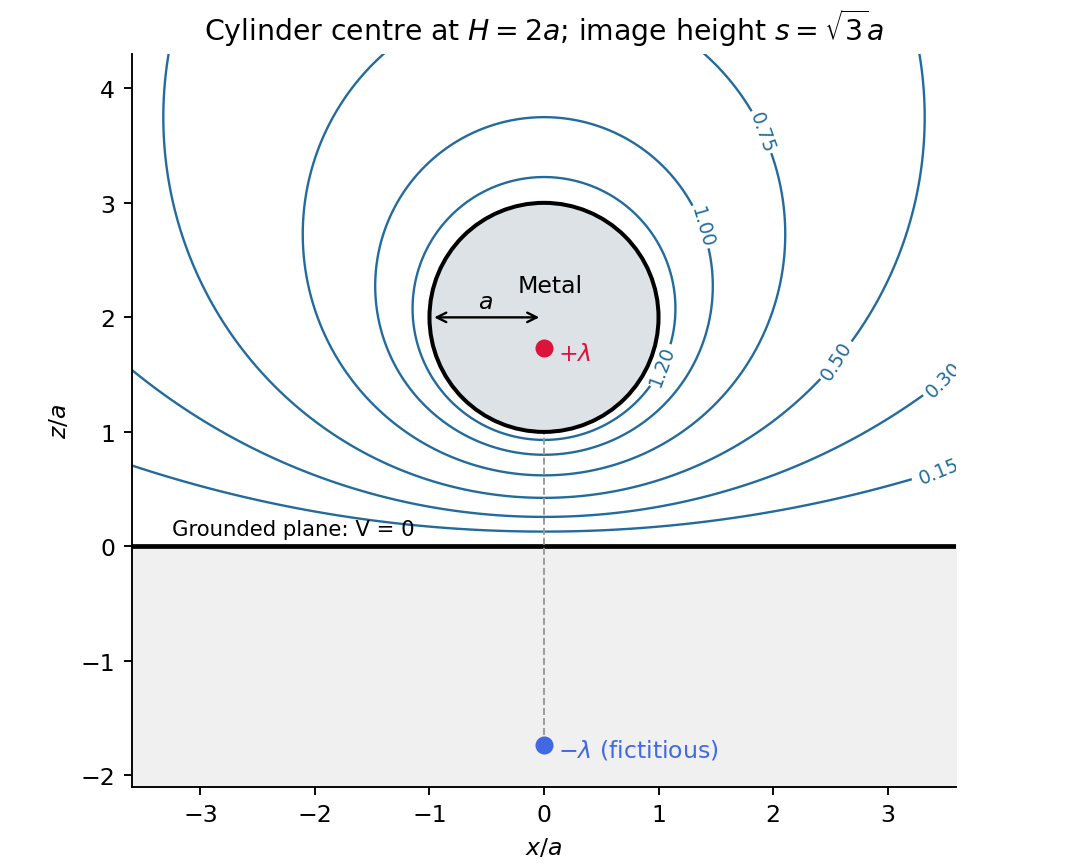
Original cylinder-plane image charges construction and exterior equipotentials
. Details. 
Past exam of the physics B course of the University of Cambridge 2017 Paper 1 Section B B6 Solution 2026-10-18
Images and uniqueness. The method of images replaces a conducting boundary by fictitious charges outside the physical field region. Choose them so that the resulting electric potential satisfies the required conductor potentials. The Uniqueness of the Dirichlet problem then guarantees the same physical exterior field. For example, a point charge at height above a grounded plane has an image at height : the plane is an equipotential at zero, and the charge is attracted toward it by . The image is a computational device; the physical conductor carries a continuous induced surface charge density.
Potential of a line. Surround an infinite line charge by a coaxial Gaussian cylinder of radius and length . Gauss's law gives , hence . Integrating givesWriting an additive constant instead is equivalent. The reference length makes the logarithm dimensionless; an isolated infinite line cannot be assigned a finite zero potential at infinity.
Locating the two lines. Put the grounded plane at and the physical cylinder at , with axis along and radius . Set , and place line charges and at and . If and are their distances from an observation point, the cylinder-plane image charges giveOn , , so . To check the cylinder, define . The level set is a circle: completing the square givesSince , its centre is and radius is . The positive line lies inside the cylinder; the negative line lies behind the plane. There is consequently no fictitious charge in the exterior physical region. A Gaussian contour around the cylinder encloses only, so the required physical charge per unit length is also correct. These boundary conditions and the far-field behaviour determine the physical solution by Uniqueness of the Dirichlet problem.
Cylinder voltage. The constant distance ratio on the cylinder immediately givesIts capacitance per unit length is . In the thin-cable limit, .
Cable attraction. Because the cable is idealized as infinite, the meaningful answer is force per unit length. For , centre height and ,The electrostatic attraction per unit length of a cylinder above a plane isFor example, this follows without any ambiguity about moving image positions from at fixed voltage, including the work of the voltage source. Its sign is negative because capacitance decreases with height. A cable length experiences approximately downward when end effects are negligible. This is the electrostatic contribution only.
Past exam of the physics B course of the University of Cambridge 2018 Paper 1 Section B B6 Solution 2026-10-18
The boundary-value method. In a charge-free region, the electric potential obeys the Laplace equation, , and . Conductors impose equipotential boundaries, with specified voltages or charges, and a far-field condition fixes the remaining behaviour. The Uniqueness of the Dirichlet problem guarantees that a solution meeting the prescribed conductor potentials is the physical one. To see why, the difference of two candidate solutions is harmonic and vanishes on the boundaries; integration by parts gives , hence no difference in their fields. An exterior problem also needs the appropriate condition at infinity.
Two axisymmetric harmonic functions. For in spherical coordinates, the Laplacian reduces toFor , the bracket is . For , it is . ThereforeThe second function is singular at the origin, which is allowed here because that point lies inside the excluded conductor. The printed spherical Laplacian has a typo in its azimuthal term: its denominator should be . Both functions are axisymmetric, so that term vanishes and the typo does not affect these calculations.
Potential and field geometry. Set the lower conductor to zero potential and the distant upper plate to . The small boss sees approximately uniform background field , where . Combining the two harmonic functions to make on gives the conducting hemispherical protrusion in a uniform field,It also vanishes on the surrounding plane . The electric field components areEquipotentials crowd near the apex, and field lines meet the conductor normally.
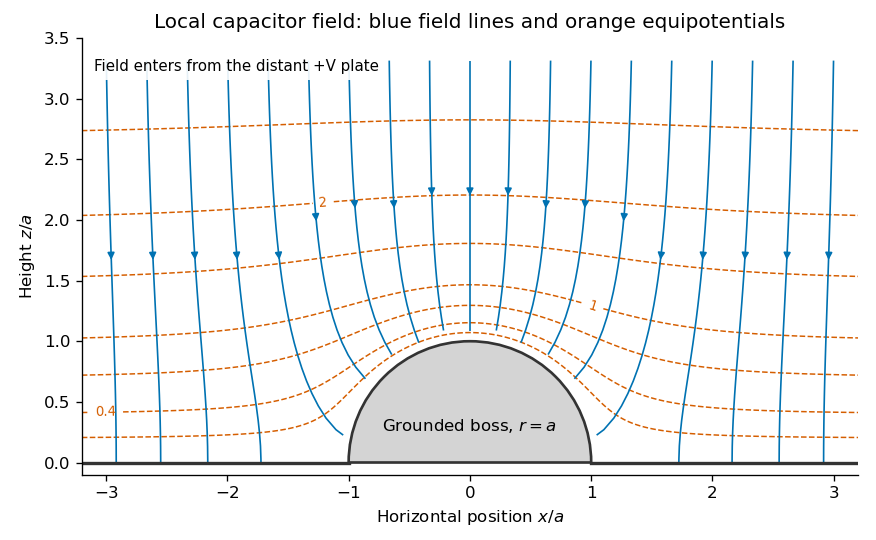
Original calculated local equipotentials and electric-field lines above the hemispherical boss; this is the small-boss approximation rather than an exact finite-gap solution
. Details. 
The formula has the correct uniform far field but does not exactly impose a flat upper equipotential at finite . It is the leading approximation justified by ; an exact finite-gap solution would include further corrections.
The original PDF places this complete question before B6 without a visible question number. It is included here under a descriptive heading.
Why images work. In the method of images, place fictitious image charges outside the region where the physical electric field is required. Choose them so that the combined electric potential satisfies the conductor boundary conditions. The Uniqueness of the Dirichlet problem then proves that this construction gives the physical exterior field. The images do not describe the actual surface-charge locations.
Two examples are a charge above a grounded conducting plane, represented by at the mirror point, and the image charge for a grounded conducting sphere used below. In each case the image lies inside the excluded conductor and makes its surface an equipotential of the required value.
Potential of the two charges. By the law of cosines, the distances from the observation point to charges at are . The superposition principle and Coulomb's law therefore give
The grounded sphere. Set and require at every polar angle. Matching the coefficients of and the constant terms givesThe useful noncoincident solution isIndeed on the sphere, so the two potential terms cancel there. A Gaussian surface enclosing the sphere but not the external charge measures the total image charge in the exterior representation. Thus the physical induced net charge is
An isolated neutral sphere. The grounded image would give nonzero net charge. Add a central image to cancel it. A central image changes the surface potential by a constant, preserving the equipotential condition, whereas an arbitrary off-centre image would generally spoil it. The image charges for a neutral conducting sphere giveThe potential is measured relative to zero at infinity for each finite .
Fixed applied field and dipole moment. For positive on the positive axis, the applied central field is . The central image contributes no electric dipole moment, soIts units are coulomb metres. Keeping fixed makes constant, so this induced moment is independent of the distance.
The distant-charge limit. As with fixed, the applied field becomes uniform over any fixed neighbourhood of the sphere. The neutral pair of opposite images approaches a point dipole of the finite moment above. The external potential contains a growing spatial constant , so the infinity-referenced conductor potential does not have a finite limit. Subtracting this irrelevant constant gives the usual induced charge on a conducting sphere in a uniform electric field; the exterior potential becomesThis has zero potential on the sphere, but a uniform applied field cannot simultaneously have its potential vanish at spatial infinity.