A connected component of a topological space is a nonempty connected subset that is maximal under subset inclusion. If is a connected component and with a connected subset, then . Maximality means that no larger connected subset contains ; it does not mean largest cardinality among all connected subsets.
For example, the connected components of in the usual subspace topology of the real line are and . Each is a real interval, and no connected subset of the real line can meet both without containing the missing point . For the finite set in the same subspace topology, the three connected components are its singleton sets.
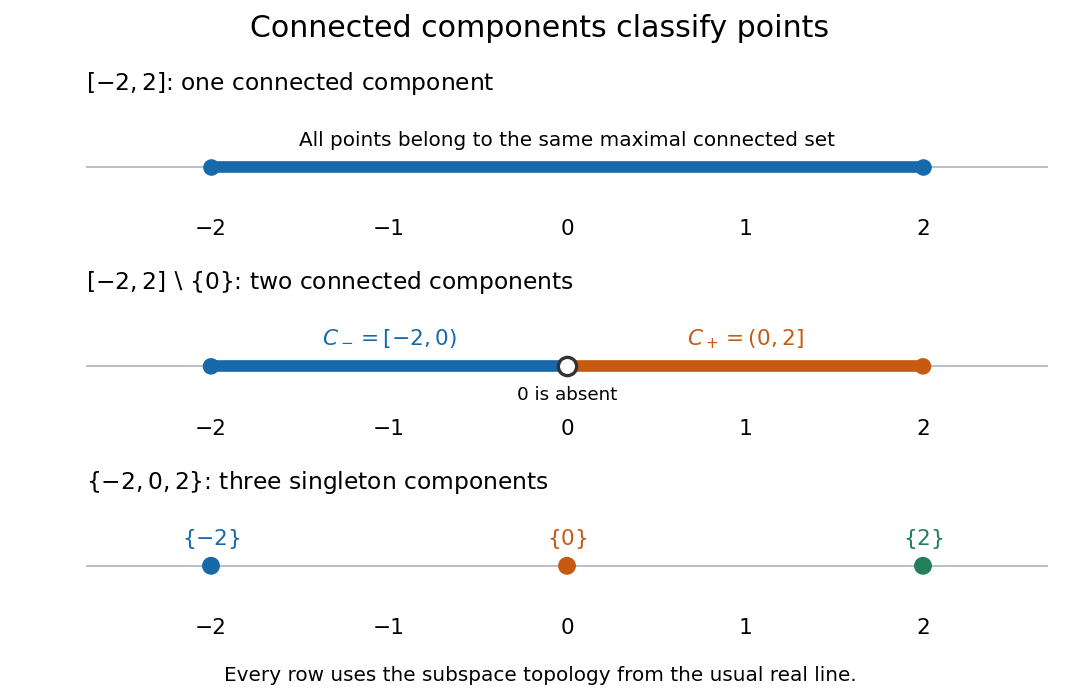
An intact real interval, an interval with an interior point removed, and a finite set have one, two, and three connected components in the usual subspace topology of the real line
. Details. Every point lies in exactly one connected component, constructed by taking the unionAll members contain , so their union is connected by connected union with a connected hub. The union includes every connected subset through , so it is maximal. Equivalently, defineThis is an equivalence relation: singleton sets give reflexivity, symmetry is immediate, and two connected subsets sharing the middle point have a connected union, giving transitivity. The equivalence classes are precisely the connected components. They form a partition of a set: they cover and any two are either equal or disjoint.[ref]
Chapter 3: Connected and compact spaces. Proposition 3.1.11, Definition 3.1.12 and Remark 3.1.16: maximal connected subsets and equivalence classes
Every nonempty connected subset lies within one connected component. Moreover, every connected component is closed in : closure of a connected set makes its closure connected, and maximality forces that closure to equal the original connected component. A connected component need not be open. For example, in with its usual subspace topology from the real line, all connected components are singleton sets, but is not open: every neighbourhood of in contains some .[ref]
Every connected component of a nonempty compact proper subset of a connected Hausdorff space meets its boundary. If not, the Šura-Bura lemma identifies as a quasi-component in the compact Hausdorff subspace . Finitely many clopen neighborhoods separate it from the compact boundary, giving a nonempty relatively clopen . Such is open in the ambient space, and is also closed there because is closed. It is proper because is proper. This contradicts connectedness.
The quasi-component of a point is the intersection of its clopen neighborhoods. Its connected component is always contained in it: a connected set meeting a clopen set cannot also meet its complement. Equality need not hold in noncompact Hausdorff spaces. The Šura-Bura lemma proves equality in compact Hausdorff spaces.
In a compact Hausdorff space, each connected component is its quasi-component and has a neighborhood basis of clopen sets. Let be the intersection of clopen neighborhoods of . It is compact. If it splits into two nonempty compact sets, normality separates them by disjoint open neighborhoods. The finite intersection characterization of compactness gives a finite intersection of clopen neighborhoods lying in their union. Its intersection with the neighborhood containing is then clopen and excludes part of , a contradiction. Thus is connected and equals the component. Applying the same finite-intersection argument to any neighborhood of proves the neighborhood-basis assertion. [ref]
https://www.cl.cam.ac.uk/research/hvg/Isabelle/dist/Isabelle/browser_info/HOL/HOL-Analysis/Homotopy.html. Formalized Šura-Bura results, including the compact Euclidean case
.Set , , , and let be the polygonal arc joining , , , and . In the planar subspace , each arc is clopen. The component of is therefore just . Any clopen neighborhood of contains the left endpoints of all sufficiently high arcs, hence those entire connected arcs, and by closedness also the limit of their right endpoints. Thus its quasi-component is . Higher arcs escape to infinity while their endpoints approach the two distinguished points.
The quasicomponent of a point is the intersection of all its clopen neighborhoods. Every connected set containing the point lies in its quasicomponent, since a clopen set cannot split a connected set. In a compact Hausdorff space, quasicomponents equal connected components by the Šura-Bura component lemma.
In a compact Hausdorff space, the quasicomponent is connected and equals the connected component of . If were a nontrivial separation, disjoint open neighborhoods of its compact pieces leave a compact complement missing . Finitely many clopen neighborhoods of intersect to a clopen containing inside . The piece is then clopen in the whole space, contains , and misses the nonempty other piece, contradicting the definition of . This also proves that any neighborhood of a component contains a clopen neighborhood of that component, by compactness of its complement.
The identity component is the connected component containing the identity element. It is a closed normal subgroup: products and inverses of connected sets through the identity remain in that component, and conjugation preserves it. It need not be open; in the additive group with its usual topology it is the nonopen singleton .
The product of connected spaces is connected, so the product of the two connected components lies in the component of . Conversely, continuous projections carry that component to connected sets in the factors, which must lie in and . These two inclusions prove equality in arbitrary topological spaces.
An embedded copy of in separates space into an inside and an outside. In particular, a connected closed surface embedded in is two-sided and orientable.
Articles by others on the same topic


When a disconnected space is made up of several smaller connected spaces, then each smaller component is called a "connected component" of the larger space.
See for example the