Consider an original abstract data type whose values are rational numbers. Store an ordered pair of integers, interpreted as a numerator and a denominator. Use exact, unbounded integer arithmetic in this model. The storage space, representation invariant and abstraction function areThe representation invariant does not require a positive denominator or a reduced fraction. Consequently , and are three different concrete states with the same abstract rational number . Similarly, and both represent zero. The abstraction function is a surjection: every rational number has an integer numerator and a nonzero integer denominator, so every abstract value has a representation.
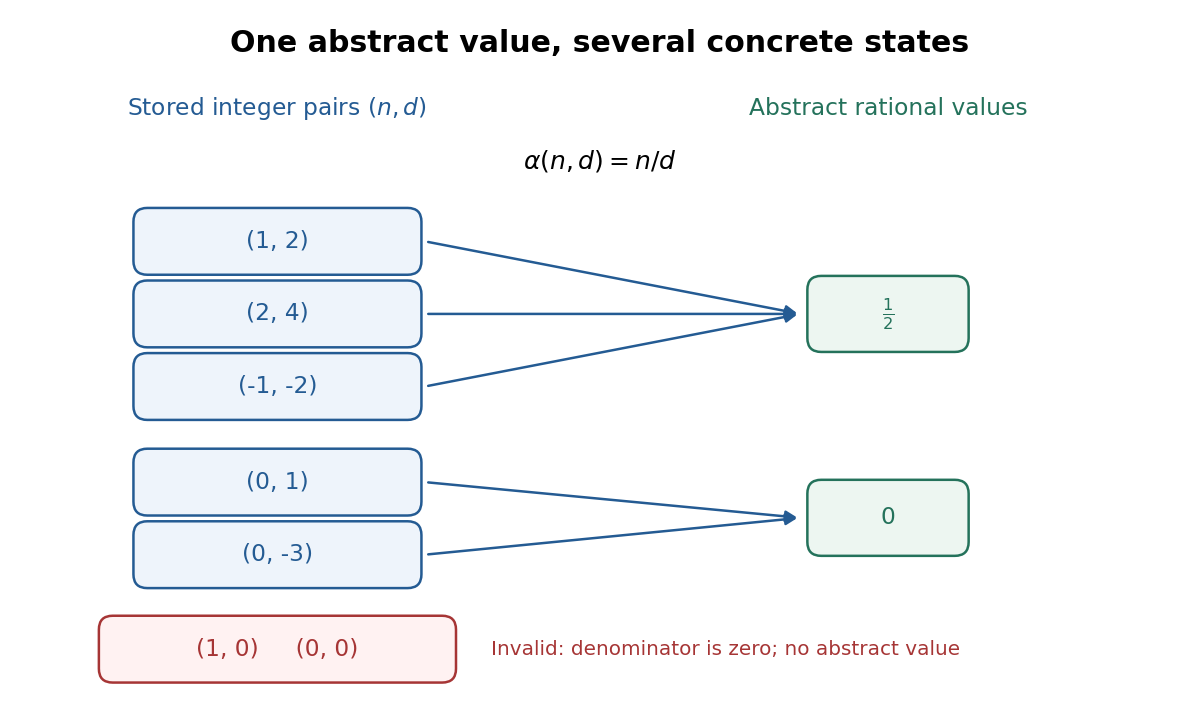

Both and violate the representation invariant; neither has a value under this abstraction function. By contrast, is completely valid. Simplifying it to the reduced fraction may be a useful implementation choice, but is not a requirement of this representation. Strengthening the representation invariant to require a positive denominator and a greatest common divisor of one would choose a unique stored representative for each rational number; every constructor and operation would then need to establish that stronger condition.
Equality of abstract values is therefore different from equality of stored ordered pairs. For valid and ,This defines an equivalence relation on : each equivalence class contains all representations of one rational number. An API equality operation can compare these cross-products using exact integer arithmetic. Comparing the two fields individually would incorrectly declare and unequal as rational numbers. The general reason is that an abstraction function may map several concrete values to one abstract value.[ref]
8.3 Module Documentation. Section 8.3.1, Abstraction Functions: several concrete values mapping to one abstract value; Section 8.3.4, Representation Invariants: valid domain of AF
Articles by others on the same topic
There are currently no matching articles.