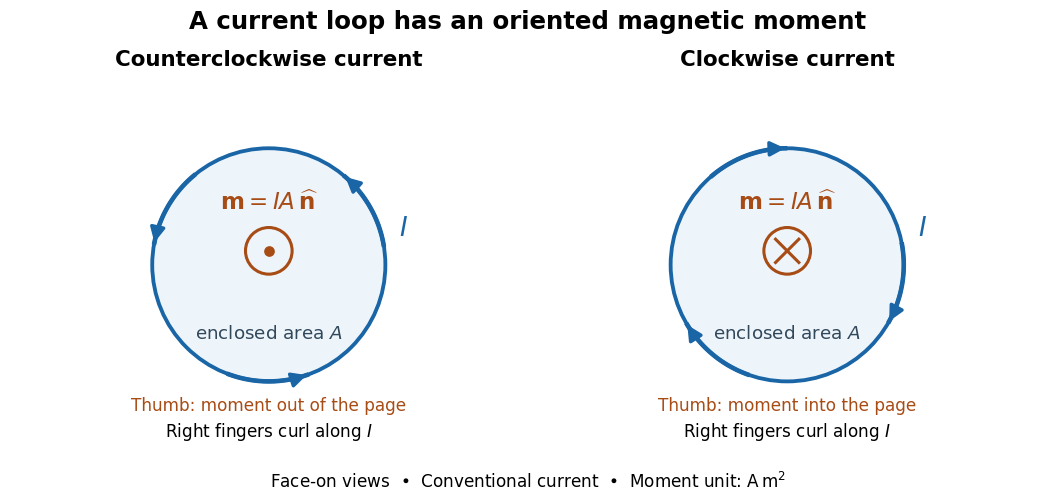
For N closely spaced identical turns carrying the same electric current, the magnetic dipole moments add: m=NIAn. Each turn contributes its own vector area; unequal areas or differently oriented turns require a vectorsum. Asa calculated example, twelve circular turns of radiusR=3.0cm carrying I=0.40A give m=NIπR2=1.36×10⁻²Am2. This is an idealized example, not an experimental measurement.
Here the cross product is integrated over the complete source, including return paths. Steadiness requires ∇⋅J=0, and localization requires sufficiently rapid decay for the boundary terms to vanish. Under these assumptions the localized steady-current moment identities give ∫Jd3r=0: shifting the origin by a changes the proposed magnetic dipole moment by −21a×∫Jd3r=0. An isolated open wire segment does not satisfy these assumptions. [ref].
This vector area of a polygonal boundary depends only on the oriented boundary, not on P, and does not require that the polygon be planar. Translating the boundary adds telescoping terms too, so the formula is independent of the choice of spatial origin. It is the polygonal instance of the vector area boundary integral 21∮B×dB.
The opposite direction gives the minimum −∣A∣; either direction maximizes the absolute algebraic area. Zero algebraic area occurs exactly for unit directions satisfying V⋅A=0, agreat circle of directions perpendicular to the areavector. If A=0, every direction gives zero and every direction is a maximizer, even though the sum of unsigned triangleareas may be positive. Reversing the initial orientation reverses every signed result consistently.
The second equality is Stokes theorem, applied componentwise to any oriented spanning surface. In particular the vector area is independent of the choice of spanning surface. From ∮Cd(ri′rj′)=0, the matrix ∮Cri′drj′ is antisymmetric, which gives ∮C(r⋅r′)dr′=S×r. Hence
Here ex points along the azimuthal bisector; another coordinate choice rotates this vector accordingly. Its magnitude is the signed projected area, not the scalar curved area2βa2. Reversing the orientation reverses its sign.
The upward orientation of Xr×Xθ corresponds to traversing the boundary from the apex to the starting rim, around the rim in increasing azimuth, and back to the apex. This is the indicated ABCA orientation and is outward from the solid. Integrate that vector area element directly:
The absolute value is needed only because the original statement permits negative b. Reversing the boundary orientation reverses the entire vector. For a full rotation the horizontal components cancel, leaving πb2k, the signed projected area of the base.
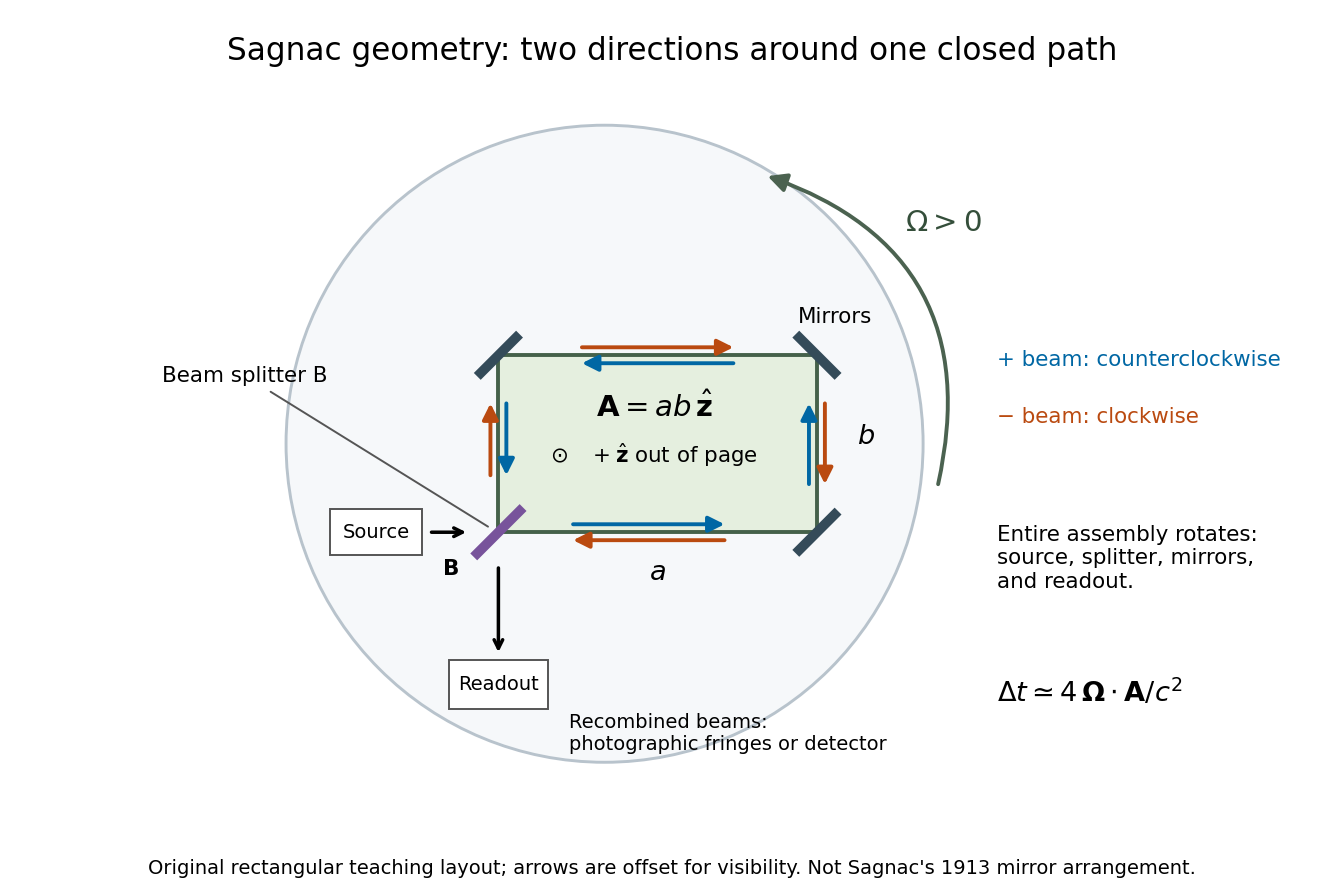
The dot product explains the geometry: only the projection of the oriented vector area along the angular velocity contributes. A planar loop whose normal vector is perpendicular to Ω has zero leading delay. For repeated traversals with the same orientation, the signed vector areas add; oppositely oriented lobes can cancel even when the total unsigned area is large. Equal perimeter alone does not imply equal response. A constant translational velocity contributes nothing to this leading closed-path line integral, since ∮Cdr=0.
Counterpropagating light around a rotating closed loop, with a shared beam splitter and readout
. Original rectangular teaching layout. The vector area points out of the page for the positive counterclockwise path. The source and readout rotate with the mirrors. Arrow offsets separate the two directions visually; they do not represent different physical paths. The drawing is not a reconstruction of the historical mirrorarrangement. Details.
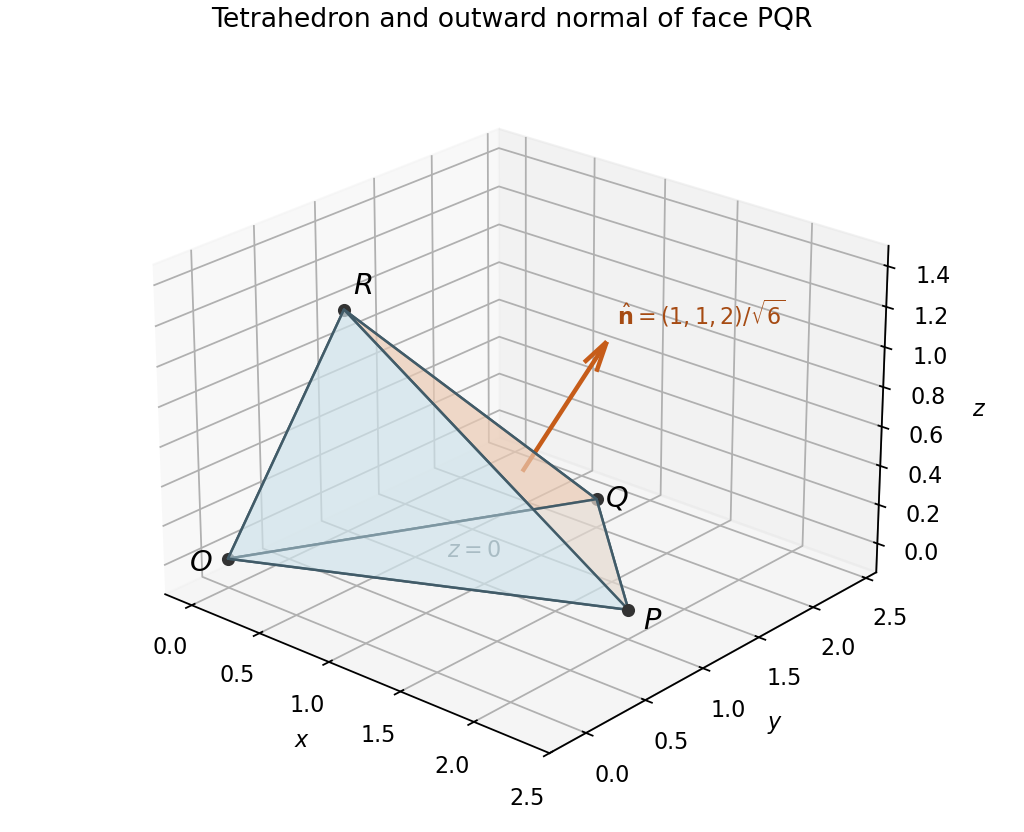
For an oriented closed polygon, triangulate with a common vertex P. Its total vector area is 21∑i(Bi−P)×(Bi+1−P); the terms involving Ptelescope, giving the displayed boundary-only formula. Its signed projected area along aunit vector V is V⋅A. The maximum is ∣A∣, in direction A/∣A∣ if nonzero, and zero projections have directions perpendicular to A. If A=0, every direction has zero signed projection despite possible nonzero unsigned surface area.