
An equation asserts that two mathematical expressions have the same value. Solving it means finding all allowed assignments to its variables that make that assertion true. It converts a relationship into a constraint: a measurement, a geometric intersection, or an equilibrium model can leave an unknown value to determine.
The allowed values matter. The equation has solution set over the rational numbers, but the empty set over the integers. Over the real numbers, has two solutions, and . A mathematical identity, such as , holds for every permitted real . The familiar equality sign therefore does not by itself say whether one is checking a particular value, solving for an unknown, or stating an identity.
For a worked linear equation over the real numbers,The first step subtracts three from both sides; the second divides both sides by the nonzero number two. Reversing the steps recovers the original equation, so these are equivalent equations with the same solution set . Checking the value gives . The role of reversible operations and the classification by solution sets are described in College Algebra 2e, §2.2: Solving Linear Equations in One Variable.
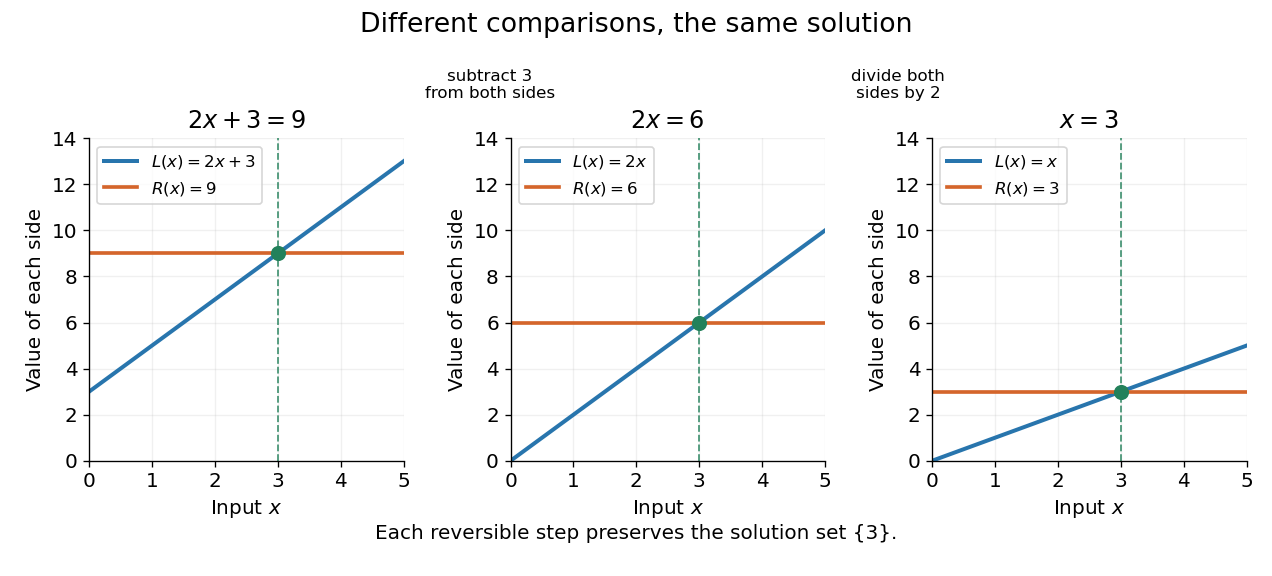
Reversible operations change the graphs of the two sides but preserve the intersection's input value
. Details. When the two sides define real-valued functions and on a common domain of a function, solutions are exactly the input values at which their function graphs intersect. Equivalently, they are the zeros of a function . This gives a useful connection between symbolic algebra and geometry: rearranging an equation can simplify the comparison without changing the inputs where equality holds.
Not every operation is reversible on every domain of a function. Dividing by gives only after restricting to ; it loses the solution if that restriction is forgotten. Squaring both sides can instead introduce an extraneous solution, because distinct real numbers can have the same square. The source equation, its domain of a function, and the direction of each implication should travel together.


An equation is a mathematical statement that asserts the equality of two expressions. It consists of two sides separated by an equal sign (=). Each side of the equation can contain numbers, variables (which represent unknown values), and mathematical operations such as addition, subtraction, multiplication, and division. For example, the equation \(2x + 3 = 7\) asserts that the expression \(2x + 3\) is equal to \(7\).
New to topics? Read the docs here!