An acyclic orientation of a directed graph (digraph) is an assignment of directions to the edges of the graph such that there are no directed cycles.
Articles by others on the same topic

An acyclic orientation is an orientation of a graph whose resulting directed graph has no directed cycle, hence is a Directed acyclic graph. A directed cycle must follow every arrow around its closed route. A cycle in a graph in the skeleton of a directed graph only requires the corresponding undirected edges; their arrows need not agree around the route.
For the same triangle in a graph with vertex set and edges , compareBoth have an undirected cycle in a graph in their skeleton of a directed graph. Only has a directed cycle. In , has no outgoing directed edge, so a route cannot continue from back to .
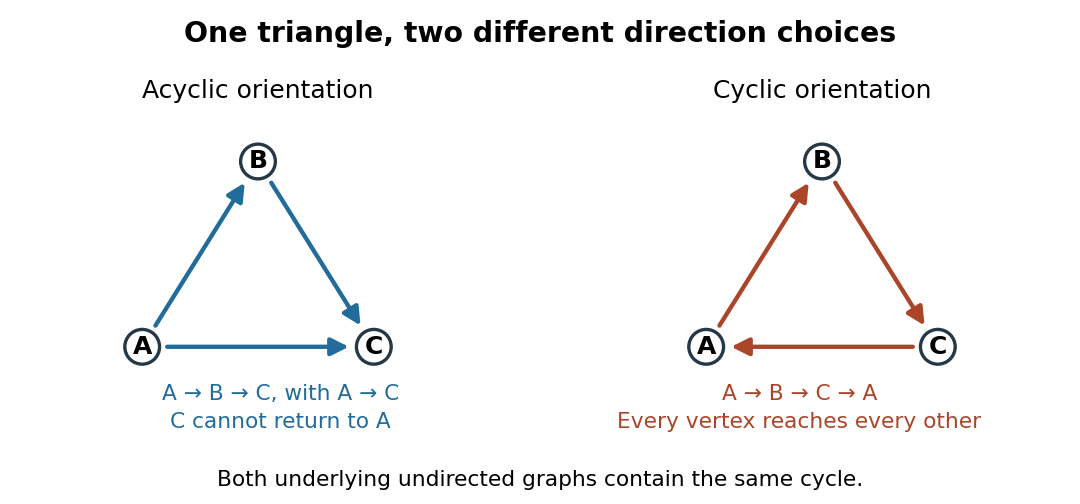
The same triangle in a graph with an acyclic orientation and an orientation of a graph containing a directed cycle
. Details. 
Thus an acyclic orientation does not require its underlying undirected graph to be a forest. Every orientation of a graph of a forest is acyclic, because a directed cycle would give an undirected cycle in a graph. Conversely, every finite simple graph, including one with many cycles in a graph, admits at least one acyclic orientation by the following ordering construction. On this triangle in a graph, six of the eight orientations of a graph are acyclic; the other two follow the directed cycle in opposite senses.