The Chinese Remainder Theorem (CRT) is a result in number theory that provides a way to solve systems of simultaneous congruences with different moduli. It states that if you have several congruences with pairwise coprime moduli, there exists a unique solution modulo the product of those moduli. ### Formulation If \( n_1, n_2, \ldots, n_k \) are pairwise coprime integers (i.e.
Articles by others on the same topic

The Chinese remainder theorem says that remainders modulo pairwise coprime positive integers can be specified independently. For pairwise coprime and , every prescribed list determines one congruence class modulo satisfying for all . It determines a class, rather than one unrestricted integer: adding a multiple of preserves every remainder.
For example, combine and . Write from the first condition. The second becomes . Since three has modular inverse two modulo five, , giving . The integers , and all work. The fifteen possibilities modulo fifteen correspond to the fifteen pairs in a three-by-five grid.
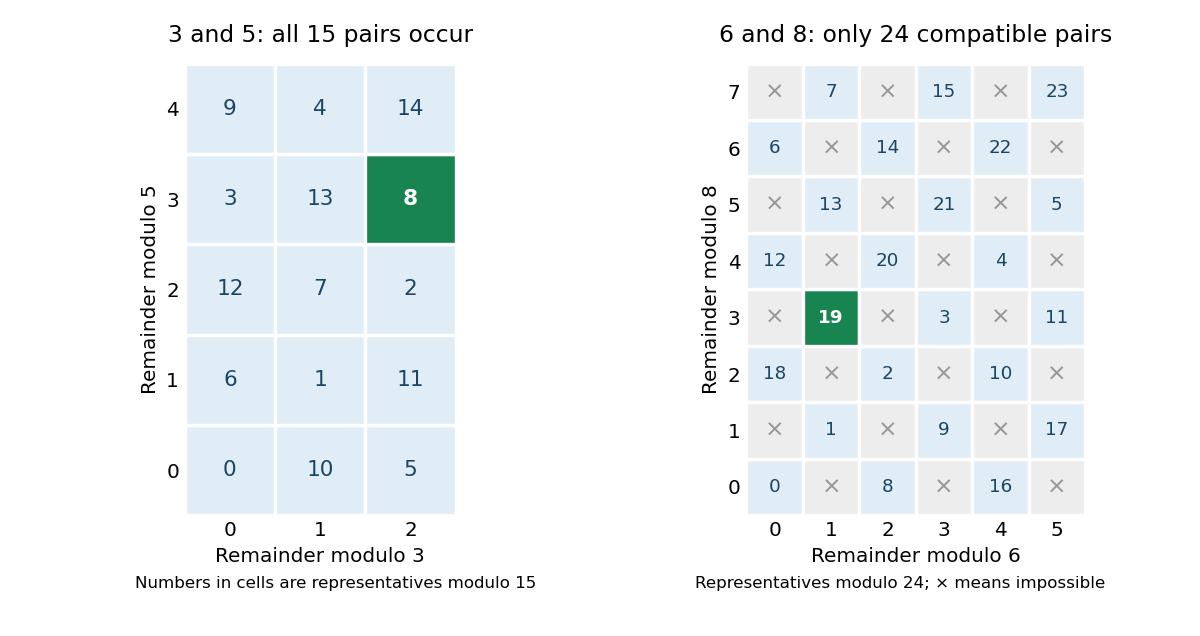

The theorem also preserves arithmetic: reducing an addition or a multiplication modulo each gives the same tuple as performing that operation on the corresponding congruence classes. In the language of quotient rings, reduction is a ring isomorphismOne large residue is thus an exact encoding of several smaller residues. This is useful for splitting arithmetic into smaller calculations and then reconstructing the result; MIT's modular arithmetic notes develop both the reconstruction and the product representation. [ref]
https://ocw.mit.edu/courses/18-200-principles-of-discrete-applied-mathematics-spring-2024/mit18_200_s24_lec15.pdf. Moitra, MIT 18.200, Lecture 15, section 4, Chinese remainder theorem
For a concrete multiplication, corresponds to and to modulo . Their componentwise product is , which reconstructs to , agreeing with .A constructive formula explains the independence. For , put and choose with , using a modular multiplicative inverse. Then is one modulo and zero modulo every other . Thereforehas the desired remainders. A modulus equal to one imposes no restriction and can be omitted. Uniqueness follows because a difference divisible by every is divisible by their product when they are pairwise coprime. This short construction gives a reusable algorithm as well as an existence statement.
The coprime hypothesis explains why every cell in the left grid is attainable. With integer moduli six and eight, a pair must agree modulo their greatest common divisor, two. There are twenty-four compatible pairs, rather than forty-eight arbitrary pairs; each corresponds to a class modulo the least common multiple, twenty-four. The Chinese remainder theorem for noncoprime moduli states the resulting compatibility rule.